Well-Quasi-Ordering of Matrices under Schur Complement and Applications to Directed Graphs
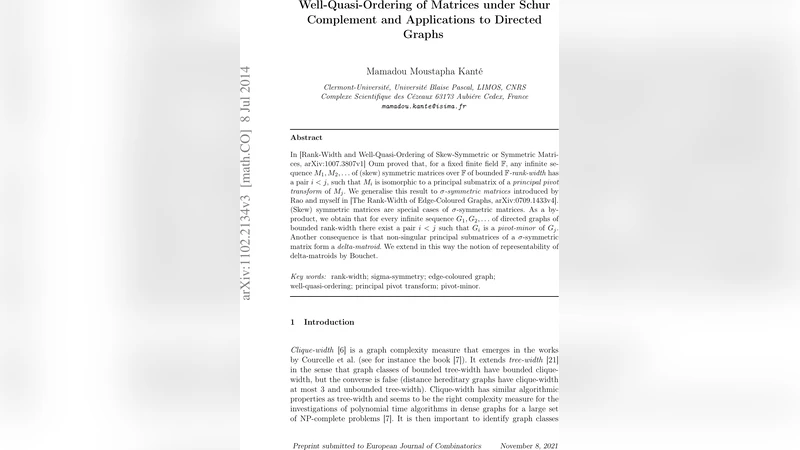
In [Rank-Width and Well-Quasi-Ordering of Skew-Symmetric or Symmetric Matrices, arXiv:1007.3807v1] Oum proved that, for a fixed finite field $\mathbf{F}$, any infinite sequence $M_1,M_2,…$ of (skew) symmetric matrices over $\mathbf{F}$ of bounded $\mathbf{F}$-rank-width has a pair $i< j$, such that $M_i$ is isomorphic to a principal submatrix of a principal pivot transform of $M_j$. We generalise this result to $\sigma$-symmetric matrices introduced by Rao and myself in [The Rank-Width of Edge-Coloured Graphs, arXiv:0709.1433v4]. (Skew) symmetric matrices are special cases of $\sigma$-symmetric matrices. As a by-product, we obtain that for every infinite sequence $G_1,G_2,…$ of directed graphs of bounded rank-width there exist a pair $i<j$ such that $G_i$ is a pivot-minor of $G_j$. Another consequence is that non-singular principal submatrices of a $\sigma$-symmetric matrix form a delta-matroid. We extend in this way the notion of representability of delta-matroids by Bouchet.
💡 Research Summary
The paper establishes a well‑quasi‑ordering (WQO) theorem for σ‑symmetric matrices over a finite field and derives several important consequences for directed and edge‑coloured graphs.
Oum’s earlier result showed that for a fixed finite field F, any infinite sequence of (skew)‑symmetric matrices with bounded F‑rank‑width contains two matrices M_i and M_j (i < j) such that M_i is isomorphic to a principal submatrix of a principal pivot transform of M_j. This unifies the WQO theorems for undirected graphs (via pivot‑minor), for binary matroids (via matroid minor), and for graphs of bounded tree‑width (via graph minor).
The present work generalises Oum’s theorem to σ‑symmetric matrices, a class introduced by Rao and the author. A σ‑symmetric matrix M satisfies m_{yx}=σ(m_{xy}) for a sesqui‑morphism σ: F→F (an involution whose scaled version is an automorphism). Skew‑symmetric and symmetric matrices correspond to the two basic sesqui‑morphisms σ(x)=−x and σ(x)=x, respectively. The authors also consider the more flexible (σ,ε)‑symmetric matrices, where a sign function ε:V→{±1} allows a local scaling of rows and columns.
The central technical tool is the theory of lagrangian chain‑groups, originally developed by Oum to capture isotropic systems and Tutte chain‑groups. A lagrangian chain‑group is a vector space equipped with a bilinear form; Oum defined a minor operation on these groups that simultaneously generalises matroid minors and isotropic‑system minors, and introduced a connectivity function f that yields a branch‑width notion. He proved that lagrangian chain‑groups of bounded branch‑width are WQO under this minor relation.
The authors extend this framework to accommodate σ‑symmetry. They define σ‑compatible lagrangian chain‑groups, prove that every such group admits a matrix representation by a σ‑symmetric matrix, and conversely that any σ‑symmetric matrix yields a lagrangian chain‑group. This bijection allows the transfer of Oum’s WQO result from chain‑groups to matrices.
The main theorem (Theorem 4.12) states: for any finite field F, any sesqui‑morphism σ, and any integer k, an infinite sequence of σ‑symmetric matrices of F‑rank‑width at most k contains indices i < j and a nonsingular principal submatrix A of M_j such that M_i is isomorphic to a principal submatrix of the Schur complement M_j/A (equivalently, a principal submatrix of a principal pivot transform of M_j). The proof follows Oum’s two‑step strategy: (1) establish the WQO for σ‑compatible lagrangian chain‑groups of bounded branch‑width, and (2) translate the result to σ‑symmetric matrices via the matrix‑group correspondence.
An immediate graph‑theoretic corollary is obtained by observing that the incidence matrix of a directed graph (or, more generally, an F*‑graph with edge colours from F) can be written as a (σ,ε)‑symmetric matrix for a suitable σ and ε. Consequently, directed graphs of bounded F‑rank‑width are WQO under the pivot‑minor relation: any infinite sequence of such graphs contains a pair G_i, G_j with i < j where G_i is a pivot‑minor of G_j. This extends the known result for undirected graphs to the directed and edge‑coloured setting.
The paper also generalises a classical theorem of Bouchet: the collection of nonsingular principal submatrices of a (skew)‑symmetric matrix forms a delta‑matroid. The authors prove that the same holds for σ‑symmetric matrices, thereby providing a new representation of delta‑matroids via σ‑symmetric matrices and extending Bouchet’s notion of representability.
Overall, the work unifies several strands of graph, matroid, and matrix theory. By marrying σ‑symmetry with lagrangian chain‑groups, it delivers a robust WQO theorem that applies to a broad class of structures: (i) σ‑symmetric matrices, (ii) directed and edge‑coloured graphs, and (iii) delta‑matroids derived from such matrices. The results open avenues for further research, such as algorithmic exploitation of bounded rank‑width in directed graphs, extensions to infinite fields or non‑linear σ, and deeper connections between delta‑matroids and graph parameters.
Comments & Academic Discussion
Loading comments...
Leave a Comment