Compact Labelings For Efficient First-Order Model-Checking
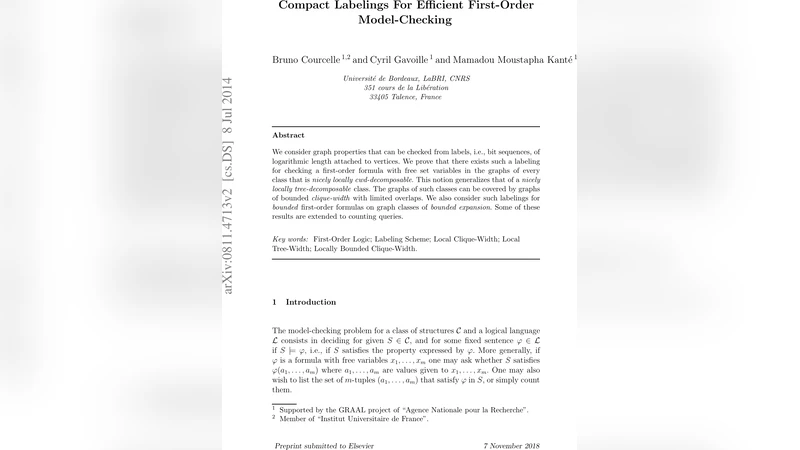
We consider graph properties that can be checked from labels, i.e., bit sequences, of logarithmic length attached to vertices. We prove that there exists such a labeling for checking a first-order formula with free set variables in the graphs of every class that is \emph{nicely locally cwd-decomposable}. This notion generalizes that of a \emph{nicely locally tree-decomposable} class. The graphs of such classes can be covered by graphs of bounded \emph{clique-width} with limited overlaps. We also consider such labelings for \emph{bounded} first-order formulas on graph classes of \emph{bounded expansion}. Some of these results are extended to counting queries.
💡 Research Summary
The paper investigates the problem of evaluating graph properties expressed in first‑order logic (FO) by means of compact vertex labels. A labeling scheme consists of two algorithms: A, which assigns a short binary string (the label) to each vertex of an input graph, and B, which, given only the labels of the vertices and of the sets involved in a query, decides whether the query holds. The authors focus on label lengths that are logarithmic in the number of vertices, which is the smallest possible sub‑linear size and is highly relevant for distributed computing where each node can store only a tiny amount of information.
The main contribution is the construction of such logarithmic‑size labeling schemes for FO formulas with free set variables on two broad families of graph classes. The first family is the class of nicely locally cwd‑decomposable graphs. A graph belongs to this class if its vertex set can be covered by a constant number of subgraphs of bounded clique‑width (cwd) such that the overlaps between subgraphs are limited in a precise way. This definition generalizes the previously studied notion of nicely locally tree‑decomposable graphs (where the subgraphs have bounded tree‑width). The authors show that for any FO formula ϕ (allowing both vertex and set variables) there exists a labeling scheme (A, B) where each label has length O(log n). Algorithm A builds the labels by first computing a cwd‑decomposition of each subgraph (using known cubic‑time or O(n log n) algorithms when a decomposition is given) and then applying the MSO‑based labeling scheme of Courcelle and Vanicat (which works for bounded‑cwd graphs). The labels from overlapping subgraphs are merged in a way that preserves enough information for B to reconstruct the local neighborhoods needed to evaluate ϕ. The evaluation algorithm B runs in O(log n·(m+q+1)) time, where m and q are the numbers of vertex and set arguments of ϕ.
The second family consists of graphs of bounded expansion. For these graphs the authors consider bounded FO formulas, i.e., formulas whose quantification is effectively confined to a constant‑size subgraph (the “p‑bound”). They prove that any such bounded formula can also be evaluated using O(log n) labels on any class of bounded‑expansion graphs. The proof relies on the well‑known fact that bounded‑expansion graphs admit low‑treedepth colorings, which yields a partition of the vertex set into a constant number of parts each inducing a subgraph of bounded tree‑width. The existing tree‑width‑based labeling schemes can then be applied to each part, and the labels are combined analogously to the cwd‑decomposable case.
Beyond decision queries, the paper extends the framework to counting queries: given a formula ϕ, one may wish to count the number of tuples satisfying ϕ. The authors augment the labels with small integer counters that can be summed by B, thereby obtaining the exact count in logarithmic time as well. This demonstrates that the labeling approach is robust enough to handle quantitative as well as qualitative queries.
The technical development proceeds as follows. After a thorough preliminaries section defining relational structures, FO and MSO syntax, clique‑width, tree‑width, and bounded expansion, the authors introduce bounded and local formulas, which are the syntactic restrictions needed for their constructions. They then formalize the notion of nicely locally cwd‑decomposable classes, give examples (e.g., bounded‑degree graphs of bounded tree‑width, certain planar graphs, and graphs obtained by bounded‑size “gluing” of low‑cwd pieces), and prove that these classes admit the required decompositions. The core theorems (Theorem 4.1 and Theorem 5.2 in the paper) state the existence of logarithmic labeling schemes for FO on the two families. Detailed proofs are provided in Section 6, where the authors describe how to compute the coverings, how to generate the cwd‑expressions, how to apply the MSO labeling scheme locally, and how to merge the resulting labels while keeping the total size logarithmic. Section 7 discusses the extension to counting queries, showing how to store and combine partial counts within the same label framework.
The work builds on a line of research that connects structural graph parameters (tree‑width, clique‑width, expansion) with algorithmic meta‑theorems for logical model checking. While previous results showed that MSO can be decided in linear time on bounded‑cwd graphs and that FO can be decided in linear time on bounded‑expansion graphs, this paper uniquely addresses the distributed scenario: each vertex holds only its own label, and global queries are answered without any further communication. The logarithmic label size guarantees that the information can be transmitted in polylogarithmic messages, making the approach suitable for networks with severe bandwidth constraints or for fault‑tolerant systems where only local information survives after failures.
In conclusion, the paper provides a comprehensive theory and constructive algorithms for compact labeling schemes that enable efficient FO model checking (including set variables and counting) on wide families of sparse and locally‑structured graphs. It opens avenues for practical implementations in distributed databases, sensor networks, and large‑scale graph processing systems where global queries must be answered with minimal per‑node storage and communication overhead. Future work suggested includes dynamic updates of labels under edge/vertex insertions, extensions to richer logics (e.g., FO+TC), and experimental evaluation of the schemes on real‑world network topologies.
Comments & Academic Discussion
Loading comments...
Leave a Comment