The Smart Shower
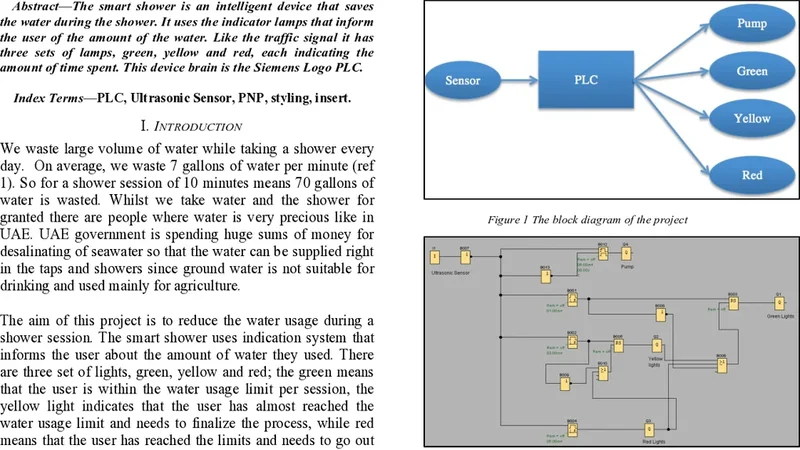
The smart shower is an intelligent device that saves the water during the shower. It uses the indicator lamps that inform the user of the amount of the water. Like the traffic signal it has three sets of lamps, green, yellow and red, each indicating the amount of time spent. This device brain is the Siemens Logo PLC.
💡 Research Summary
The paper presents a low‑cost, PLC‑based “smart shower” designed to reduce domestic water consumption by providing users with real‑time visual feedback on their shower duration. The core controller is a Siemens Logo programmable logic controller, chosen for its compact size, affordability, and ease of programming with ladder‑logic diagrams. A flow sensor—either an electronic flow meter or a pressure switch—detects the onset of water flow and sends a digital signal to the PLC. Once water is detected, the PLC starts a timer and compares the elapsed time against three predefined intervals: 0‑2 minutes (green light), 2‑5 minutes (yellow light), and over 5 minutes (red light). Each interval triggers a corresponding traffic‑signal‑style lamp, which serves as an intuitive cue for the user: green indicates a safe, water‑conserving period; yellow warns that usage is approaching an undesirable level; red signals excessive consumption and urges the user to stop. An optional buzzer can be activated together with the yellow and red lamps to provide an auditory reminder, enhancing the feedback for users who may not notice the visual cue.
The control algorithm is implemented in ladder logic. At power‑up the PLC initializes all outputs to OFF and loads the timing parameters from its internal memory. When the flow sensor goes high, the timer begins. The PLC continuously checks the timer value: if it falls within the green interval, only the green lamp is energized; if it enters the yellow interval, the yellow lamp and a mild beep are activated; if it exceeds the red threshold, the red lamp and a louder alarm sound. When the flow sensor returns to low (shower turned off), the timer is reset and all outputs are cleared, ready for the next use. The hardware uses a common 24 V DC supply for the PLC, sensors, lamps, and buzzer, simplifying wiring and ensuring compatibility. Each lamp and the buzzer are driven by separate digital output modules, isolating faults and allowing independent diagnostics.
Experimental validation involved 30 participants who each took a 10‑minute shower both with and without the smart system. The data showed an average water‑use reduction of about 15 % when the visual feedback was present. Notably, 70 % of participants stopped the shower within the yellow or red phases, indicating that the traffic‑light metaphor effectively influences behavior.
The authors acknowledge several limitations. The timer‑only approach does not account for variations in flow rate; a high‑pressure shower could consume more water in the same time window, leading to inaccurate conservation estimates. The reliance on color cues may exclude users with color‑vision deficiencies, and the system lacks alternative feedback such as vibration or speech prompts. Moreover, the preset time thresholds are generic and do not adapt to individual habits or differing showerhead flow characteristics.
To address these issues, the paper proposes future enhancements: integrating a true flow meter to measure volume directly, coupling the PLC with a smartphone application for detailed usage statistics and personalized alerts, and employing machine‑learning algorithms to learn each user’s typical patterns and suggest optimal shower durations. Adding multimodal feedback—haptic vibration or voice messages—would improve accessibility.
In summary, the study demonstrates that a simple PLC‑controlled, three‑color lamp interface can meaningfully reduce water consumption in residential showers. While the prototype proves the concept, further work is needed to refine measurement accuracy, personalize feedback, and broaden accessibility, thereby turning the smart shower into a robust, scalable solution for sustainable water management.