Complex Dynamics of a Bilamellar Vesicle as a Simple Model for Leukocytes
The influence of the internal structure of a biological cell (e.g., a leukocyte) on its dynamics and rheology is not yet fully understood. By using 2D numerical simulations of a bilamellar vesicle (BL
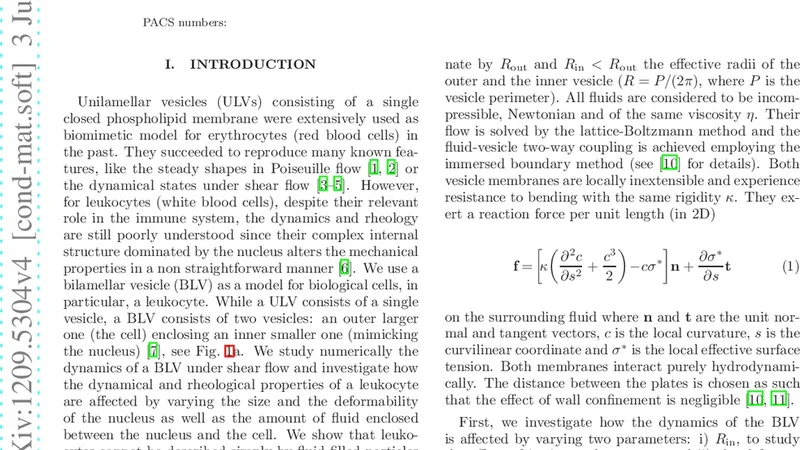
The influence of the internal structure of a biological cell (e.g., a leukocyte) on its dynamics and rheology is not yet fully understood. By using 2D numerical simulations of a bilamellar vesicle (BLV) consisting of two vesicles as a cell model, we find that increasing the size of the inner vesicle (mimicking the nucleus) triggers a tank-treading-to-tumbling transition. A new dynamical state is observed, the undulating motion: the BLV inclination with respect to the imposed flow oscillates while the outer vesicle develops rotating lobes. The BLV exhibits a non-Newtonian behavior with a time-dependent apparent viscosity during its unsteady motion. Depending on its inclination and on its inner vesicle dynamical state, the BLV behaves like a solid or a liquid.
💡 Research Summary
**
The authors investigate how the internal structure of a cell, exemplified by a leukocyte, influences its dynamics and rheology by employing a bilamellar vesicle (BLV) model. The BLV consists of two concentric, deformable membranes: an outer membrane that mimics the cell cortex and an inner membrane that represents the nucleus. Using two‑dimensional Stokes‑flow simulations with a boundary‑integral formulation, they systematically vary the size ratio λ = R_in/R_out while keeping the reduced volume, membrane bending rigidity, and external shear rate fixed.
Key findings can be grouped into three dynamical regimes. For small λ (≤ 0.3) the BLV exhibits classic tank‑treading: the outer membrane aligns at a steady inclination angle relative to the flow, the membrane material circulates around the vesicle, and the inner nucleus remains essentially stationary. As λ increases to an intermediate range (≈ 0.45–0.55) a novel “undulating” state emerges. In this regime the inclination angle oscillates periodically, and the outer membrane develops rotating lobes (typically two to three) that protrude outward like waves. The lobes are generated by a persistent imbalance of hydrodynamic stresses between the inner and outer compartments, leading to a time‑dependent shape modulation. When λ exceeds a critical value (≥ 0.65) the BLV transitions to tumbling, where the entire structure flips end‑over‑end and the inner nucleus rotates synchronously with the outer membrane.
The authors quantify the rheological response by computing an apparent viscosity η_app = σ_xy/γ as a function of time. In the tank‑treading regime η_app is essentially constant and equal to the suspending fluid viscosity. In contrast, both the tumbling and undulating regimes display strong oscillations in η_app; peaks can be two to three times larger than the baseline value. This non‑Newtonian behavior reflects the BLV’s ability to alternate between solid‑like (high‑viscosity) and liquid‑like (low‑viscosity) responses depending on its instantaneous orientation and the dynamical state of the inner vesicle. When the inclination angle is close to zero (the BLV aligns with the flow), the inner nucleus acts as a rigid core, and the system behaves like a solid particle. When the angle deviates significantly and the inner vesicle participates in the motion, the BLV behaves more like a deformable liquid droplet.
The study provides several biologically relevant insights. First, the size of the nucleus relative to the cell determines whether a leukocyte will tank‑tread, tumble, or adopt the newly identified undulating motion under shear. This suggests that leukocytes with larger nuclei (e.g., activated or immature cells) are more prone to tumbling, which could affect their ability to navigate narrow capillaries or to interact with the endothelium. Second, the observed time‑dependent apparent viscosity implies that leukocytes can locally stiffen or soften in response to flow, potentially influencing margination, adhesion, and the mechanical signaling pathways that regulate immune responses.
Methodologically, the work demonstrates that a simple bilamellar vesicle, despite being a two‑dimensional abstraction, captures essential features of a multi‑compartment cell that single‑membrane models miss. The authors argue that incorporating an explicit nuclear compartment is crucial for realistic predictions of cell mechanics in microcirculatory flows.
In conclusion, the paper identifies a size‑controlled transition from tank‑treading to tumbling, discovers an intermediate undulating state, and shows that BLVs exhibit non‑Newtonian, orientation‑dependent viscosity. These results advance our understanding of leukocyte biomechanics and provide a foundation for future extensions to three‑dimensional geometries, heterogeneous nuclear viscosities, and interactions with compliant vessel walls.
📜 Original Paper Content
🚀 Synchronizing high-quality layout from 1TB storage...