Conways game of life is a near-critical metastable state in the multiverse of cellular automata
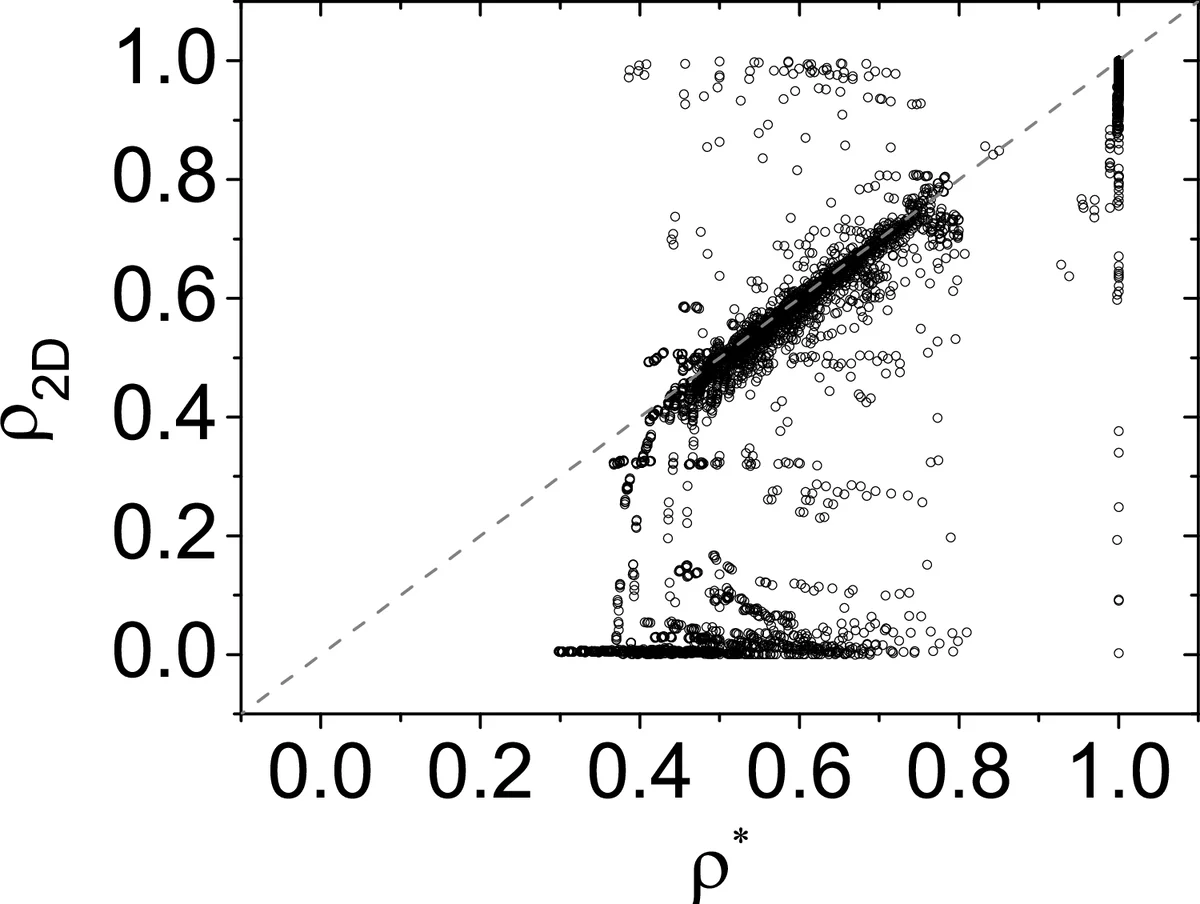
Conway’s cellular automaton Game of LIFE has been conjectured to be a critical (or quasicritical) dynamical system. This criticality is generally seen as a continuous order-disorder transition in cellular automata (CA) rule space. LIFE’s mean-field return map predicts an absorbing vacuum phase ($\rho=0$) and an active phase density, with $\rho=0.37$, which contrasts with LIFE’s absorbing states in a square lattice, which have a stationary density $\rho_{2D} \approx 0.03$. Here, we study and classify mean-field maps for $6144$ outer-totalistic CA and compare them with the corresponding behavior found in the square lattice. We show that the single-site mean-field approach gives qualitative (and even quantitative) predictions for most of them. The transition region in rule space seems to correspond to a nonequilibrium discontinuous absorbing phase transition instead of a continuous order-disorder one. We claim that LIFE is a quasicritical nucleation process where vacuum phase domains invade the alive phase. Therefore, LIFE is not at the “border of chaos,” but thrives on the “border of extinction.”
💡 Research Summary
The paper investigates the dynamical nature of Conway’s Game of Life (Life) within the broader landscape of outer‑totalistic binary cellular automata (CA) on a two‑dimensional square lattice. The authors begin by noting that Life has long been conjectured to sit at a critical point—often described as the “edge of chaos”—but that previous attempts to quantify this criticality have produced conflicting results. In particular, a single‑site mean‑field (MF) analysis predicts an active fixed point at a density ρ*≈0.37, whereas direct simulations on a regular lattice yield a stationary density of only about ρ₂D≈0.03. This discrepancy motivates a systematic study of a large ensemble of CA rules.
The authors select 6 144 “order‑3” rules from the total of 2¹⁸ possible outer‑totalistic rules. An order‑3 rule is defined by the property that, in the limit of low density, the MF update map is dominated by a cubic term (ρ³). For each rule they derive the MF return map ρ(t+1)=M(ρ(t)), which is a polynomial of degree up to nine because the Moore neighborhood contains eight cells. Fixed points of M(ρ) and their stability are then classified. For Life the map is M(ρ)=2 ρ³(1−ρ)⁵(3−ρ), which possesses three fixed points: an absorbing state at ρ=0, a stable active state at ρ*≈0.37, and an unstable saddle at ρ≈0.19.
To test the MF predictions, the authors run extensive Monte‑Carlo simulations on a square lattice with Moore neighborhoods (fixed, not annealed). They find that, when initialized at the MF active density ρ*, the system quickly develops low‑density “vacuum bubbles” (regions where ρ=0). These bubbles grow and eventually dominate, driving the global density down to the observed stationary value ρ₂D≈0.03. The authors interpret this behavior as a nucleation process: the vacuum phase invades the active phase, leading to a metastable coexistence of domains. By contrast, when the same rules are simulated on a lattice with random (annealed) neighbors, the MF predictions are reproduced accurately, confirming that spatial correlations are the source of the discrepancy.
A key contribution of the paper is the introduction of a heuristic control parameter σ₀ that quantifies the growth rate of the vacuum phase at an interface. Assuming an interfacial density ρ⁺≈ρ*/2, the authors define σ₀=
Comments & Academic Discussion
Loading comments...
Leave a Comment