Using an Online Learning Environment to Teach an Undergraduate Statistics Course: the tutor-web
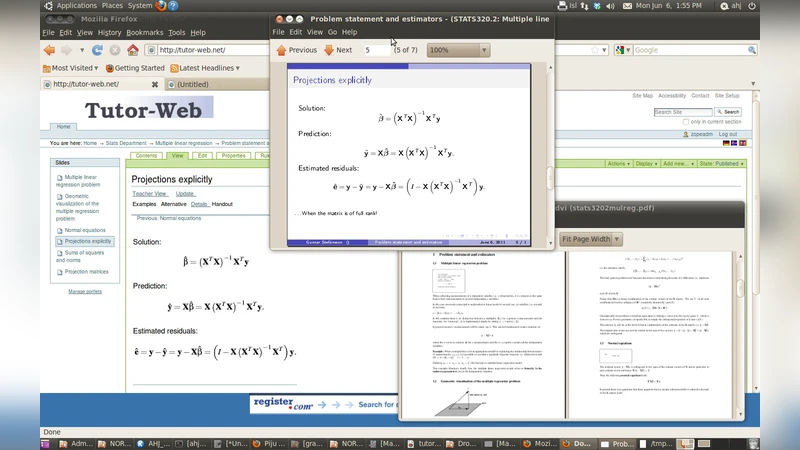
A learning environment, the tutor-web (http://tutor-web.net), has been developed and used for educational research. The system is accessible and free to use for anyone having access to the Web. It is based on open source software and the teaching material is licensed under the Creative Commons Attribution-ShareAlike License. The system has been used for computer-assisted education in statistics and mathematics. It offers a unique way to structure and link together teaching material and includes interactive quizzes with the primary purpose of increasing learning rather than mere evaluation. The system was used in a course on basic statistics in the University of Iceland, spring 2013. A randomized trial was conducted to investigate the difference in learning between students doing regular homework and students using the system. The difference between the groups was not found to be significant.
💡 Research Summary
The paper presents the development, architecture, and educational evaluation of the tutor‑web, an open‑source, web‑based learning environment designed to support undergraduate statistics instruction. Built on standard web technologies (PHP, MySQL, HTML/JavaScript) and released under the Creative Commons Attribution‑ShareAlike license, the system is freely accessible to anyone with internet connectivity. Its core features are (1) a modular repository of teaching materials—lecture notes, examples, and exercises—organized hierarchically by topic and difficulty, and (2) an interactive quiz engine that delivers immediate feedback, explanations, and adaptive difficulty adjustments. Unlike conventional assessment‑only quizzes, these activities are explicitly framed as learning tools intended to reinforce concepts and promote long‑term retention.
To assess the pedagogical impact, the authors conducted a randomized controlled trial during the spring 2013 semester of a basic statistics course at the University of Iceland. All enrolled students (N≈84) were randomly assigned to either a control group, which completed traditional paper‑based homework assignments, or an experimental group, which used tutor‑web for all homework and quiz activities. Both groups attended identical lectures, followed the same syllabus, and were evaluated with a common final examination consisting of multiple‑choice and short‑answer items covering descriptive statistics, probability distributions, and basic inferential techniques.
Statistical analysis of the exam scores revealed mean performances of 78.4 (control) versus 79.1 (tutor‑web), a difference that was not statistically significant (two‑sample t‑test, p = 0.46). The authors interpret this null result in several ways. First, the immediate feedback and self‑paced nature of tutor‑web may have produced learning gains comparable to those achieved through conventional homework. Second, the modest sample size and single‑semester timeframe limited the statistical power to detect small effect sizes. Third, uncontrolled variables—such as prior computer literacy, intrinsic motivation, and varying levels of instructor interaction—could have masked potential benefits.
The discussion highlights both strengths and limitations of the platform. Strengths include its zero‑cost model, the sustainability afforded by open‑source code and openly licensed content, and the learner‑centered design that encourages autonomous study and reduces instructor grading workload. Limitations are noted in the current lack of sophisticated learning analytics, limited real‑time communication tools (e.g., chat or discussion forums), and scalability concerns related to server load and data security when deployed to larger cohorts.
Future work proposed by the authors involves (a) conducting larger‑scale, longitudinal studies to examine retention and transfer of statistical knowledge, (b) integrating adaptive algorithms and learning‑analytics dashboards to personalize learning pathways, (c) expanding collaborative features to foster peer‑to‑peer interaction, and (d) testing the system in other quantitative disciplines such as physics, biology, and engineering. The authors conclude that, while the initial trial did not demonstrate a statistically superior learning outcome, tutor‑web offers a viable, flexible alternative to traditional homework that merits further refinement and broader empirical validation.
Comments & Academic Discussion
Loading comments...
Leave a Comment