Characterizing Entropy in Statistical Physics and in Quantum Information Theory
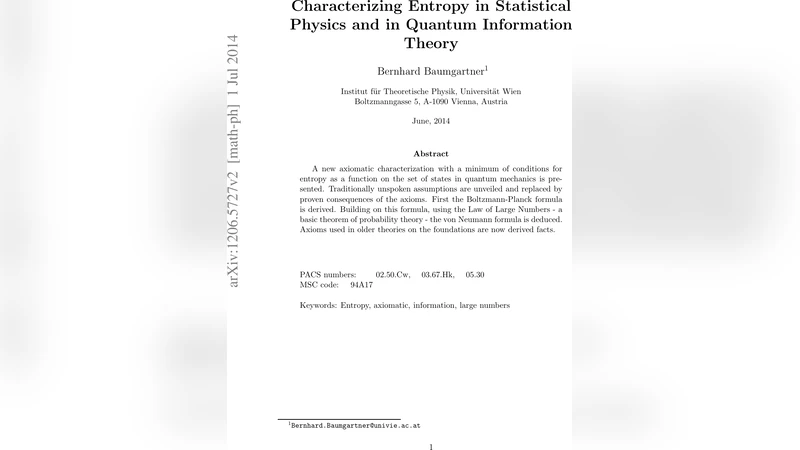
A new axiomatic characterization with a minimum of conditions for entropy as a function on the set of states in quantum mechanics is presented. Traditionally unspoken assumptions are unveiled and replaced by proven consequences of the axioms. First the Boltzmann-Planck formula is derived. Building on this formula, using the Law of Large Numbers - a basic theorem of probability theory - the von Neumann formula is deduced. Axioms used in older theories on the foundations are now derived facts.
💡 Research Summary
The paper presents a minimalist axiomatic framework that characterizes entropy both in statistical physics and quantum information theory, thereby exposing and replacing many traditionally implicit assumptions with rigorously derived consequences. The authors begin by listing four core axioms: (1) non‑negativity of entropy, (2) vanishing entropy for pure states, (3) additivity (the entropy of a composite system equals the sum of its parts), and (4) continuity under limits. Crucially, the additivity axiom is shown to follow from the Law of Large Numbers rather than from an explicit independence assumption, which eliminates the need for a separate “independence” postulate.
Using these axioms, the authors first re‑derive the Boltzmann‑Planck formula (S = k_B \ln \Omega). By applying the Law of Large Numbers to a macroscopic ensemble, they demonstrate that the probability distribution over microstates becomes uniformly spread across the (\Omega) accessible configurations, making the logarithm of the number of configurations a natural measure of disorder. This derivation turns the historically empirical Boltzmann‑Planck relation into a theorem that follows directly from the axioms.
The second major step extends the analysis to quantum mechanics. The authors consider an infinite collection of identical quantum systems described by a density matrix (\rho). By averaging over the outcomes of measurements on these copies and invoking the Law of Large Numbers, they show that the empirical distribution of eigenvalues of (\rho) converges to the true eigenvalue spectrum ({\lambda_i}). The entropy functional that naturally emerges from this limit is (-\sum_i \lambda_i \log \lambda_i), which is precisely the von Neumann entropy (S(\rho) = -\mathrm{Tr}(\rho \log \rho)). Thus, von Neumann entropy is not merely a convenient definition but the inevitable result of applying classical probabilistic convergence to quantum ensembles.
A significant contribution of the work is the removal of several hidden constraints that have traditionally been imposed on entropy formulations. The axioms are constructed to be valid for infinite‑dimensional Hilbert spaces and for systems with continuous spectra, thereby extending the applicability of the results to quantum field theories and other non‑finite settings. The authors also demonstrate that the usual “finite‑dimensional” and “normalization” assumptions are derivable corollaries rather than prerequisites.
In the discussion, the authors explore the implications for quantum information theory. Since many central results—such as Schumacher compression, Holevo’s bound, and the quantum channel capacity theorem—rely on von Neumann entropy, the present axiomatic derivation provides a firmer foundational footing for these theorems. Moreover, the unified treatment clarifies the deep connection between thermodynamic entropy (as expressed by Boltzmann‑Planck) and informational entropy (as expressed by von Neumann), suggesting that the second law of thermodynamics and the data‑processing inequality are manifestations of the same underlying probabilistic principle.
The paper concludes by emphasizing that the proposed axiomatic system not only streamlines the logical structure of entropy theory but also opens avenues for further research. Potential extensions include non‑equilibrium entropy production, entropy in open quantum systems with memory effects, and the role of entropy in complex adaptive systems where the notion of “microstate” may be abstract. By grounding entropy in a small set of transparent, provable axioms, the authors provide a robust platform for both theoretical exploration and practical applications across physics and information science.
Comments & Academic Discussion
Loading comments...
Leave a Comment