Wisdom of the Confident: Using Social Interactions to Eliminate the Bias in Wisdom of the Crowds
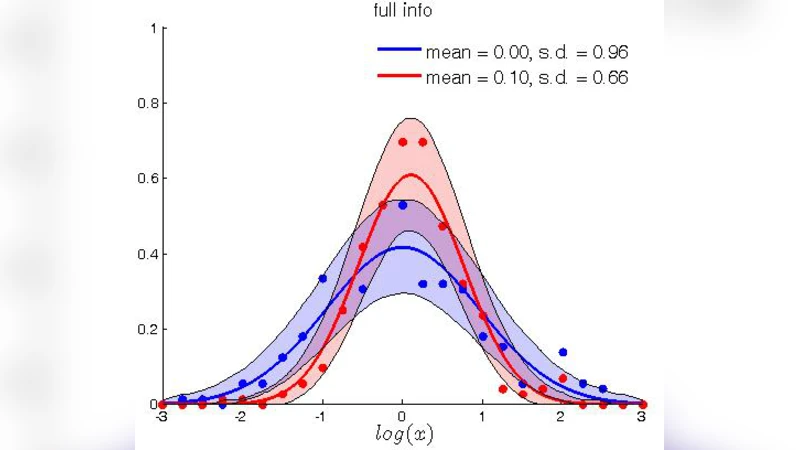
Human groups can perform extraordinary accurate estimations compared to individuals by simply using the mean, median or geometric mean of the individual estimations [Galton 1907, Surowiecki 2005, Page 2008]. However, this is true only for some tasks and in general these collective estimations show strong biases. The method fails also when allowing for social interactions, which makes the collective estimation worse as individuals tend to converge to the biased result [Lorenz et al. 2011]. Here we show that there is a bright side of this apparently negative impact of social interactions into collective intelligence. We found that some individuals resist the social influence and, when using the median of this subgroup, we can eliminate the bias of the wisdom of the full crowd. To find this subgroup of individuals more confident in their private estimations than in the social influence, we model individuals as estimators that combine private and social information with different relative weights [Perez-Escudero & de Polavieja 2011, Arganda et al. 2012]. We then computed the geometric mean for increasingly smaller groups by eliminating those using in their estimations higher values of the social influence weight. The trend obtained in this procedure gives unbiased results, in contrast to the simpler method of computing the median of the complete group. Our results show that, while a simple operation like the mean, median or geometric mean of a group may not allow groups to make good estimations, a more complex operation taking into account individuality in the social dynamics can lead to a better collective intelligence.
💡 Research Summary
The paper revisits the classic “wisdom of crowds” phenomenon, which holds that simple aggregations such as the arithmetic mean, median, or geometric mean of individual estimates can yield remarkably accurate collective judgments. While this holds for many tasks, prior work (e.g., Lorenz et al., 2011) has shown that when individuals are exposed to each other’s estimates, social influence drives convergence toward a biased consensus, degrading collective accuracy. The authors turn this apparent drawback into an advantage by focusing on a subset of participants who are relatively resistant to social influence—those they term “confident” individuals.
To formalize confidence, each participant is modeled as a Bayesian‑style estimator that combines a private signal (x_i^{\text{priv}}) with a social signal (x_i^{\text{soc}}) using a weight (w_i) (0 ≤ (w_i) ≤ 1): \
Comments & Academic Discussion
Loading comments...
Leave a Comment