When none of us perform better than all of us together: the role of analogical decision rules in groups
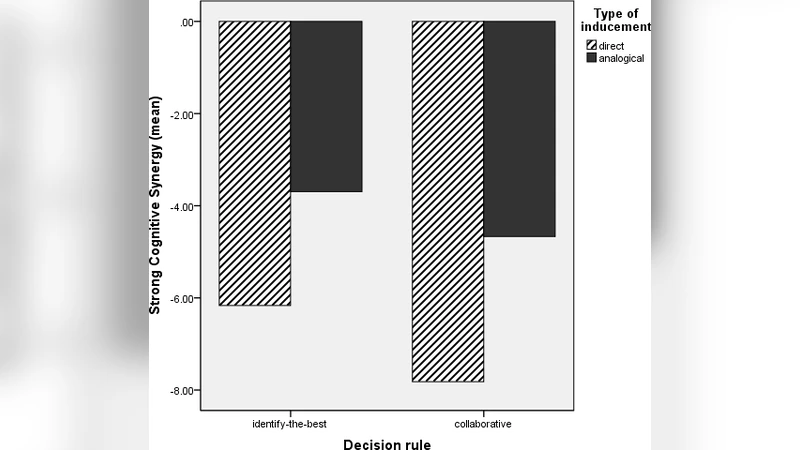
During social interactions, groups develop collective competencies that (ideally) should assist groups to outperform average standalone individual members (weak cognitive synergy) or the best performing member in the group (strong cognitive synergy). In two experimental studies we manipulate the type of decision rule used in group decision-making (identify the best vs. collaborative), and the way in which the decision rules are induced (direct vs. analogical) and we test the effect of these two manipulations on the emergence of strong and weak cognitive synergy. Our most important results indicate that an analogically induced decision rule (imitate-the-successful heuristic) in which groups have to identify the best member and build on his/her performance (take-the-best heuristic) is the most conducive for strong cognitive synergy. Our studies bring evidence for the role of analogy-making in groups as well as the role of fast-and-frugal heuristics for group decision-making.
💡 Research Summary
The paper investigates how groups can achieve cognitive synergy—performing better than the average individual (weak synergy) or better than the best individual (strong synergy)—by manipulating two dimensions of decision‑making: the type of decision rule and the way that rule is introduced. The decision rules are (1) a “best‑identify” rule, in which the group locates the most competent member and follows that person’s judgment, and (2) a “collaborative” rule, in which all members pool their information to reach a joint decision. The introduction methods are (a) a direct, explicit instruction and (b) an analogical induction, where participants are shown a successful past example or metaphor and must infer the rule themselves.
Two laboratory experiments with four‑person groups were conducted. In Experiment 1, a 2 × 2 factorial design crossed rule type (best‑identify vs. collaborative) with induction method (direct vs. analogical). Groups solved complex inference tasks that required integrating multiple attributes. Performance was measured by accuracy and response time, allowing calculation of weak and strong synergy scores. The results showed that the best‑identify rule generally yielded higher weak synergy than the collaborative rule, but the crucial finding concerned strong synergy: groups that received the best‑identify rule via analogical induction outperformed all other conditions. The analogical “imitate‑the‑successful” heuristic prompted participants to adopt a fast‑and‑frugal “take‑the‑best” strategy, effectively bypassing costly information aggregation while still capitalizing on the most informative cue.
Experiment 2 added two contextual moderators—time pressure (limited vs. unlimited) and task difficulty (low vs. high)—to test the robustness of the effect. The same 2 × 2 design was retained. Again, the analogically induced best‑identify condition produced the highest strong synergy, especially under tight time constraints where the collaborative rule’s performance collapsed. Direct instruction, regardless of rule type, led to weaker internalization of the rule and consequently lower synergy.
The authors interpret these findings through two theoretical lenses. First, the fast‑and‑frugal heuristics literature predicts that in environments with limited cognitive resources, simple heuristics such as “take‑the‑best” can yield higher accuracy than exhaustive integration. Second, analogical reasoning research suggests that exposure to a successful exemplar facilitates implicit learning of the underlying rule, creating a shared cognitive schema that enhances group performance over time.
Practical implications are clear: when organizations face complex, time‑sensitive decisions, prompting teams to identify and emulate the most successful member—using an analogical story or case rather than a blunt directive—can generate strong cognitive synergy. This approach reduces information overload, accelerates decision speed, and leverages the expertise of top performers without the need for formal hierarchy.
The paper acknowledges limitations, including reliance on student samples and laboratory tasks, and calls for field studies across diverse organizational cultures to examine long‑term effects and potential boundary conditions. Nonetheless, the research provides compelling evidence that analogical induction of a “best‑identify” heuristic is a powerful lever for unlocking group-level performance that exceeds even the best individual contributor.
Comments & Academic Discussion
Loading comments...
Leave a Comment