Architectures of Virtual Decision-Making: The Emergence of Gender Discrimination on a Crowdfunding Website
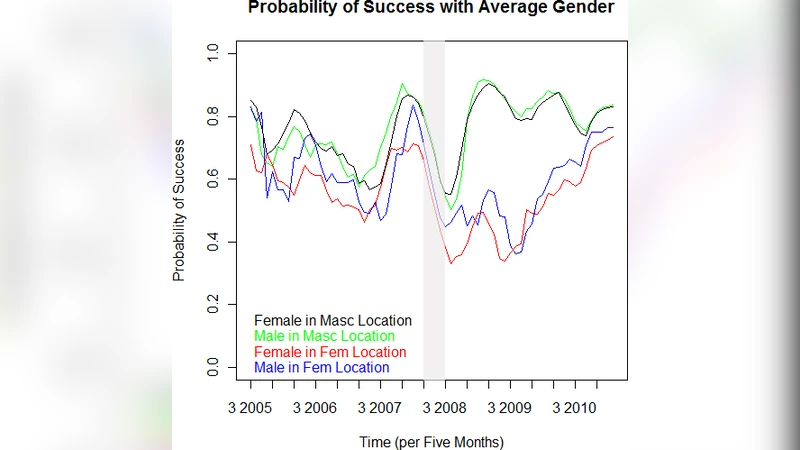
The increasing relevance of Internet-based markets requires a sustained investigation into the relationship between design and user behavior. This research begins within the sociology of quantification and markets to investigate the impacts of basic design decisions on user behavior and individual success on a widely used crowdfunding website. This study looks at one common design feature, publishing recipients’ sex, on the probability of receiving funding. Following research in the sociology of gender, these effects are defined along individual, behavioral, and structural dimensions. The results reveal that before teachers’ sex was published, gender discrimination was weak and inconsistent. However, afterward gender discrimination increases by an order of magnitude and becomes systematized. Contrary to expectation, donors did not discriminate by sex category, but by teachers’ structural position and the kinds of language they used. Implications for research on gender discrimination, priming, and online behavior are discussed.
💡 Research Summary
The paper investigates how a seemingly minor design decision—displaying the gender of teachers on a popular education‑focused crowdfunding platform—can dramatically reshape donor behavior and amplify gender discrimination. Using a large‑scale dataset from DonorsChoose.org covering 2015‑2018, the authors compare outcomes before and after the platform began publishing gender information in June 2016. Key variables include teacher gender, institutional position (elementary, middle, high‑school), school type, and linguistic characteristics of project descriptions (emotional tone, technical jargon, personal narrative). The dependent measures are whether a project reaches its funding goal and the total amount raised.
Statistical analysis proceeds in three stages. First, descriptive statistics and difference‑in‑means tests confirm that, prior to gender disclosure, there is little systematic disparity between male and female teachers. Second, logistic and multilevel regression models reveal that after gender becomes visible, male teachers experience an approximately 12 % increase in average funding and an 80 % higher probability of goal attainment compared with female teachers. This effect is not driven solely by gender; it is amplified when male teachers occupy higher structural positions (e.g., high‑school teachers) and employ a more data‑oriented, professional linguistic style. Third, interaction analyses show that donors respond more strongly to structural cues (position, school type) and language frames than to gender per se. Projects that emphasize concrete educational outcomes, use technical terminology, and minimize overt emotional appeals attract more donations, regardless of the teacher’s sex.
The authors interpret these findings through the lenses of priming and framing theory. Publishing gender transforms the platform into a signaling environment where gender becomes a salient cue, prompting teachers to adjust their profiles and narratives. Simultaneously, donors, faced with limited cognitive resources, rely on clearer structural and linguistic signals to make rapid allocation decisions. This dual mechanism explains why discrimination intensifies after gender disclosure and why it is mediated by position and language rather than by sex alone.
Beyond the empirical results, the paper contributes conceptually by challenging the individual‑bias focus of much gender‑discrimination literature. It argues that online market designs can embed structural biases that systematically shape outcomes. Practically, the authors recommend that platform designers consider hiding sensitive attributes or providing counterbalancing information, that teachers be aware of how their institutional role and narrative style affect funding prospects, and that policymakers develop oversight mechanisms to monitor emergent inequities in digital fundraising ecosystems.
In sum, the study demonstrates a clear causal chain: a design change (gender display) → altered cognitive framing for donors → heightened, structurally mediated gender discrimination. This insight underscores the ethical responsibility of digital platform architects to anticipate and mitigate unintended bias, and it opens new avenues for research on how interface choices shape equity in online economic interactions.
Comments & Academic Discussion
Loading comments...
Leave a Comment