Encouraging Knowledge Sharing Using Web 2.0 Technologies In Higher Education: A Survey
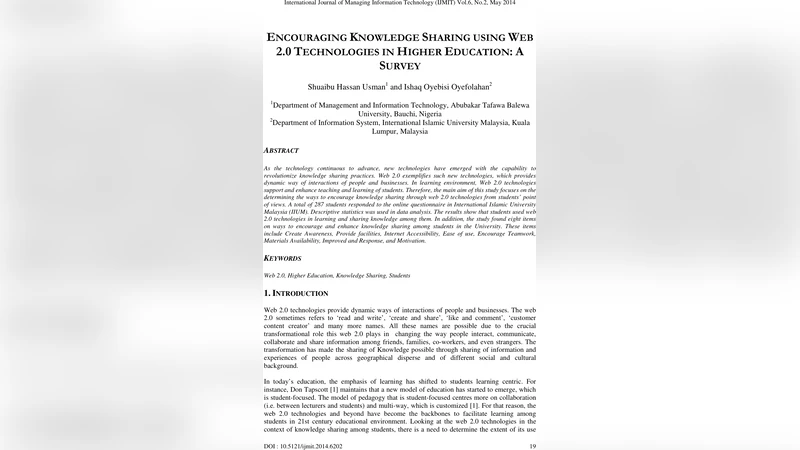
As the technology continuous to advance new technologies have emerged with the capability to revolutionize knowledge sharing practices. Web 2.0 exemplifies such new technologies which provides dynamic way of interactions of people and businesses. In learning environment Web 2.0 technologies support and enhance teaching and learning of students. Therefore the main aim of this study focuses on the determining the ways to encourage knowledge sharing through web 2.0 technologies from students’ point of views. A total of 287 students responded to the online questionnaire in International Islamic University Malaysia. Descriptive statistics was used in data analysis. The results show that students used web 2.0 technologies in learning and sharing knowledge among them. In addition the study found eight items on ways to encourage and enhance knowledge sharing among students in the University. These items include Create Awareness Provide facilities Internet Accessibility Ease of use Encourage Teamwork Materials Availability Improved Responses and Motivation.
💡 Research Summary
This study investigates how Web 2.0 technologies can be leveraged to encourage knowledge sharing among university students, focusing on the perspectives of the learners themselves. Conducted at the International Islamic University Malaysia, the research collected responses from 287 undergraduate students through an online questionnaire administered during the 2025 academic year. The questionnaire comprised three sections: demographic information, frequency and contexts of Web 2.0 tool usage (such as blogs, wikis, social networking sites, and discussion forums), and a set of Likert‑scale items designed to capture students’ perceptions of factors that might promote knowledge sharing.
Descriptive statistics were employed to summarize usage patterns, revealing that a majority of participants regularly employed Web 2.0 platforms for coursework, collaborative projects, and informal information exchange. To uncover underlying dimensions influencing knowledge‑sharing behavior, an exploratory factor analysis was performed on the perception items. Eight distinct factors emerged, each receiving a high internal reliability score and representing a specific facilitator:
- Awareness – the extent to which students understand the educational value and potential of Web 2.0 tools;
- Provide Facilities – institutional provision of dedicated platforms, cloud storage, and technical support;
- Internet Accessibility – reliable, high‑speed network connectivity on campus and off‑campus;
- Ease of Use – intuitive user interfaces, clear navigation, and minimal learning curves;
- Encourage Teamwork – curricular designs that embed group‑based assignments and collaborative problem‑solving;
- Materials Availability – systematic provision of lecture notes, reference documents, multimedia resources, and open‑access repositories;
- Improved Responses – real‑time feedback mechanisms such as comments, quizzes, polls, and peer‑review tools;
- Motivation – incentive structures including badges, points, gamified challenges, and recognition of contributions.
Statistical comparison of factor means indicated that “Internet Accessibility” and “Ease of Use” received the highest average ratings, underscoring the foundational role of robust infrastructure and user‑friendly design. Conversely, “Motivation” and “Awareness” scored lower, suggesting that while technical prerequisites are largely satisfied, there remains room to cultivate a stronger culture of sharing and to embed motivational elements more deliberately.
The authors situate these findings within established theoretical frameworks. The first four factors align closely with the Technology Acceptance Model (TAM), where perceived usefulness (Awareness) and perceived ease of use (Ease of Use) drive adoption. The remaining four resonate with Social Learning Theory and Knowledge Management (KM) principles, emphasizing collaborative interaction, resource availability, feedback loops, and reward systems as catalysts for communal knowledge creation. By integrating these perspectives, the study offers a comprehensive model that bridges individual acceptance with collective knowledge‑management practices.
Practical implications are articulated as a set of actionable recommendations for university administrators and instructional designers:
- Develop awareness campaigns that showcase success stories of Web 2.0‑enabled learning and clarify how these tools support academic outcomes.
- Invest in campus‑wide high‑speed internet and ensure that Wi‑Fi coverage extends to all learning spaces, including libraries, labs, and student lounges.
- Select or develop platforms with clean, intuitive interfaces and provide short onboarding tutorials to lower the entry barrier for novice users.
- Embed teamwork‑oriented assignments into curricula, making collaborative output a graded component to naturally stimulate sharing.
- Create a centralized digital repository where lecturers upload lecture slides, reading lists, and multimedia assets, guaranteeing that all students have equal access to learning materials.
- Implement real‑time feedback tools (e.g., embedded comment sections, live polls) that allow peers and instructors to respond promptly, reinforcing a dynamic learning environment.
- Introduce gamification elements such as digital badges, leaderboards, and point systems to recognize frequent contributors and sustain motivation over time.
The study acknowledges several limitations. The sample is confined to a single institution in Malaysia, which may limit the generalizability of the results to other cultural or institutional contexts. The reliance on self‑reported questionnaire data introduces potential social desirability bias, and the cross‑sectional design precludes causal inference. Moreover, the absence of qualitative data (e.g., interviews or focus groups) restricts deeper insight into the nuanced motivations behind students’ sharing behaviors.
Future research directions include expanding the sample to multiple universities across different regions, employing longitudinal designs to track changes in sharing practices over time, and conducting experimental interventions that manipulate specific facilitators (e.g., introducing a gamified reward system) to assess their causal impact on knowledge‑sharing frequency and quality. Additionally, integrating learning analytics from actual platform usage logs could complement self‑report measures and provide a richer, behavior‑based perspective.
In conclusion, this paper contributes both theoretically and practically to the discourse on digital learning environments. By empirically identifying eight key factors that encourage knowledge sharing through Web 2.0 technologies, the authors provide a nuanced roadmap for higher‑education institutions seeking to harness the collaborative potential of modern web tools. The findings affirm that while technical infrastructure and usability are essential prerequisites, fostering awareness, teamwork, accessible resources, responsive feedback, and motivational incentives are equally critical to cultivating a vibrant, knowledge‑sharing culture among university students.