Symmetric and exterior powers of categories
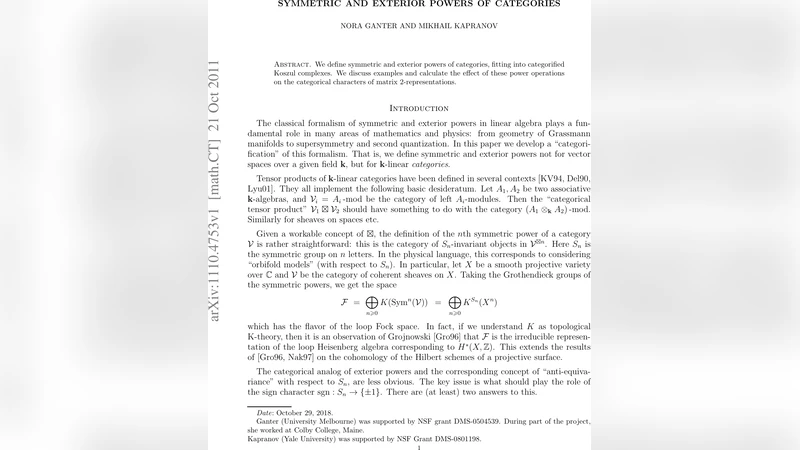
We define symmetric and exterior powers of categories, fitting into categorified Koszul complexes. We discuss examples and calculate the effect of these power operations on the categorical characters of matrix 2-representations.
💡 Research Summary
The paper “Symmetric and Exterior Powers of Categories” develops a systematic theory of symmetric (Symⁿ) and exterior (Λⁿ) power operations for k‑linear categories, where k is an algebraically closed field. The authors begin by reviewing several existing notions of tensor product ⊠ for linear, abelian, and pre‑triangulated categories, emphasizing its universal bilinear property: for any linear category X, bilinear functors V×W→X correspond uniquely to linear functors V⊠W→X. They then introduce completed tensor products (abelian and triangulated) to retain exactness properties that ordinary ⊠ lacks.
With a robust tensor product in hand, the n‑th symmetric power Symⁿ(V) is defined as the full subcategory of Sₙ‑invariant objects in the n‑fold tensor product V⊠…⊠V. Physically this corresponds to an Sₙ‑orbifold model; mathematically it yields, for example, the category of coherent sheaves on Xⁿ invariant under the diagonal action of the symmetric group. Taking Grothendieck groups, the authors recover the familiar Fock space construction: ⊕ₙK(Symⁿ(V)) ≅ ⊕ₙK^{Sₙ}(Xⁿ), which Grojnowski identified with the irreducible representation of the loop Heisenberg algebra attached to H⁎(X,ℤ).
The exterior power Λⁿ(V) is more subtle because one must categorify the sign character sgn:Sₙ→{±1}. Two approaches are discussed. The “naïve” method uses a non‑trivial element of H²(Sₙ,k^*) (discrete torsion) to twist the Sₙ‑action, mirroring projective representations. However, this fails to reproduce the Koszul duality patterns that the authors aim for. The authors therefore adopt a “super‑algebra” answer: they introduce a Picard character Sgn:Sₙ→Pic_{ℤ/2}(k), a functor taking values in the Picard category of super‑lines (1|0 or 0|1 dimensional super‑vector spaces). This simultaneously encodes the classical sign and the 2‑cocycle, and it restores the expected S‑Λ duality at the categorical level.
Using these definitions, the authors construct categorical Koszul complexes … → Symⁿ(V) → Λⁿ(V) → Symⁿ⁺¹(V) → … and prove (Theorem 4.1.2) that after applying the complexified Grothendieck group functor they become exact sequences of vector spaces. Remarkably, the generating functions for the dimensions of K‑groups of Symⁿ(V) and Λⁿ(V) involve the Euler function φ(q)=∏{n>1}(1−qⁿ) rather than the naive symmetric‑exterior power formulas. This leads to identities linking φ(q)−1 (the generating function for ordinary partitions) with ∏{n>0}(1+qⁿ) (the generating function for strict partitions), reflecting a deep combinatorial reciprocity.
Section 5 provides representation‑theoretic examples. For matrix 2‑representations (categorifications of linear representations), the symmetric power corresponds to an “untwisted” Kac‑Moody algebra, while the exterior power yields a “twisted” Kac‑Moody algebra. This mirrors the classical relationship between symmetric and exterior powers of vector spaces and the untwisted/twisted affine Lie algebras. The authors explain that this phenomenon is rooted in the Barratt‑Priddy‑Quillen theorem: the stable homotopy type of the sphere spectrum can be reconstructed from symmetric groups, and the loop space ΩS⁰ carries a canonical homotopy‑theoretic sign character sgn:Sₙ→ΩS⁰. Truncating ΩS⁰ to its 0‑ and 1‑st homotopy groups yields the Picard category Pic_{ℤ/2}(ℤ) of super‑lines, which after base change to k gives the Picard character used above. Higher truncations would produce 2‑, 3‑categorical analogues of the sign character, suggesting a hierarchy of “higher signs”.
Section 6 studies the effect of Symⁿ and Λⁿ on 2‑representations of a group G. The authors compute how categorical characters (2‑characters) transform: symmetric powers preserve the character, while exterior powers twist it by the super‑sign, leading to the aforementioned untwisted/twisted Kac‑Moody correspondence at the level of 2‑characters.
Finally, the paper outlines future directions: extending the constructions to higher (∞,1)‑categories, exploring other finite groups beyond Sₙ, and investigating connections with elliptic genera and topological quantum field theories.
Overall, the work provides a coherent framework for symmetric and exterior powers of categories, introduces a novel super‑line Picard character to categorify the sign, establishes categorical Koszul complexes with exactness properties, and reveals deep links between these constructions, homotopy theory, and representation theory of affine Lie algebras.
Comments & Academic Discussion
Loading comments...
Leave a Comment