Constitution and model. The quantum theory of Bohr and imagining the atom
The quantum theory of Bohr has roots in the theories of Rutherford and J. J. Thomson on the one hand, and that of Nicholson on the other. We note that Bohr neither presented the theories of Rutherford
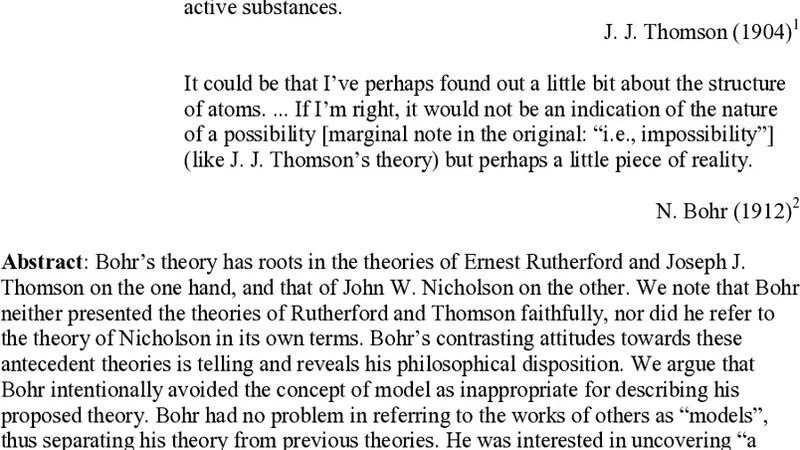
The quantum theory of Bohr has roots in the theories of Rutherford and J. J. Thomson on the one hand, and that of Nicholson on the other. We note that Bohr neither presented the theories of Rutherford and Thomson faithfully, nor did he refer to the theory of Nicholson in its own terms. The contrasting attitudes towards these antecedent theories is telling and reveals the philosophical disposition of Bohr. We argue that Bohr intentionally avoided the concept of model as inappropriate for describing his proposed theory. Bohr had no problem in referring to the works of others as ‘models’, thus separating his theory from previous theories. He was interested in uncovering ‘a little piece of reality’.
💡 Research Summary
The paper investigates Niels Bohr’s 1913 quantum model of the atom, tracing its intellectual lineage to the earlier theories of Ernest Rutherford, J. J. Thomson, and the less‑cited work of J. W. Nicholson. By closely reading Bohr’s original publications and correspondence, the author shows that Bohr did not faithfully reproduce Rutherford’s nuclear atom or Thomson’s plum‑pudding model; instead, he selectively critiqued their assumptions while retaining the term “model” for those predecessors. In contrast, Bohr never referred to Nicholson’s quantized orbital ideas as a “model,” even though many of Nicholson’s concepts—discrete electron orbits, quantized radiation—appear implicitly in Bohr’s postulates. This linguistic asymmetry is interpreted as a deliberate philosophical stance. Bohr regarded the word “model” as a provisional, representational tool inadequate for describing what he considered a genuine piece of reality. He wanted his theory to be presented not as a schematic analogy but as a direct statement about the atom’s actual structure, albeit limited to the “little piece of reality” that could be accessed experimentally.
The author argues that Bohr’s avoidance of the term “model” served two strategic purposes. First, it distinguished his work from the prevailing tradition in which models were seen as merely heuristic devices that reproduced known data without claiming ontological truth. Second, it allowed Bohr to position his quantum postulates as a radical break—a new explanatory framework rather than an incremental refinement of existing pictures. By labeling Rutherford’s and Thomson’s constructions as “models” while refusing the same label for his own theory, Bohr created a rhetorical boundary that emphasized the novelty and epistemic authority of his approach.
The paper also examines the broader impact of this stance on the development of quantum mechanics. Bohr’s insistence on a non‑model description encouraged subsequent physicists—Planck, Schrödinger, Heisenberg, and others—to focus on formal structures and mathematical relations that could be directly linked to experimental spectra, rather than on visualizable mechanical analogues. This shift contributed to the emergence of the abstract, operator‑based formalism that characterizes modern quantum theory.
In conclusion, the study contends that Bohr’s selective use of the word “model” reveals a deeper philosophical disposition: a commitment to uncovering a fragment of the atom’s true nature, even at the cost of abandoning the comforting metaphor of a model. This choice not only clarified Bohr’s own theoretical intentions but also helped reshape the methodological culture of early 20th‑century physics, steering it away from representational models toward a more austere, reality‑focused conception of scientific theory.
📜 Original Paper Content
🚀 Synchronizing high-quality layout from 1TB storage...