Generalized Wong sequences and their applications to Edmonds problems
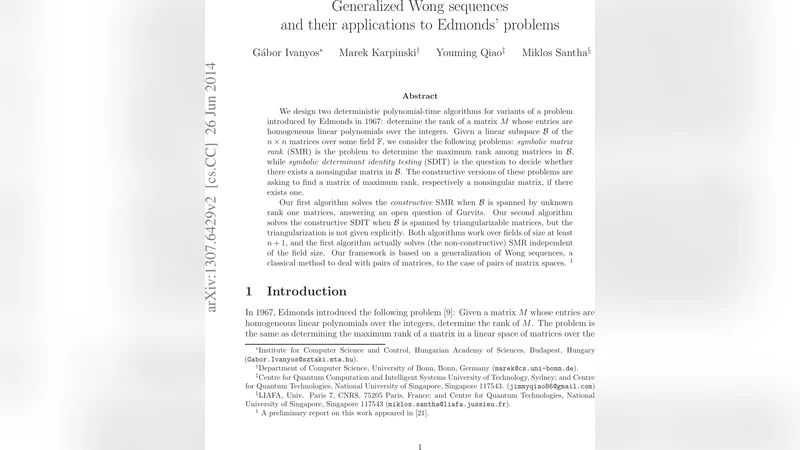
We design two deterministic polynomial time algorithms for variants of a problem introduced by Edmonds in 1967: determine the rank of a matrix M whose entries are homogeneous linear polynomials over the integers. Given a linear subspace B of the n by n matrices over some field F, we consider the following problems: symbolic matrix rank (SMR) is the problem to determine the maximum rank among matrices in B, symbolic determinant identity testing (SDIT) is the question to decide whether there exists a nonsingular matrix in B. The constructive versions of these problems are asking to find a matrix of maximum rank, respectively a nonsingular matrix, if there exists one. Our first algorithm solves the constructive SMR when B is spanned by unknown rank one matrices, answering an open question of Gurvits. Our second algorithm solves the constructive SDIT when B is spanned by triangularizable matrices, but the triangularization is not given explicitly. Both algorithms work over finite fields of size at least n+1 and over the rational numbers, and the first algorithm actually solves (the non-constructive) SMR independently from the field size. Our main tool to obtain these results is to generalize Wong sequences, a classical method to deal with pairs of matrices, to the case of pairs of matrix spaces.
💡 Research Summary
The paper revisits Edmonds’ 1967 problem of determining the rank of a matrix whose entries are homogeneous linear polynomials, recasting it in the modern language of matrix spaces. Given a linear subspace B ⊆ Mₙ(F) of n × n matrices over a field F, two fundamental computational tasks are considered: (1) Symbolic Matrix Rank (SMR) – compute the maximum rank of any matrix in B, and (2) Symbolic Determinant Identity Testing (SDIT) – decide whether B contains a nonsingular matrix. The constructive versions of these problems require actually producing a matrix of maximum rank or a nonsingular matrix, respectively.
Previous work solved special cases: Lovász showed SMR is polynomial‑time for spaces spanned by rank‑1 matrices, while Gurvits gave a deterministic polynomial‑time algorithm for SDIT on the Edmonds‑Rado class (spaces that are either nonsingular or admit a singularity witness) over subfields of ℂ. However, for finite fields of modest size the problem remained open, especially SMR for the rank‑1‑spanned class (R₁), which Gurvits explicitly listed as an open question.
The authors introduce a new algebraic tool: generalized Wong sequences. Classical Wong sequences apply to a pair of matrices (A, B) and alternate between taking images and pre‑images to produce two monotone sequences of subspaces that stabilize after at most n steps. The paper extends this notion to pairs of matrix spaces A, B ⊆ Lin(V, V′). For a subspace U ⊆ V, the image under A is defined as the span of all A(u) for A∈A, u∈U; the pre‑image of a subspace W ⊆ V′ under A is the intersection of all A⁻¹(W) over A∈A. Using these definitions the first Wong sequence is U₀ = V, U_{i+1} = B⁻¹(A(U_i)), and the second Wong sequence is W₀ = 0, W_{i+1} = B(A⁻¹(W_i)). Both sequences are monotone (U_{i+1} ⊆ U_i, W_{i+1} ⊇ W_i) and converge in ≤ n steps to limit subspaces U* and W*. U* is the largest subspace T with B(T) ⊆ A(T); W* is the smallest subspace with A⁻¹(W*) ⊆ B⁻¹(W*).
A c‑singularity witness is a subspace U with dim U − dim B(U) ≥ c; the maximal such c is denoted disc(B) and satisfies disc(B) ≤ corank(B). The authors prove that the second Wong sequence directly yields singularity witnesses, and that for spaces that are upper‑triangularizable (UT)—i.e., there exist nonsingular C, D such that D B C⁻¹ is upper‑triangular for all B∈B—the first Wong sequence alone suffices to decide SDIT and to construct a witness when the space is singular.
For the rank‑1‑spanned class (R₁), the second Wong sequence is linked to a new combinatorial problem called power‑over‑flow: repeatedly apply the operator B⁻¹ ∘ A to a subspace and check whether the dimension ever stops decreasing. The authors show that for R₁ spaces this problem can be solved in polynomial time by exploiting the rank‑1 factorization B_i = u_i v_iᵀ. Each iteration reduces to solving a linear system involving dot products of the u_i and v_i vectors, which can be done in O(poly(n)) field operations. Solving power‑over‑flow yields a subspace U with dim U − dim B(U) = corank(B), i.e., a maximal singularity witness, and consequently the exact value of SMR. Importantly, this algorithm works over any field size, thereby answering Gurvits’s open question: SMR for R₁ is deterministic polynomial‑time even on tiny finite fields.
For UT spaces, the algorithm proceeds by computing the first Wong sequence until stabilization. No explicit triangularizing matrices C, D are required; the sequence itself discovers the invariant subspace that witnesses singularity. If the limit U* is non‑zero, the space is singular and U* serves as a witness; otherwise, a nonsingular matrix can be extracted from the construction. This algorithm needs the field size to satisfy |F| ≥ n + 1, a condition that matches the requirement of the Schwartz‑Zippel lemma for randomized identity testing. Under this condition the algorithm runs in deterministic polynomial time on an algebraic RAM; over ℚ the bit‑complexity remains polynomial.
Both algorithms run in O(poly(n, log|F|)) time on an algebraic RAM, and over ℚ the Boolean (bit) complexity is also polynomial in the input size. The paper also discusses the relationship of these results to earlier work on mixed matrices, linear matroid intersection, and algebraic branching programs (ABPs). It notes that while SDIT for ABPs is equivalent to identity testing for arithmetic circuits, the present results apply to specific structural subclasses of matrix spaces rather than general ABPs.
In summary, the authors develop a unified framework based on generalized Wong sequences that captures the structural essence of two important Edmonds problems. By exploiting this framework they obtain:
- A deterministic polynomial‑time algorithm for SMR on rank‑1‑spanned spaces, independent of field size (solving Gurvits’s open problem).
- A deterministic polynomial‑time algorithm for constructive SDIT on upper‑triangularizable spaces, requiring only a modest field size (|F| ≥ n + 1).
- Efficient construction of singularity witnesses in both settings. These contributions extend the reach of deterministic algorithms beyond the previously known Edmonds‑Rado class, offering concrete, implementable methods for matrix spaces that arise in combinatorial optimization, coding theory, and symbolic computation. Future work may aim to broaden these techniques to the full Edmonds‑Rado class or to develop field‑size‑independent algorithms for even larger families of matrix spaces.
Comments & Academic Discussion
Loading comments...
Leave a Comment