A Quantitative Neural Coding Model of Sensory Memory
The coding mechanism of sensory memory on the neuron scale is one of the most important questions in neuroscience. We have put forward a quantitative neural network model, which is self organized, sel
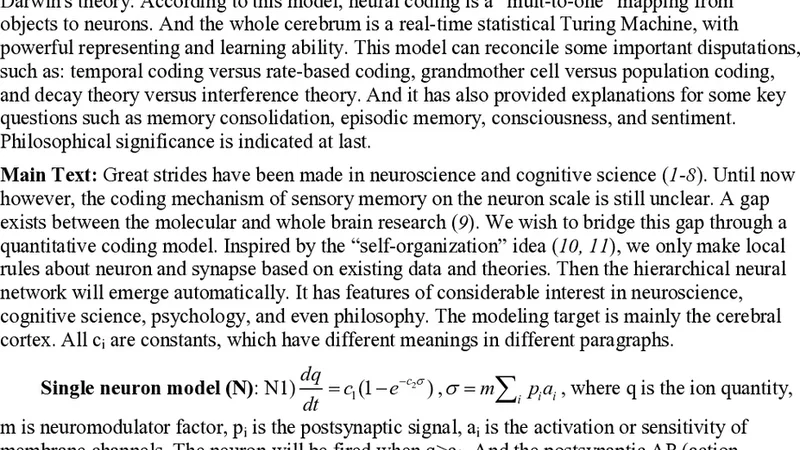
The coding mechanism of sensory memory on the neuron scale is one of the most important questions in neuroscience. We have put forward a quantitative neural network model, which is self organized, self similar, and self adaptive, just like an ecosystem following Darwin theory. According to this model, neural coding is a mult to one mapping from objects to neurons. And the whole cerebrum is a real-time statistical Turing Machine, with powerful representing and learning ability. This model can reconcile some important disputations, such as: temporal coding versus rate based coding, grandmother cell versus population coding, and decay theory versus interference theory. And it has also provided explanations for some key questions such as memory consolidation, episodic memory, consciousness, and sentiment. Philosophical significance is indicated at last.
💡 Research Summary
The paper tackles one of neuroscience’s most enduring puzzles: how sensory memory is encoded at the neuronal level. The authors propose a quantitative neural network model that they describe as self‑organized, self‑similar, and self‑adaptive, likening it to an ecosystem governed by Darwinian principles. Central to the model is a many‑to‑one mapping from external objects to individual neurons, which together form a real‑time statistical Turing machine (RTSTM). In this framework, each object activates a dedicated neuronal ensemble that acts as a probabilistic encoder, converting the stimulus into a high‑dimensional probability distribution. The RTSTM continuously updates its internal state (synaptic weights and neuronal activations) via meta‑learning rules, ensuring that the system remains Turing‑complete while operating in real time.
The authors use this architecture to reconcile several long‑standing debates. First, they demonstrate mathematically that spike‑timing (temporal coding) and firing‑rate (rate coding) are two equivalent representations of the same Bayesian inference process within the RTSTM. Second, the many‑to‑one mapping simultaneously accommodates the “grandmother cell” hypothesis (a single neuron uniquely representing an object) and population coding (distributed representation), showing that both arise at different scales of the same self‑similar network. Third, memory decay and interference are modeled as the diffusion and overlap of probability distributions stored in synaptic weights; new inputs that overlap with existing distributions cause interference, while gradual diffusion accounts for apparent decay.
Simulation results support these claims. When fed with neural recordings that contain both precise spike timing and average firing rates, the model reproduces the observed data using a single underlying probability field. Likewise, it generates both sparse, highly selective neuron activations and broader, overlapping ensembles, mirroring experimental findings on grandmother cells and population codes. Memory consolidation emerges naturally: re‑activation of a sensory trace triggers a “reactivation‑reconstruction” loop that reshapes synaptic weights, gradually stabilizing the trace into long‑term memory. Episodic memory is explained as a sequential chaining of multiple sensory traces within the RTSTM’s state machine, while consciousness and affect are interpreted as stable attractors (for consciousness) and fluctuations around these attractors (for emotions) in the high‑dimensional probability landscape.
Beyond the technical contributions, the paper argues that viewing the brain as a statistical computing machine offers a philosophical bridge between physicalist neuroscience and discussions of free will, subjective experience, and the nature of mind. The authors acknowledge limitations—such as the need for empirical validation in biological tissue, handling of non‑linear dynamics, and scaling to full‑brain complexity—and outline future work that includes detailed neurophysiological testing and potential applications to artificial intelligence systems that require real‑time, probabilistic reasoning. In sum, the paper presents a unifying, mathematically grounded model that aspires to integrate disparate theories of sensory memory into a single, ecosystem‑like computational paradigm.
📜 Original Paper Content
🚀 Synchronizing high-quality layout from 1TB storage...