Quasi-geostrophic approximation of anelastic convection
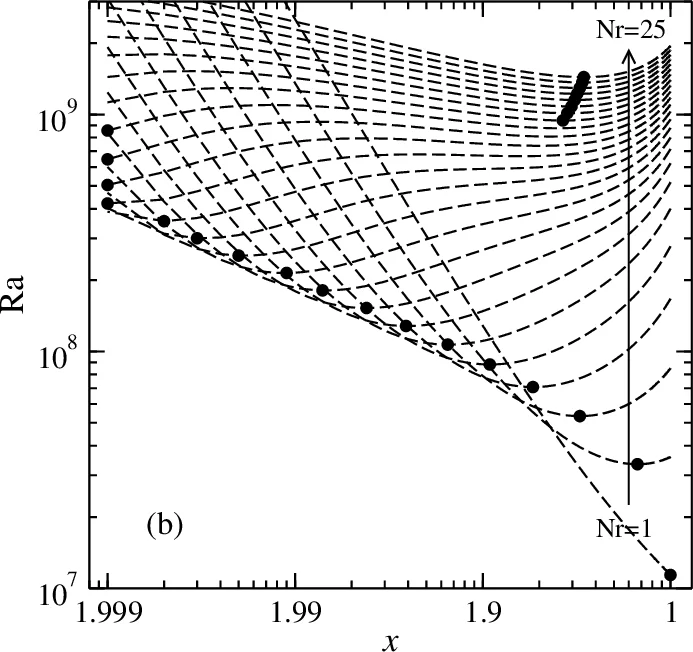
The onset of convection in a rotating cylindrical annulus with parallel ends filled with a compressible fluid is studied in the anelastic approximation. Thermal Rossby waves propagating in the azimuthal direction are found as solutions. The analogy to the case of Boussinesq convection in the presence of conical end surfaces of the annular region is emphasized. As in the latter case the results can be applied as an approximation for the description of the onset of anelastic convection in rotating spherical fluid shells. Reasonable agreement with three-dimensional numerical results published by Jones et al. (J. Fluid Mech., vol. 634, 2009, pp. 291-319) for the latter problem is found. As in those results the location of the onset of convection shifts outward from the tangent cylinder with increasing number $N_\rho$ of density scale heights until it reaches the equatorial boundary. A new result is that at a much higher number $N_\rho$ the onset location returns to the interior of the fluid shell.
💡 Research Summary
The paper investigates the linear onset of convection in a rapidly rotating cylindrical annulus filled with a compressible (ideal) gas, using the anelastic approximation. The authors adopt a narrow‑gap geometry (gap width d ≪ inner radius) so that a Cartesian coordinate system (x, y, z) can be introduced locally, with x pointing radially, y azimuthally, and z along the rotation axis. Gravity is taken to be uniform and directed opposite to the radial coordinate, although in laboratory analogues it could be replaced by a centrifugal force.
The governing equations are the anelastic momentum, continuity and entropy equations, nondimensionalised with length scale d, time scale d²/κ (κ = entropy diffusivity) and entropy scale Δs. The dimensionless parameters are the Rayleigh number
(R = \frac{g d^{3},\Delta s}{\kappa \nu c_{p}}),
the Prandtl number (Pr = \nu/\kappa), and the Coriolis number (\tau = 2\Omega d^{2}/\nu). The only spatially varying background quantity is the reference density (\bar\rho(x)) (and the associated temperature profile (T(x))).
Assuming two‑dimensional motions (independent of z) that satisfy the Proudman‑Taylor constraint, the velocity is expressed through a streamfunction ψ as
(\mathbf{u}= \frac{1}{\bar\rho},\nabla\psi\times\mathbf{k}).
Linearising about the conductive state yields coupled equations for the vertical vorticity ζ and the entropy perturbation (\tilde s). A key parameter emerges:
(\eta^{}_{\rho}= \tau,\bigl|-\frac{1}{\bar\rho}\frac{d\bar\rho}{dx}\bigr|),
which measures the product of rotation rate and the (dimensionless) density gradient. In the rapid‑rotation limit (τ ≫ 1) the authors consider the asymptotic regime (|\eta^{}_{\rho}|\to\infty).
With stress‑free boundaries at (x=\pm 1/2) the normal‑mode ansatz
(\psi = \sin!\bigl
Comments & Academic Discussion
Loading comments...
Leave a Comment