The genetic code invariance: when Euler and Fibonacci meet
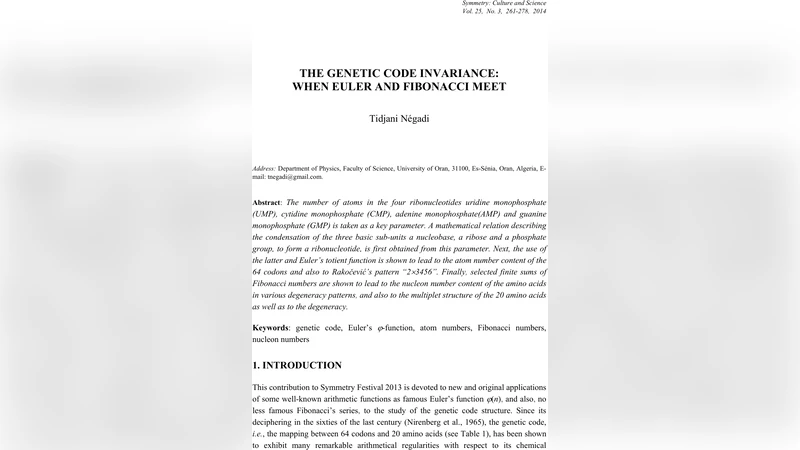
The number of atoms in the four ribonucleotides uridine monophosphate, cytidine monophosphate, adenine monophosphate and guanine monophosphate is taken as a key parameter. A mathematical relation describing the condensation of the three basic subunits a nucleobase, a ribose and a phosphate group, to form a ribonucleotide, is first obtained from this parameter. Next, the use of the latter and Euler totient function is shown to lead to the atom number content of the 64 codons and also to Rakocevic pattern. Finally, selected finite sums of Fibonacci numbers are shown to lead to the nucleon number content of the amino acids in various degeneracy patterns, and also to the multiplet structure of the 20 amino acids as well as to the degeneracy.
💡 Research Summary
This paper delves into the invariance of the genetic code by integrating mathematical concepts with biological structures. It begins by taking the number of atoms in four ribonucleotides (uridine monophosphate, cytidine monophosphate, adenine monophosphate, and guanine monophosphate) as a key parameter to describe the condensation process forming these ribonucleotides from their basic subunits: a nucleobase, a ribose, and a phosphate group. The paper then explores how Euler’s totient function can be applied to derive the atomic number content of all 64 codons and also leads to what is known as the Rakocevic pattern. Additionally, by using selected finite sums of Fibonacci numbers, the authors show that they can determine the nucleon number content of amino acids in various degeneracy patterns. This approach not only elucidates the multiplet structure of the 20 amino acids but also their degeneracy. The paper provides a significant insight into how mathematical principles like Euler’s totient function and Fibonacci numbers can be applied to understand biological structures, offering a novel perspective on genetic code invariance and potentially opening new avenues for interdisciplinary research between mathematics and biology.
Comments & Academic Discussion
Loading comments...
Leave a Comment