Putnam looks at quantum mechanics (again and again)
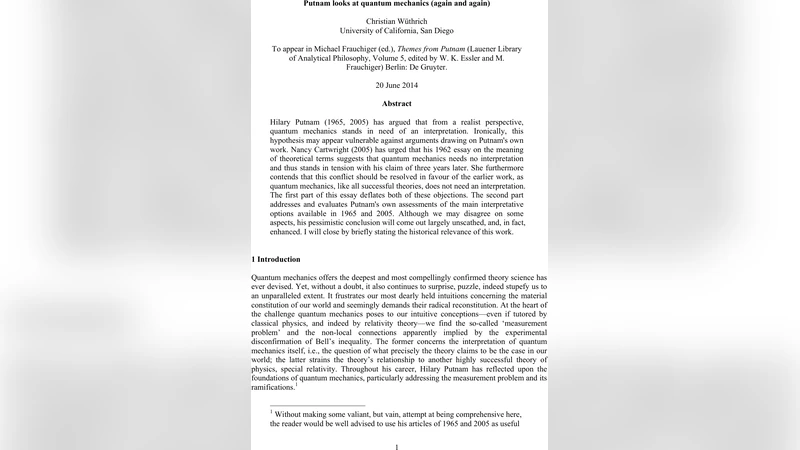
Hilary Putnam (1965, 2005) has argued that from a realist perspective, quantum mechanics stands in need of an interpretation. Ironically, this hypothesis may appear vulnerable against arguments drawing on Putnam’s own work. Nancy Cartwright (2005) has urged that his 1962 essay on the meaning of theoretical terms suggests that quantum mechanics needs no interpretation and thus stands in tension with his claim of three years later. She furthermore contends that this conflict should be resolved in favour of the earlier work, as quantum mechanics, like all successful theories, does not need an interpretation. The first part of this essay deflates both of these objections. The second part addresses and evaluates Putnam’s own assessments of the main interpretative options available in 1965 and 2005. Although we may disagree on some aspects, his pessimistic conclusion will come out largely unscathed, and, in fact, enhanced. I will close by briefly stating the historical relevance of this work.
💡 Research Summary
The paper revisits Hilary Putnam’s longstanding claim that quantum mechanics (QM) requires an interpretation from a realist standpoint, first articulated in 1965 and reiterated in 2005. It does so by confronting two criticisms that appear to undermine Putnam’s position. The first criticism, advanced by Nancy Cartwright in 2005, draws on Putnam’s 1962 essay on the meaning of theoretical terms. Cartwright argues that the 1962 work, which emphasizes a structuralist or “meaning‑as‑use” view of theoretical vocabulary, implies that successful scientific theories—QM included—do not need an additional interpretative layer. She therefore claims a direct inconsistency between Putnam’s early semantic view and his later realist insistence that QM is under‑determined without an interpretation.
The author dismantles this objection on two fronts. First, the 1962 essay does not deny the relevance of interpretation; rather, it holds that the meaning of theoretical terms is secured by their empirical success, but it leaves open the question of how that empirical success connects to the ontology that a realist wishes to recover. In other words, even a perfectly predictive theory can still leave open the metaphysical question of what the world is like “behind” the formalism. Second, Cartwright’s blanket claim that “all successful theories need no interpretation” overlooks the distinctive features of QM—non‑locality, contextuality, and the measurement problem—that set it apart from classical successes such as thermodynamics or electromagnetism. These features generate a persistent gap between the mathematical apparatus and a clear realist picture, a gap that cannot be bridged merely by citing empirical adequacy.
The second part of the paper turns to Putnam’s own assessment of the main interpretative options available at the two key moments (1965 and 2005). The author systematically reviews the Copenhagen interpretation, the many‑worlds (or Everettian) view, hidden‑variable theories (including Bohmian mechanics and the Bell‑David‑Gleason approaches), and Putnam’s later endorsement of a structuralist interpretation. For each option the paper reconstructs Putnam’s criticisms: Copenhagen’s reliance on a classical‑quantum cut and its instrumentalist flavor; many‑worlds’ ontological extravagance and empirical inaccessibility; hidden‑variables’ vulnerability to Bell‑type no‑go theorems and the need for non‑local dynamics; and structuralism’s failure to deliver a genuine realist commitment because it still presupposes that the mathematical structure corresponds to something in the world.
In 2005 Putnam argued that structuralism came closest to satisfying both the empirical and philosophical constraints, yet he remained uneasy because the approach still tacitly assumes a realist stance about the existence of the structure itself. Consequently, Putnam concluded that none of the available interpretations succeeded in providing a fully satisfactory realist account of QM. The paper shows that this pessimistic conclusion is not a relic of an earlier era but a robust position that has been reinforced by later developments—quantum information theory, experimental demonstrations of contextuality, and ongoing work on quantum foundations—that have sharpened the very issues Putnam identified.
Finally, the author situates Putnam’s work within the broader history of philosophy of science. By insisting that the meaning of a theory is tied to its empirical performance while simultaneously demanding a realist ontology, Putnam highlighted the persistent tension between “theory as a predictive tool” and “theory as a description of reality.” This tension remains central to contemporary debates over the interpretation of quantum mechanics, the role of information‑theoretic approaches, and the prospects for a future theory of quantum gravity. In sum, the paper deflates Cartwright’s alleged contradiction, re‑examines Putnam’s own interpretative surveys, and demonstrates that Putnam’s skeptical verdict on the interpretative landscape of QM stands largely unscathed—indeed, it appears more compelling in light of the scientific advances of the past half‑century.