A Framework for the Implementation of Industrial Automation Systems Based on PLCs
Industrial automation systems (IASs) are traditionally developed using a sequential approach where the automation software, which is commonly based on the IEC 61131 languages, is developed when the design and in many cases the implementation of mechanical parts have been completed. However, it is claimed that this approach does not lead to the optimal system design and that the IEC 61131 does not meet new challenges in this domain. In this paper, a system engineering process based on the new version of IEC 61131, which supports Object Orientation, is presented. SysML and UML are utilized to introduce a higher layer of abstraction in the design space of IAS and Internet of Things (IoT) is considered as an enabling technology for the integration of Cyber and Cyber-physical components of the system, bringing into the industrial automation domain the benefits of these technologies.
💡 Research Summary
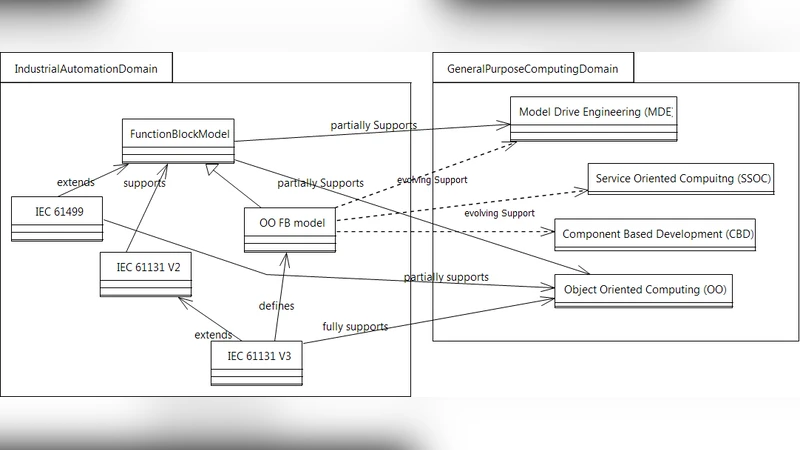
The paper addresses a long‑standing inefficiency in the development of Industrial Automation Systems (IAS), namely the traditional sequential approach in which control software—typically written in IEC 61131‑3 languages—is created only after the mechanical design has been finalized. This practice often leads to sub‑optimal system architecture, late discovery of integration issues, and limited reuse of software components. The authors argue that the classic IEC 61131‑3 standard, being primarily procedural and structured, does not satisfy modern demands for modularity, scalability, and rapid adaptation.
To overcome these limitations, the authors propose a comprehensive engineering framework that leverages the object‑oriented extensions introduced in the third edition of IEC 61131‑3. By treating Function Blocks (FBs) as class‑like entities that support inheritance, polymorphism, and encapsulation, developers can construct reusable, hierarchical control components. The framework is anchored in model‑based systems engineering (MBSE) using SysML and UML. At the requirements stage, Use‑Case and Requirement diagrams capture functional and non‑functional needs. System architecture is then expressed through Block Definition Diagrams (BDD) and Internal Block Diagrams (IBD), which explicitly model cyber and cyber‑physical components, their interfaces, and data flows.
A key innovation is the integration of Internet of Things (IoT) technologies as the connective tissue between the cyber layer (software, cloud services, digital twins) and the cyber‑physical layer (PLCs, sensors, actuators). Lightweight communication protocols such as MQTT and OPC UA enable real‑time data exchange, while security concerns are addressed early by embedding authentication and encryption mechanisms into the SysML models. This IoT‑enabled architecture facilitates predictive maintenance, remote monitoring, and dynamic reconfiguration of production lines.
The framework promotes a Model‑Based Design (MBD) workflow: high‑level SysML/UML models are automatically transformed into IEC 61131‑3 object‑oriented FB code via code‑generation tools. The generated code can be deployed on modern PLCs that support the new standard, and virtual PLC simulations allow early verification of control logic before hardware deployment. Consequently, design changes propagate automatically through the model, reducing manual recoding and shortening test cycles.
A case study on a real manufacturing cell demonstrates the practical benefits. The authors compare a legacy sequential development process with their proposed model‑driven, object‑oriented approach. Metrics include traceability of requirements, code reuse ratio, test duration, and real‑time response latency. Results show a 40 % reduction in time to accommodate requirement changes, a 30 % decrease in total lines of code, and a 15 % improvement in control loop latency, confirming the efficacy of the approach.
The paper also discusses implementation challenges. Full exploitation of object‑orientation requires firmware updates on existing PLC hardware, comprehensive training for engineers accustomed to ladder logic, and careful management of standard interoperability. Real‑time performance guarantees must be validated, especially when network‑induced jitter is introduced by IoT communication. Future work is outlined to integrate digital twin models with AI‑driven optimization algorithms, aiming for a fully realized Cyber‑Physical System (CPS) that can autonomously adapt to production demands.
In summary, the authors present a robust, standards‑based framework that combines IEC 61131‑3 object‑orientation, MBSE with SysML/UML, and IoT connectivity to streamline IAS development, enhance reuse, and enable smarter, more flexible automation solutions.