On variables with few occurrences in conjunctive normal forms
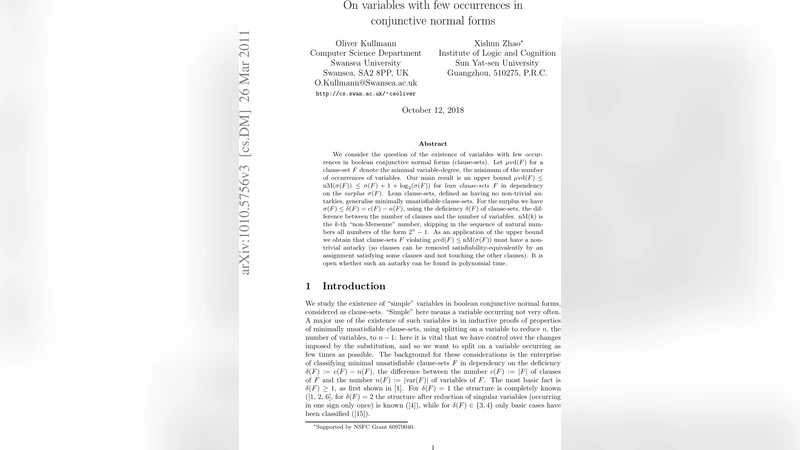
We consider the question of the existence of variables with few occurrences in boolean conjunctive normal forms (clause-sets). Let mvd(F) for a clause-set F denote the minimal variable-degree, the minimum of the number of occurrences of variables. Our main result is an upper bound mvd(F) <= nM(surp(F)) <= surp(F) + 1 + log_2(surp(F)) for lean clause-sets F in dependency on the surplus surp(F). - Lean clause-sets, defined as having no non-trivial autarkies, generalise minimally unsatisfiable clause-sets. - For the surplus we have surp(F) <= delta(F) = c(F) - n(F), using the deficiency delta(F) of clause-sets, the difference between the number of clauses and the number of variables. - nM(k) is the k-th “non-Mersenne” number, skipping in the sequence of natural numbers all numbers of the form 2^n - 1. We conjecture that this bound is nearly precise for minimally unsatisfiable clause-sets. As an application of the upper bound we obtain that (arbitrary!) clause-sets F with mvd(F) > nM(surp(F)) must have a non-trivial autarky (so clauses can be removed satisfiability-equivalently by an assignment satisfying some clauses and not touching the other clauses). It is open whether such an autarky can be found in polynomial time. As a future application we discuss the classification of minimally unsatisfiable clause-sets depending on the deficiency.
💡 Research Summary
The paper investigates the existence of variables that occur only a few times in Boolean conjunctive normal form (CNF) clause‑sets. For a clause‑set F, the minimal variable degree mvd(F) is defined as the smallest number of occurrences of any variable (counting both positive and negative literals). The central question is how low mvd(F) can be in relation to structural parameters of F, especially for clause‑sets that are “lean”, i.e., they admit no non‑trivial autarkies. An autarky is a partial assignment that satisfies every clause it touches while leaving the remaining clauses untouched; the presence of an autarky means that a clause‑set can be reduced without changing its satisfiability status.
The authors introduce two auxiliary notions. First, the surplus surp(F) = c(F) − n(F), where c(F) is the number of clauses and n(F) the number of variables. Surplus is always bounded above by the classical deficiency δ(F) = c(F) − n(F) and coincides with it for many natural classes, such as minimally unsatisfiable (MU) clause‑sets. Second, they define the “non‑Mersenne” numbers nM(k). Starting from the natural numbers, the sequence skips every number of the form 2ⁿ − 1 (the Mersenne numbers). Thus nM(1)=2, nM(2)=4, nM(3)=5, nM(4)=6, nM(5)=8, and so on. This sequence grows essentially linearly, with a logarithmic correction: nM(k) ≤ k + 1 + ⌊log₂ k⌋.
The main theorem states that for any lean clause‑set F, \
Comments & Academic Discussion
Loading comments...
Leave a Comment