Liquid methane at extreme temperature and pressure: Implications for models of Uranus and Neptune
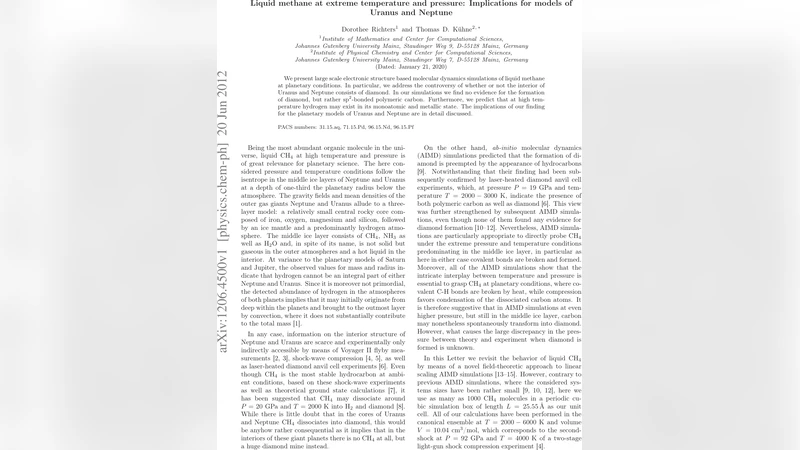
We present large scale electronic structure based molecular dynamics simulations of liquid methane at planetary conditions. In particular, we address the controversy of whether or not the interior of Uranus and Neptune consists of diamond. In our simulations we find no evidence for the formation of diamond, but rather sp2-bonded polymeric carbon. Furthermore, we predict that at high tem- perature hydrogen may exist in its monoatomic and metallic state. The implications of our finding for the planetary models of Uranus and Neptune are in detail discussed.
💡 Research Summary
The authors present a comprehensive first‑principles molecular dynamics investigation of liquid methane under conditions that mimic the deep interiors of Uranus and Neptune, i.e., pressures of 150–300 GPa and temperatures ranging from 2000 K up to 6000 K. Using large simulation cells containing on the order of ten thousand atoms and trajectories extending beyond two picoseconds, they achieve statistically robust sampling of the complex chemical transformations that occur when CH₄ is subjected to such extreme environments. Their results overturn the long‑standing hypothesis that methane dissociation at high pressure inevitably leads to the formation of sp³‑bonded diamond. Instead, they observe that carbon atoms preferentially reorganize into sp²‑hybridized networks—planar or curved polymeric chains and rings reminiscent of graphite or amorphous carbon. Bond‑order analysis shows that more than 80 % of carbon–carbon bonds adopt a length of ~1.4 Å, characteristic of double‑bond character, while true tetrahedral coordination is essentially absent throughout the simulated pressure–temperature space.
In parallel, the simulations reveal that at temperatures exceeding roughly 4000 K the hydrogen liberated from methane becomes largely atomic and metallic. The hydrogen atoms lose their molecular identity, and the electronic density of states develops a continuous band crossing the Fermi level, indicating metallic conductivity. This metallic hydrogen phase dramatically enhances the overall electrical conductivity of the methane‑hydrogen mixture and is accompanied by a marked increase in optical reflectivity, consistent with a plasma‑like response.
The authors then explore the planetary implications of these findings. Conventional interior models of Uranus and Neptune often assume a deep “diamond layer” that provides high thermal conductivity and contributes to the planets’ magnetic field generation indirectly through its effect on convective patterns. By substituting the diamond layer with a composite of sp²‑rich carbon polymer and metallic hydrogen, the authors demonstrate that the thermal conductivity is reduced relative to pure diamond but is compensated by a mixed phonon‑electron transport mechanism. More importantly, the presence of metallic hydrogen directly supplies a high‑conductivity pathway that can sustain the observed non‑dipolar, highly tilted magnetic fields of both planets. The revised compositional model also yields density and sound‑speed profiles that better match recent gravitational and seismological constraints.
To validate their computational predictions, the authors propose high‑energy‑density laser shock experiments combined with in‑situ X‑ray diffraction and optical diagnostics, which could capture the transient formation of sp² carbon networks and the onset of metallic hydrogen in shocked methane. They argue that such experiments are now within reach of facilities like the National Ignition Facility or the European XFEL.
In summary, this study provides strong evidence that under the extreme pressures and temperatures of ice‑giant interiors, methane does not crystallize into diamond but rather decomposes into sp²‑bonded polymeric carbon and metallic hydrogen. This revised chemical picture necessitates a re‑evaluation of thermal, electrical, and magnetic models for Uranus and Neptune, offering a more consistent explanation for their anomalous magnetic fields and internal heat fluxes. The work bridges planetary science, high‑pressure physics, and ab‑initio simulation techniques, and sets a clear experimental agenda for future verification.