Towards a theory of granular sets
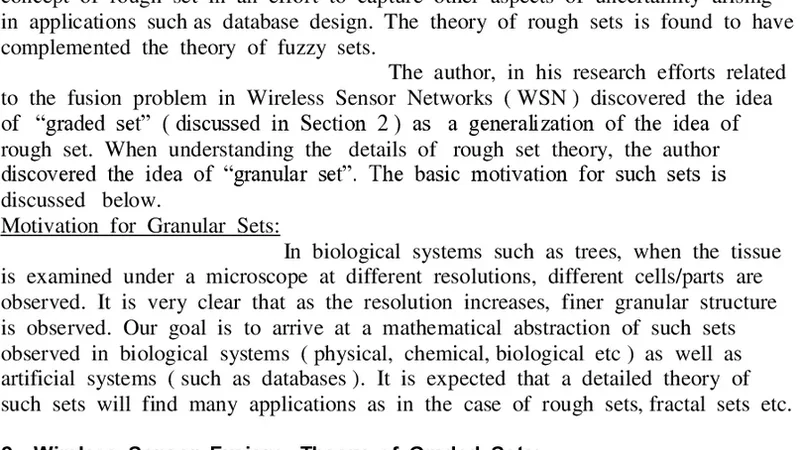
Motivated by the application problem of sensor fusion the author introduced the concept of graded set. It is reasoned that in classification problem arising in an information system (represented by information table), a novel set called Granular set naturally arises. It is realized that in any hierarchical classification problem, Granular set naturally arises. Also when the target set of objects forms a graded set the lower and upper approximations of target sets form a graded set. This generalizes the concept of rough set. It is hoped that a detailed theory of granular/ graded sets finds several applications.
💡 Research Summary
The paper addresses a fundamental limitation of classical Rough Set theory when applied to modern information systems that often contain multi‑level uncertainty, such as those arising from sensor fusion. Classical Rough Sets model uncertainty with a single pair of lower and upper approximations. However, in practice measurements may be continuous, come from heterogeneous sources with different accuracies, and evolve across several abstraction levels. To capture this richer structure the author introduces two new concepts: graded sets and granular sets.
A graded set is defined as an ordered chain of subsets (G_0 \subseteq G_1 \subseteq \dots \subseteq G_n) of a universal object set (U). Each level (G_i) represents a distinct “uncertainty tier”: the lower the index, the stricter the inclusion criteria; the higher the index, the more objects are admitted. The paper formalises basic set‑theoretic operations (union, intersection, complement, difference) on graded sets and shows that these operations preserve the chain structure.
A granular set emerges naturally from hierarchical classifications in an information table. At each decision level the objects are grouped into granules (clusters) that share similar attribute values (or approximations thereof). The collection of granules at level (i) is denoted (\mathcal{G}_i). As the classification becomes coarser, granules merge, yielding a nested family (\mathcal{G}_0, \mathcal{G}_1, \dots, \mathcal{G}_n). The crucial insight is that the family of granules ({\mathcal{G}_i}) is isomorphic to a graded set ({G_i}); each granule family can be identified with a corresponding graded subset of (U).
The central theorem states: If a target object set forms a graded set, then its lower and upper approximations (as defined in Rough Set theory) also form graded sets. In other words, the approximation process respects the multi‑level structure rather than collapsing it into a single pair of sets. This result generalizes Rough Set theory: ordinary Rough Sets appear as the special case where the graded chain has only two levels (the lower and the upper approximation).
To illustrate practical relevance, the author presents a sensor‑fusion scenario. Suppose three sensors measure temperature, humidity, and pressure, each with different noise characteristics and sampling rates. Each sensor’s reading is mapped to a granule at a specific level of precision; the collection of all sensor readings thus yields a multi‑level granular representation of the environment. The target condition (e.g., “safe operating region”) is expressed as a graded set. The lower approximation consists of states that all sensors agree belong to the safe region, while the upper approximation consists of states that at least one sensor deems safe. Both approximations inherit the graded hierarchy, enabling decision makers to explicitly trade off confidence (lower) against coverage (upper) across multiple uncertainty tiers.
The paper also introduces quantitative measures for each level: precision (P_i = |G_i|/|U|) and coverage (C_i = |G_{i+1}\setminus G_i|/|U|). These metrics allow analysts to assess how much information is gained or lost when moving between levels, and to compare different granularizations.
Beyond the theoretical development, the author outlines several avenues for future work:
- Algorithmic development – design of clustering and classification algorithms that operate directly on graded/granular structures.
- Dynamic adaptation – mechanisms for updating the graded chain in streaming or time‑varying environments, such as online sensor networks.
- Scalable implementation – exploration of data structures and parallel processing techniques to handle large‑scale datasets typical of big‑data applications.
- Cross‑disciplinary applications – potential use in areas like medical diagnosis, fault detection, and knowledge discovery where multi‑resolution information is intrinsic.
In summary, the paper proposes a robust extension of Rough Set theory by formalising graded and granular sets, demonstrates that hierarchical classifications naturally give rise to these structures, and proves that lower/upper approximations preserve the graded nature of target sets. This framework not only unifies existing Rough Set concepts but also provides a versatile mathematical tool for handling multi‑level uncertainty in modern information systems, especially those involving heterogeneous sensor data.