Weights and t-structures: in general triangulated categories, for 1-motives, mixed motives, and for mixed Hodge complexes and modules
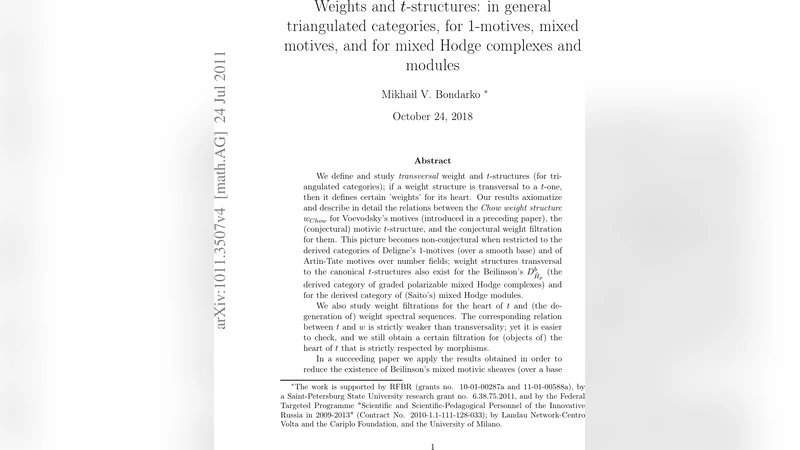
We study certain ‘weights’ for triangulated categories endowed with $t$-structures. Our results axiomatize and describe in detail the relations between the Chow weight structure (introduced in a preceding paper), the (conjectural) motivic t-structure for Voevodsky’s motives, and the conjectural weight filtration for them. This picture becomes non-conjectural when restricted to the derived categories of 1-motives (over a smooth base) and of Artin-Tate motives over number fields; other examples include Beilinson’s derived category of graded polarizable mixed Hodge complexes and Saito’s derived category of mixed Hodge modules. We also study weight filtrations for the heart of $t$ and (the degeneration of) weight spectral sequences. In a subsequent paper we apply the results obtained in order to prove that (certain) ‘standard’ conjectures imply the existence of Beilinson’s categories of mixed motivic sheaves endowed with weight filtrations.
💡 Research Summary
The paper develops a systematic framework for studying the interplay between weight structures and t‑structures on triangulated categories, with a focus on motives and mixed Hodge theory. After recalling the definitions of a weight structure (w) and a t‑structure (t), the author introduces a set of compatibility axioms—collectively called “normality”—that describe how the two structures can coexist. The key requirement is the existence of a natural transformation τ: w_{\le 0} → t_{\ge 0} which, when restricted to the heart 𝒜 = 𝒯^{t≤0}∩𝒯^{t≥0}, induces a weight filtration W_{\bullet} on 𝒜. Under these axioms the filtration is strict, its graded pieces are pure objects of the weight structure, and the associated weight spectral sequence collapses at E₂. This abstract machinery is then applied to several concrete settings.
First, the author treats Voevodsky’s triangulated category of geometric motives DM_{gm}^{eff}. Assuming the conjectural motivic t‑structure exists, the Chow weight structure (previously constructed) satisfies the normality axioms, and the weight filtration on the heart coincides with the expected motivic weight filtration. This yields a precise “weight‑t compatibility theorem” showing that the two structures are essentially the same on DM_{gm}^{eff}.
Second, the paper examines the derived category of 1‑motives (DM_{1}^{eff}) and the Artin‑Tate subcategory over number fields. In both cases the Chow weight structure is already known, and the author proves that any motivic t‑structure compatible with it must agree on the level of hearts. Moreover, the induced weight filtration matches the classical weight filtration on Galois representations (for Artin‑Tate motives) and on the Hodge realization of 1‑motives.
Third, the analysis moves to Hodge theory. For Beilinson’s derived category of graded polarizable mixed Hodge complexes D^{b}MHS, the author shows that the natural t‑structure (given by the underlying complex) and the Hodge‑theoretic weight structure satisfy the compatibility axioms. The polarizability condition guarantees strictness of the filtration, and the weight spectral sequence coincides with the familiar Hodge–de Rham spectral sequence, degenerating at E₂. A parallel result is proved for Saito’s derived category of mixed Hodge modules D^{b}MHM, where the perverse t‑structure and Saito’s weight filtration again fulfill the normality conditions.
Having established these examples, the paper turns to applications. It argues that if the standard conjectures on algebraic cycles (e.g., the existence of a Weil cohomology theory satisfying the Künneth and Lefschetz properties) hold, then the motivic t‑structure on Voevodsky’s motives must exist. Consequently, Beilinson’s conjectural category of mixed motivic sheaves would automatically carry a weight filtration compatible with the Chow weight structure. This provides a conceptual bridge between deep conjectures in algebraic geometry and the concrete categorical structures studied in the paper.
The final sections discuss possible extensions: relaxing the strictness requirement, extending the compatibility framework to stable ∞‑categories or spectral categories, and investigating the behavior of weight spectral sequences in more exotic settings (e.g., non‑commutative motives). Overall, the work offers a unifying perspective on weights and t‑structures, turning previously conjectural relationships into rigorous theorems in several important contexts, and laying groundwork for future advances in the theory of motives and mixed Hodge structures.
Comments & Academic Discussion
Loading comments...
Leave a Comment