On the Privacy of Optimization Approaches
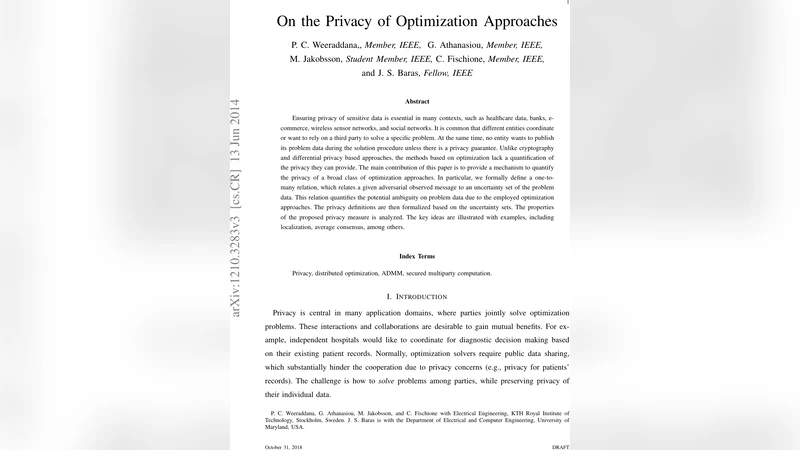
Ensuring privacy of sensitive data is essential in many contexts, such as healthcare data, banks, e-commerce, wireless sensor networks, and social networks. It is common that different entities coordinate or want to rely on a third party to solve a specific problem. At the same time, no entity wants to publish its problem data during the solution procedure unless there is a privacy guarantee. Unlike cryptography and differential privacy based approaches, the methods based on optimization lack a quantification of the privacy they can provide. The main contribution of this paper is to provide a mechanism to quantify the privacy of a broad class of optimization approaches. In particular, we formally define a one-to-many relation, which relates a given adversarial observed message to an uncertainty set of the problem data. This relation quantifies the potential ambiguity on problem data due to the employed optimization approaches. The privacy definitions are then formalized based on the uncertainty sets. The properties of the proposed privacy measure is analyzed. The key ideas are illustrated with examples, including localization, average consensus, among others.
💡 Research Summary
The paper addresses a gap in the privacy analysis of collaborative optimization procedures, which are increasingly used in domains such as healthcare, finance, e‑commerce, sensor networks, and social platforms. While cryptographic protocols and differential privacy offer strong guarantees, they are not directly applicable to the intrinsic structure of many optimization algorithms that exchange intermediate variables, gradients, or final solutions. To fill this void, the authors introduce a formal mechanism that quantifies privacy for a broad class of optimization approaches. The core construct is a one‑to‑many relation that maps an observed message—any data that an adversary can intercept during the algorithm’s execution—to an uncertainty set of all possible problem data consistent with that message. This relation captures the inherent ambiguity left for the adversary after observing the algorithm’s output. Privacy is then defined as a function of geometric or information‑theoretic properties of the uncertainty set, such as its volume, diameter, or entropy. The authors prove that the resulting privacy measure satisfies desirable mathematical properties: monotonicity (additional information can only shrink the uncertainty set), sub‑additivity (privacy of a composite system is bounded by the privacy of its components), and composability across multiple rounds or algorithms. To illustrate the framework, two canonical examples are examined. In a wireless sensor localization task, distance measurements sent to a central server are noisy; the uncertainty set becomes an annular region whose radius depends on measurement noise and solver tolerance, providing a concrete privacy bound. In a distributed average‑consensus protocol, each node shares only the current average; the adversary’s uncertainty about individual initial states remains high, and the uncertainty set forms a high‑dimensional polytope whose volume decays slowly with the number of iterations. Both cases demonstrate that the proposed metric yields intuitive, quantitative privacy assessments without requiring algorithmic redesign. The paper concludes by outlining future research directions, including integrating privacy directly into the optimization objective, designing algorithms that deliberately enlarge the uncertainty set, and extending empirical validation to real‑world applications such as smart grids and personalized medicine. Overall, the work offers a rigorous, adaptable framework for measuring and reasoning about privacy in optimization‑driven collaborative systems.
Comments & Academic Discussion
Loading comments...
Leave a Comment