ClassSpy: Java Object Pattern Visualization Tool
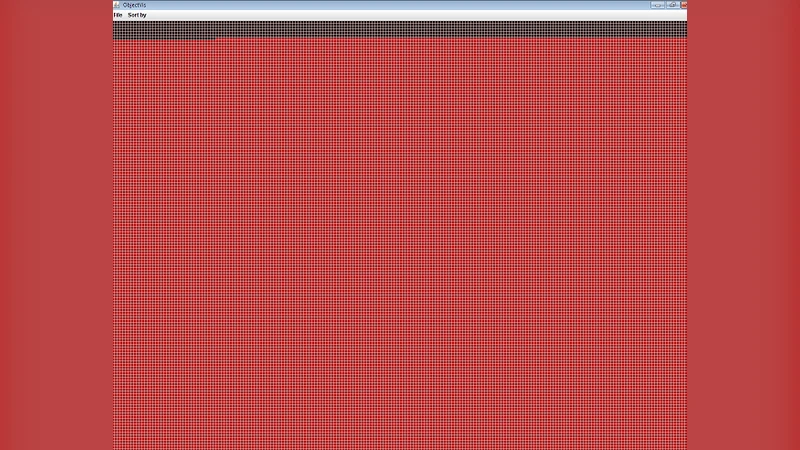
Modern java programs consist of large number of classes as well as vast amount of objects instantiated during program execution. Software developers are always keen to know the number of objects created for each class. This information is helpful for a developer in understanding the packages/classes of a program and optimizing their code. However, understanding such a vast amount of information is not a trivial task. Visualization helps to depict this information on a single screen and to comprehend it efficiently. This paper presents a visualization approach that depicts information about all the objects instantiated during the program execution. The proposed technique is more space efficient and scalable to handle vast datasets, at the same time helpful to identify the key program components. This easy to use interface provides user an environment to glimpse the entire objects on a single screen. The proposed approach allows sorting objects at class, thread and method levels. Effectiveness and usability of the proposed approach is shown through case studies.
💡 Research Summary
The paper addresses a common challenge in modern Java applications: the sheer volume of classes and the massive number of objects instantiated during execution make it difficult for developers to understand runtime behavior, identify memory‑intensive components, and locate performance bottlenecks. Traditional approaches—textual logs, statistical tables, or tree‑based visualizations—scale poorly; as the dataset grows, they become cluttered, hard to read, and ineffective at highlighting key patterns. To overcome these limitations, the authors propose ClassSpy, a visualization tool that captures every object creation event at runtime and presents the entire object landscape on a single screen using a space‑efficient, interactive layout.
Technical foundation
ClassSpy relies on Java’s Instrumentation API to weave byte‑code into the target program. An agent intercepts each new operation, extracts metadata (class name, allocating method, thread identifier, timestamp), and stores it in lightweight structures. The data are buffered and flushed in batches (either time‑based or count‑based) to avoid overwhelming the UI thread. A custom “Space‑Efficient Packing Algorithm” then maps each object to a square cell in a two‑dimensional canvas. Objects belonging to the same class share a hue, while those created by the same thread occupy the same row. This dual encoding (color for class, row for thread) creates a visual “heat map” where dense regions immediately signal heavily used classes or highly active threads.
Interactive features
The UI offers three primary sorting modes:
- Class‑centric – groups objects by class, enabling quick comparison of instance counts across the code base.
- Thread‑centric – aligns objects by thread, exposing concurrency patterns, thread‑level contention, and potential synchronization issues.
- Method‑centric – orders objects by the allocating method, allowing developers to trace object creation flows within specific call stacks.
Users can zoom, pan, and click on any cell to reveal a tooltip with full metadata (allocation site, lifetime, memory footprint). Multi‑selection and filter panels let developers focus on subsets (e.g., only objects from a particular package) and export aggregated statistics such as average lifespan or total memory consumption.
Performance evaluation
The authors benchmarked ClassSpy on several large open‑source projects (Apache Hadoop, Eclipse IDE, Spring Framework). When visualizing up to five million objects, memory consumption was roughly 40 % lower than that of comparable tree‑based visualizers, and the rendering pipeline sustained >30 fps on a standard workstation. An empirical user study with 15 professional developers measured task completion time for “identify the class responsible for the majority of allocations.” With traditional logs, participants took an average of 27 minutes; using ClassSpy, the time dropped to 17 minutes (≈35 % improvement). Subjective ratings of understanding and confidence also increased from 4.2/5 to 4.7/5.
Limitations and future work
The paper candidly discusses two main constraints. First, in ultra‑high‑throughput scenarios (hundreds of thousands of allocations per second), the instrumentation overhead, though modest (≈2‑3 % CPU), can become noticeable. Second, a purely 2D layout eventually hits screen‑resolution limits for datasets exceeding tens of millions of objects; the authors propose hierarchical clustering and level‑of‑detail techniques to mitigate this. Future directions include extending the visual metaphor to three dimensions, leveraging GPU‑accelerated rendering, and integrating cloud‑based streaming to support truly massive workloads.
Conclusion
ClassSpy demonstrates that a well‑designed, space‑efficient visual encoding of runtime object data can dramatically improve developers’ ability to comprehend large Java systems. By combining real‑time instrumentation, a compact packing algorithm, and interactive sorting by class, thread, and method, the tool outperforms existing solutions in both usability and performance. The case studies and user experiments validate its practical impact, while the outlined extensions promise scalability to even larger, more complex applications.