Relational Hidden Variables and Non-Locality
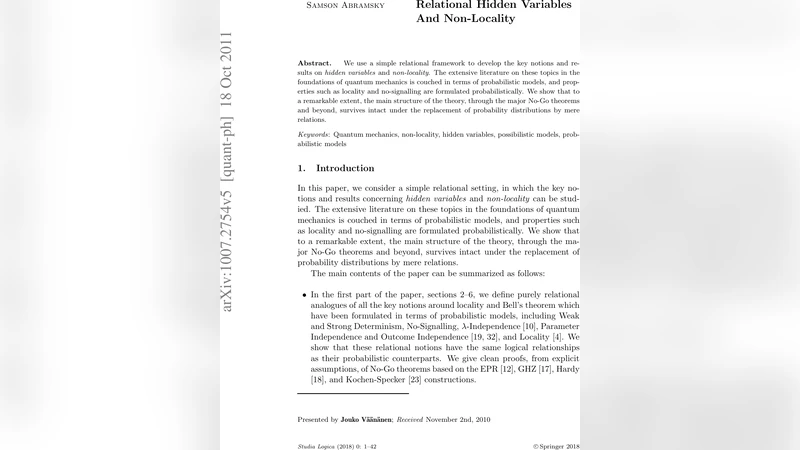
We use a simple relational framework to develop the key notions and results on hidden variables and non-locality. The extensive literature on these topics in the foundations of quantum mechanics is couched in terms of probabilistic models, and properties such as locality and no-signalling are formulated probabilistically. We show that to a remarkable extent, the main structure of the theory, through the major No-Go theorems and beyond, survives intact under the replacement of probability distributions by mere relations.
💡 Research Summary
The paper proposes a relational framework that replaces probability distributions with simple set‑theoretic relations in the study of hidden‑variable models and quantum non‑locality. Starting from the observation that most foundational results—Bell’s theorem, Kochen‑Specker, Fine’s theorem, and the no‑signalling condition—are traditionally expressed in probabilistic terms, the authors ask whether the essential structure of these results survives when the quantitative aspect of probability is stripped away.
To answer this, they define a hidden‑variable model as a relation R ⊆ Λ × A × B, where Λ is the set of hidden variables and A, B are the outcome sets for two distant parties. Instead of a distribution p(λ), the model only records which triples (λ, a, b) are possible. Locality is captured by requiring R to factor as a Cartesian product of two relations R_A ⊆ Λ × A and R_B ⊆ Λ × B, i.e. (λ, a, b) ∈ R iff (λ, a) ∈ R_A and (λ, b) ∈ R_B. No‑signalling becomes the purely relational statement that the marginal relation on one side does not depend on the choice of measurement on the other side.
Within this setting the authors re‑derive the main no‑go theorems. They show that any relational model satisfying the factorisation condition cannot realize the CHSH‑type correlation, reproducing Bell’s inequality without probabilities. The Kochen‑Specker theorem is reformulated as the impossibility of a non‑contextual colouring of a relational hypergraph, and Fine’s theorem is proved by demonstrating the equivalence between the existence of a joint probability distribution and the existence of a joint relation that marginalises to the observed pairwise relations.
Concrete examples illustrate the power of the approach. The PR‑box, which exhibits maximal non‑local correlations while respecting no‑signalling, is represented by a relation that violates the factorisation condition but satisfies the marginal independence condition. Similarly, standard quantum entangled states are modelled by relations that are non‑factorisable yet no‑signalling. These examples confirm that the relational framework captures exactly the same class of non‑local behaviours as the probabilistic one.
The paper concludes that the logical core of quantum non‑locality does not depend on probabilistic numerics; it is already present in the combinatorial structure of possible outcome assignments. This insight opens new avenues for cross‑disciplinary research, linking quantum foundations with relational database theory, categorical logic, and computational complexity of non‑local games. The authors suggest that future work could explore relational complexity measures, automated verification of non‑local protocols, and the discovery of novel non‑classical correlation structures beyond the probabilistic paradigm.
Comments & Academic Discussion
Loading comments...
Leave a Comment