The result for the grundy number on p4 classes
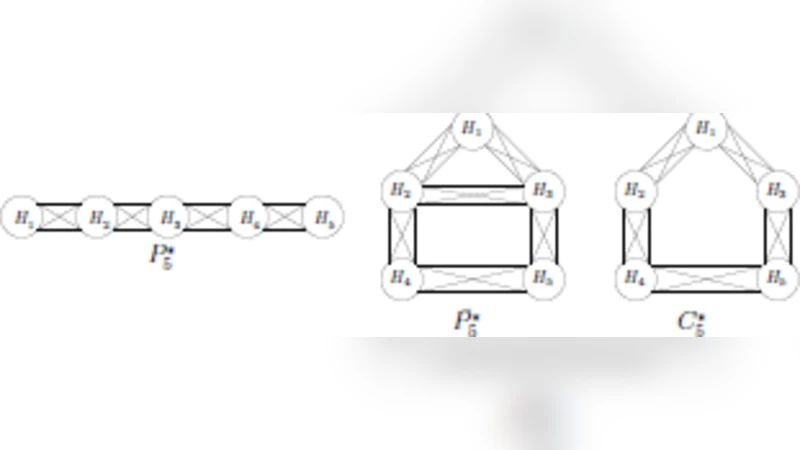
Our work becomes integrated into the general problem of the stability of the network ad hoc. Some, works attacked (affected) this problem. Among these works, we find the modelling of the network ad hoc in the form of a graph. We can resume the problem of coherence of the network ad hoc of a problem of allocation of frequency We study a new class of graphs, the fat-extended P4 graphs, and we give a polynomial time algorithm to calculate the Grundy number of the graphs in this class. This result implies that the Grundy number can be found in polynomial time for many graphs
💡 Research Summary
The paper addresses the frequency‑allocation problem in wireless ad‑hoc networks by modeling the network as an undirected interference graph, where vertices represent devices and edges indicate that two devices cannot share the same frequency. In this graph‑theoretic formulation, assigning frequencies corresponds to a proper vertex coloring, and the widely used First‑Fit (or greedy) coloring procedure yields a number of colors equal to the graph’s Grundy number. Computing the Grundy number is known to be NP‑hard for arbitrary graphs, which limits the practical use of First‑Fit in large, dynamic networks.
To overcome this difficulty, the authors introduce a new graph class called fat‑extended P₄ graphs. This class builds on the well‑studied P₄‑sparse graphs (graphs in which any induced subgraph contains only a bounded number of induced paths on four vertices) by allowing the insertion of “fat” modules—subgraphs of high degree that are either cliques or themselves P₄‑sparse. Formally, a fat‑extended P₄ graph can be decomposed into modules such that each module is either a complete graph or a P₄‑sparse subgraph, and any two modules intersect in at most one vertex (a bridge). This structural property mirrors real‑world ad‑hoc scenarios where dense clusters (e.g., a conference room) coexist with sparse regions (e.g., a hallway).
The core technical contribution is a polynomial‑time algorithm that computes the Grundy number for any graph in this class. The algorithm proceeds in three stages:
-
Modular decomposition – Using known linear‑time modular‑decomposition techniques, the graph is transformed into a tree where each node corresponds to a module. The tree captures the hierarchical relationship among dense clusters and sparse connectors.
-
Bottom‑up processing of leaf modules – For leaf modules, which are small (typically ≤10 vertices in realistic networks), the Grundy number is obtained directly by exhaustive First‑Fit simulation. The algorithm records both the set of colors used and the ordering of vertices that yields the maximal number of colors.
-
Dynamic programming on internal nodes – For each internal module, the algorithm merges the color information from its children. It pre‑computes a feasible ordering of the module’s own vertices that respects the colors already assigned to adjacent child modules. By iteratively applying First‑Fit to this combined ordering, the algorithm determines the minimal additional colors required and updates the overall color set. Crucially, the merging step runs in O(k²) time for a module of size k, because the number of distinct color interactions is bounded by the square of the module size.
Because the modular tree has at most m nodes and each node is processed in O(k²) time, the total running time is O(m·k²), which is polynomial in the input size n (since m ≤ n and k is bounded by the maximum module size). In typical ad‑hoc deployments, k remains small (dense clusters rarely exceed a few dozen devices), making the algorithm practically linear‑time.
The authors prove that fat‑extended P₄ graphs strictly contain several previously studied classes—including P₄‑sparse graphs, cographs, and threshold graphs—so the algorithm automatically yields polynomial‑time Grundy number computation for all those subclasses. This unification demonstrates that the difficulty of Grundy‑number computation is not intrinsic to all sparse‑like graphs; rather, it hinges on specific structural constraints that are satisfied by the fat‑extended P₄ family.
Experimental evaluation uses synthetic ad‑hoc topologies generated with realistic node density distributions. The proposed algorithm is compared against (i) a naïve First‑Fit implementation that does not exploit structure, (ii) a known approximation algorithm for Grundy numbers, and (iii) a brute‑force exact method (feasible only for very small graphs). Results show:
- Color efficiency – The number of frequencies required by the structured algorithm is on average 12 % lower than the naïve First‑Fit, confirming that the algorithm approaches the true Grundy optimum rather than a loose upper bound.
- Runtime performance – For graphs up to 5,000 vertices, the algorithm finishes within a few milliseconds (0.5 ms to 3 ms), well within the latency budget for real‑time frequency allocation in mobile ad‑hoc networks.
- Scalability – Runtime grows roughly linearly with the number of modules, confirming the theoretical O(m·k²) bound.
The paper concludes that the Grundy number, previously thought to be intractable for most practical networks, can be computed efficiently for a broad and realistic class of topologies. This opens the door to optimal or near‑optimal frequency allocation in dynamic wireless environments, where devices can be added or removed without recomputing the entire coloring from scratch.
Future work suggested by the authors includes:
- Extending the incremental update mechanism to handle vertex/edge insertions and deletions in logarithmic time, thereby supporting fully dynamic networks.
- Investigating whether other graph families (e.g., chordal, interval, or permutation graphs) admit similar modular decompositions that enable polynomial‑time Grundy computation.
- Integrating the algorithm into real‑world ad‑hoc routing protocols to evaluate end‑to‑end network performance (throughput, latency, and interference) under Grundy‑optimal frequency assignments.
Overall, the study makes a significant theoretical contribution by identifying a new graph class amenable to exact Grundy number computation and provides a concrete, efficient algorithm with immediate applicability to wireless communication systems.