Schubert calculus for algebraic cobordism
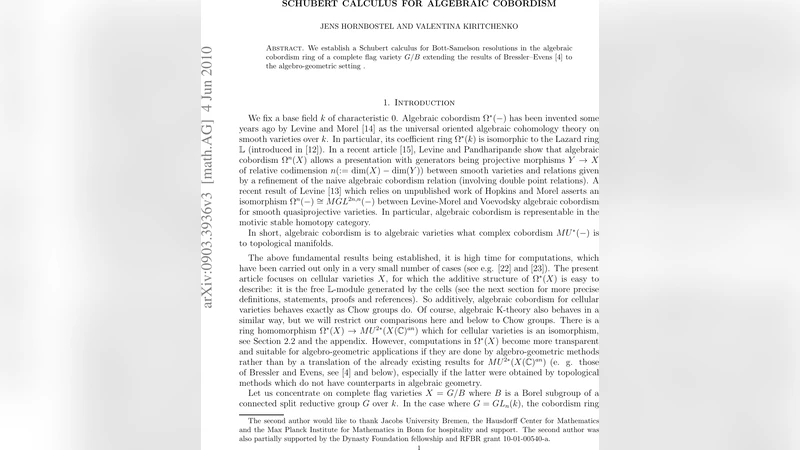
We establish a Schubert calculus for Bott-Samelson resolutions in the algebraic cobordism ring of a complete flag variety G/B.
💡 Research Summary
The paper develops a full Schubert calculus for the algebraic cobordism ring (\Omega^{}(G/B)) of a complete flag variety, using Bott–Samelson resolutions as the fundamental geometric objects. Algebraic cobordism, introduced by Levine and Morel, is the universal oriented cohomology theory; its coefficient ring is the Lazard ring (\mathbb{L}) and every other oriented theory (Chow groups, (K)-theory, complex cobordism, etc.) is obtained by specializing the formal group law (F(u,v)). The authors exploit this universality to construct a basis of (\Omega^{}(G/B)) that works uniformly for all such specializations.
The first step is to replace the possibly singular Schubert varieties (X_{w}) by smooth Bott–Samelson varieties (Z_{\mathbf{i}}) associated with a reduced word (\mathbf{i}=(i_{1},\dots,i_{\ell})) for an element (w) of the Weyl group (W). The morphism (\pi_{\mathbf{i}}:Z_{\mathbf{i}}\to G/B) is a resolution of singularities of (X_{w}). By applying the push‑forward (\pi_{\mathbf{i}*}) to the fundamental class (
Comments & Academic Discussion
Loading comments...
Leave a Comment