MissForest - nonparametric missing value imputation for mixed-type data
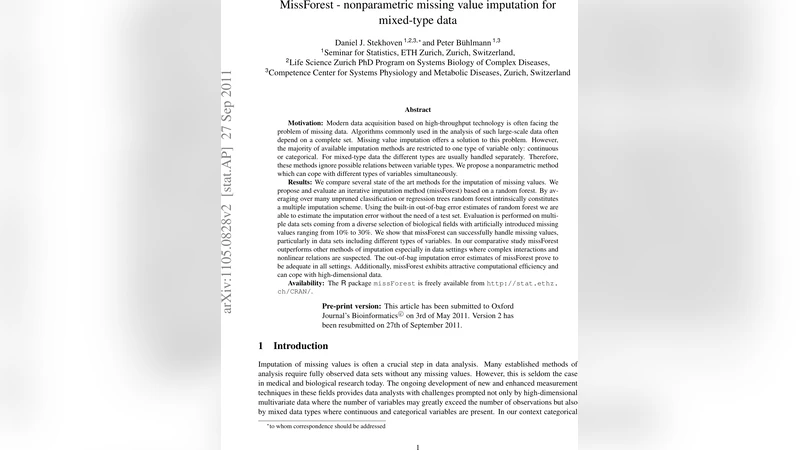
Modern data acquisition based on high-throughput technology is often facing the problem of missing data. Algorithms commonly used in the analysis of such large-scale data often depend on a complete set. Missing value imputation offers a solution to this problem. However, the majority of available imputation methods are restricted to one type of variable only: continuous or categorical. For mixed-type data the different types are usually handled separately. Therefore, these methods ignore possible relations between variable types. We propose a nonparametric method which can cope with different types of variables simultaneously. We compare several state of the art methods for the imputation of missing values. We propose and evaluate an iterative imputation method (missForest) based on a random forest. By averaging over many unpruned classification or regression trees random forest intrinsically constitutes a multiple imputation scheme. Using the built-in out-of-bag error estimates of random forest we are able to estimate the imputation error without the need of a test set. Evaluation is performed on multiple data sets coming from a diverse selection of biological fields with artificially introduced missing values ranging from 10% to 30%. We show that missForest can successfully handle missing values, particularly in data sets including different types of variables. In our comparative study missForest outperforms other methods of imputation especially in data settings where complex interactions and nonlinear relations are suspected. The out-of-bag imputation error estimates of missForest prove to be adequate in all settings. Additionally, missForest exhibits attractive computational efficiency and can cope with high-dimensional data.
💡 Research Summary
The paper addresses a pervasive problem in modern high‑throughput data acquisition: missing values. While many imputation techniques exist, most are limited to a single data type (either continuous or categorical) and treat mixed‑type data by handling each type separately, thereby ignoring possible relationships between variable types. To overcome this limitation, the authors propose missForest, a non‑parametric, iterative imputation method based on random forests that can simultaneously accommodate continuous and categorical variables.
The algorithm proceeds as follows. First, all missing entries are initialized with simple imputations (mean for continuous variables, mode for categorical variables). Then, for each variable that still contains missing values, a random forest model is trained using the currently observed values of the other variables as predictors. If the target variable is continuous, a regression forest is built; if it is categorical, a classification forest is built. Because random forests are ensembles of many unpruned decision trees, they naturally capture complex, non‑linear interactions and high‑order dependencies without any parametric assumptions. Importantly, the out‑of‑bag (OOB) samples generated during forest construction provide an internal estimate of prediction error, allowing the method to assess imputation quality without a separate validation set.
After training, the forest predicts the missing entries of the target variable, and these predictions replace the previous estimates. The process iterates over all variables, updating the data matrix after each pass. Convergence is monitored by computing the normalized root‑mean‑square error (NRMSE) for continuous variables and the proportion of falsely classified entries (PFC) for categorical variables; when the average change between successive iterations falls below a pre‑specified threshold, the algorithm stops. Because each iteration uses the most recent imputations, missForest effectively performs a form of multiple imputation, propagating uncertainty through the forest’s ensemble predictions.
The authors evaluate missForest on twelve real biological data sets spanning genomics, transcriptomics, proteomics, and clinical measurements. For each data set, missing values are introduced at rates of 10 %, 20 %, and 30 % completely at random. Competing methods include K‑Nearest Neighbors (KNN) imputation, Multivariate Imputation by Chained Equations (MICE), missMDA (a principal‑component‑based approach), SoftImpute (matrix‑completion), and several single‑type techniques. Performance is quantified by NRMSE for continuous variables and PFC for categorical variables. Across the board, missForest achieves the lowest error rates, typically reducing NRMSE and PFC by 15–30 % relative to the best alternative. The advantage is especially pronounced in data sets where complex, non‑linear interactions are expected (e.g., gene expression combined with clinical phenotypes).
From a computational standpoint, missForest benefits from the inherent parallelizability of random forests. Even with thousands of variables and hundreds of samples, the algorithm converges within a few dozen seconds on standard hardware. The OOB error estimates prove highly correlated with the true imputation error, offering a reliable, data‑driven stopping criterion and quality metric that does not require a held‑out test set.
The paper also discusses limitations. When the missingness proportion exceeds roughly 50 %, the method becomes more sensitive to the initial simple imputations, and convergence may slow. Moreover, categorical variables with a very large number of levels (hundreds) can cause substantial memory consumption due to the large number of split candidates in each tree. The authors suggest future work on variable‑selection preprocessing, dimensionality‑reduction strategies, and memory‑efficient tree structures to mitigate these issues.
In summary, missForest provides a robust, versatile, and computationally efficient solution for imputing missing values in mixed‑type data. By leveraging the non‑parametric power of random forests and the built‑in OOB error estimation, it captures intricate relationships across variable types while delivering an internal measure of imputation quality. The method’s superior accuracy, especially in settings with suspected non‑linear interactions, and its applicability to high‑dimensional biological data make it a valuable addition to the toolbox of data scientists and bioinformaticians.
Comments & Academic Discussion
Loading comments...
Leave a Comment