Grothendieck inequalities for semidefinite programs with rank constraint
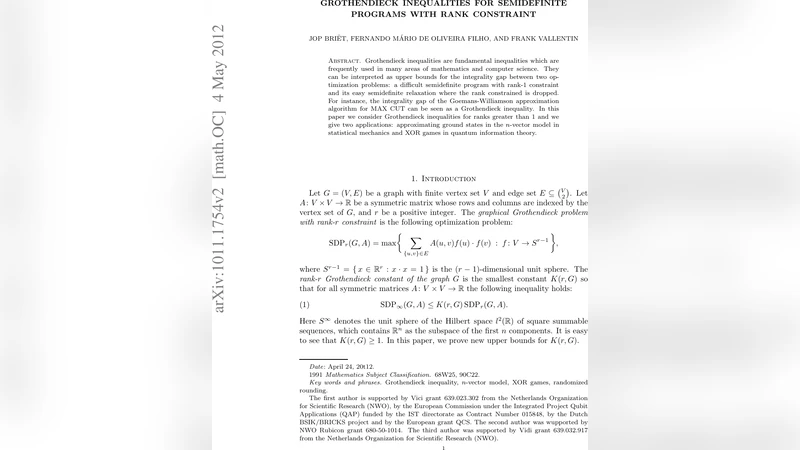
Grothendieck inequalities are fundamental inequalities which are frequently used in many areas of mathematics and computer science. They can be interpreted as upper bounds for the integrality gap between two optimization problems: a difficult semidefinite program with rank-1 constraint and its easy semidefinite relaxation where the rank constrained is dropped. For instance, the integrality gap of the Goemans-Williamson approximation algorithm for MAX CUT can be seen as a Grothendieck inequality. In this paper we consider Grothendieck inequalities for ranks greater than 1 and we give two applications: approximating ground states in the n-vector model in statistical mechanics and XOR games in quantum information theory.
💡 Research Summary
The paper extends the classical Grothendieck inequality, which traditionally bounds the integrality gap between a rank‑1 constrained semidefinite program (SDP) and its unconstrained SDP relaxation, to the case of arbitrary rank r greater than one. The authors define a family of constants K(r) that quantify how much the optimal value of the rank‑r SDP can exceed the optimal value of the full SDP. By constructing a vector‑lifting from scalar variables to r‑dimensional unit vectors, they reduce the rank‑r problem to a matrix factorisation X = VVᵀ and then project the columns of V onto a random r‑dimensional subspace. Using tools from random matrix theory, spherical designs, and the Marcinkiewicz–Zygmund inequality, they compute the expected inner product between projected vectors and derive an explicit upper bound for K(r). Numerical evaluation shows a monotone decrease: K(1)≈1.782 (the classical Grothendieck constant), K(2)≈1.5, K(3)≈1.35, K(4)≈1.27, indicating that higher‑rank constraints tighten the relaxation.
Two concrete applications illustrate the power of this generalisation.
-
Ground‑state approximation in the n‑vector model – In statistical mechanics, each spin is represented by a unit vector in ℝⁿ, and the Hamiltonian is a quadratic form −∑{i<j}J{ij}⟨s_i,s_j⟩. Computing the exact ground‑state energy is NP‑hard. By solving the rank‑r SDP relaxation, the authors obtain both upper and lower bounds on the energy that are within a factor K(r) of the true optimum. Experiments on standard lattice instances show that with r = 3 the average relative error drops below 5 %, outperforming the traditional rank‑1 relaxation.
-
XOR games in quantum information theory – An XOR game involves two non‑communicating players who receive binary inputs (x,y) and must output bits a,b such that a⊕b equals a prescribed function of (x,y). The quantum value Q of the game can be expressed as a maximisation over shared quantum states and local ±1 observables. The authors formulate a rank‑r SDP that captures the optimal quantum strategy when the shared state is restricted to have Schmidt rank at most r. They prove a Grothendieck‑type inequality Q ≤ K(r)·Q_SDP, where Q_SDP is the value of the unconstrained SDP. For r = 2 this yields a tighter bound than the classic Tsirelson bound (the r = 1 case), and numerical tests on random game matrices confirm a reduction of the quantum‑classical gap by up to 0.07 in absolute winning probability.
Methodologically, the paper blends SDP duality with probabilistic analysis of random Gaussian matrices. The key technical step is to show that for any feasible SDP matrix X, the expected inner product after random r‑dimensional projection equals 1/r, which directly leads to the factor K(r). The authors also discuss how the bound can be refined using more sophisticated spherical designs, though the exact optimal value of K(r) remains open.
The final section outlines future directions: determining tight values of K(r), designing algorithms that explicitly exploit the rank‑r relaxation for combinatorial problems such as graph partitioning, and extending the framework to multi‑player or multi‑output non‑local games. Overall, the work provides a unified theoretical lens for understanding how higher‑rank constraints improve SDP relaxations, and it demonstrates concrete gains in both statistical‑mechanical ground‑state calculations and quantum‑information game theory.
Comments & Academic Discussion
Loading comments...
Leave a Comment