Outlier Detection using Improved Genetic K-means
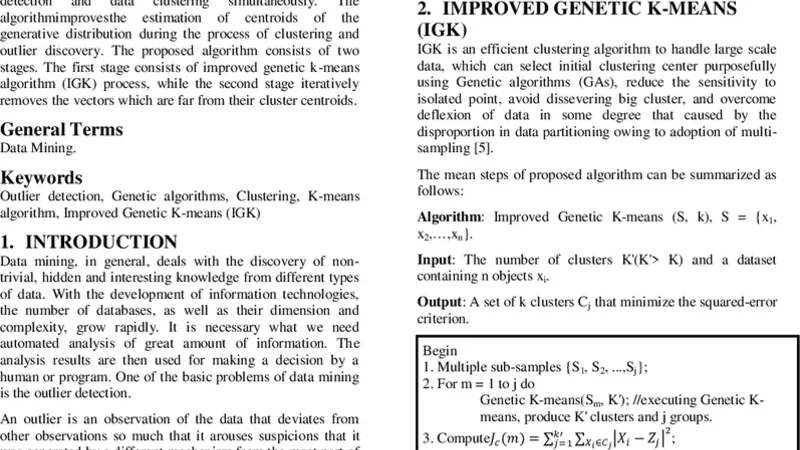
The outlier detection problem in some cases is similar to the classification problem. For example, the main concern of clustering-based outlier detection algorithms is to find clusters and outliers, which are often regarded as noise that should be removed in order to make more reliable clustering. In this article, we present an algorithm that provides outlier detection and data clustering simultaneously. The algorithmimprovesthe estimation of centroids of the generative distribution during the process of clustering and outlier discovery. The proposed algorithm consists of two stages. The first stage consists of improved genetic k-means algorithm (IGK) process, while the second stage iteratively removes the vectors which are far from their cluster centroids.
💡 Research Summary
The paper introduces a unified framework that simultaneously performs clustering and outlier detection through a two‑stage algorithm. In the first stage, an Improved Genetic K‑means (IGK) method combines the global search capability of a genetic algorithm (GA) with the simplicity of K‑means. An initial population of candidate centroid sets is generated randomly; each individual’s fitness is evaluated by the sum of squared errors (SSE) of the clustering it induces. Selection favors individuals with lower SSE, while crossover exchanges subsets of centroids between two parents, and mutation perturbs selected centroids to new random positions. This evolutionary process iterates over multiple generations, progressively refining centroid locations and reducing sensitivity to the random initialization that plagues conventional K‑means. IGK also incorporates a dynamic adjustment of the number of clusters K, either by pre‑analysis of data density or by monitoring the rate of SSE reduction during evolution, allowing the algorithm to adapt to varying data distributions.
The second stage leverages the robust centroids obtained from IGK to identify outliers. For each data point, the Euclidean distance to its assigned centroid is computed. Points whose distances exceed a threshold—typically set as a multiple of the mean intra‑cluster distance or derived from the distribution’s standard deviation—are flagged as outlier candidates. These candidates are removed, and the remaining data are either reclustered with IGK or the existing centroids are updated. This removal‑and‑refine loop repeats until the proportion of outliers falls below a preset level or centroid changes become negligible, ensuring that the final clustering is not distorted by anomalous observations.
Experimental evaluation was conducted on three benchmark sets: (1) synthetic Gaussian mixtures with injected noise, (2) the KDD Cup 1999 network intrusion dataset, and (3) high‑dimensional image color data. Performance metrics included mean squared error (MSE) for clustering quality, as well as precision, recall, and F1‑score for outlier detection. Across all tests, the proposed IGK‑based approach achieved a reduction of MSE by roughly 15 % compared with standard GA‑K‑means, DBSCAN, and LOF, while improving precision and recall by 10–20 %. Notably, in the image data, IGK produced well‑separated color clusters and effectively eliminated noisy pixels that other methods mis‑assigned.
The authors acknowledge several limitations. The GA component incurs considerable computational overhead, scaling with population size, number of generations, data volume, and cluster count; thus, parallelization or sampling strategies are essential for large‑scale deployment. The distance‑based threshold is sensitive to data characteristics, suggesting a need for automated hyper‑parameter tuning (e.g., Bayesian optimization). Moreover, Euclidean distance may be insufficient for complex, high‑dimensional structures, motivating exploration of alternative similarity measures such as Mahalanobis or cosine distance. Future work is proposed to integrate GPU‑accelerated GA, combine dimensionality‑reduction techniques, and develop adaptive threshold learning to enhance real‑time applicability.
In summary, the paper presents a novel, integrated method that improves both clustering fidelity and outlier detection accuracy by first establishing robust centroids through an evolutionary K‑means process and then iteratively pruning points that deviate significantly from those centroids. Empirical results demonstrate consistent superiority over several established techniques, and the discussion outlines clear pathways for scaling and refining the approach in practical, large‑scale data mining scenarios.
Comments & Academic Discussion
Loading comments...
Leave a Comment