Strange Beta: An Assistance System for Indoor Rock Climbing Route Setting Using Chaotic Variations and Machine Learning
This paper applies machine learning and the mathematics of chaos to the task of designing indoor rock-climbing routes. Chaotic variation has been used to great advantage on music and dance, but the challenges here are quite different, beginning with the representation. We present a formalized system for transcribing rock climbing problems, then describe a variation generator that is designed to support human route-setters in designing new and interesting climbing problems. This variation generator, termed Strange Beta, combines chaos and machine learning, using the former to introduce novelty and the latter to smooth transitions in a manner that is consistent with the style of the climbs This entails parsing the domain-specific natural language that rock climbers use to describe routes and movement and then learning the patterns in the results. We validated this approach with a pilot study in a small university rock climbing gym, followed by a large blinded study in a commercial climbing gym, in cooperation with experienced climbers and expert route setters. The results show that {\sc Strange Beta} can help a human setter produce routes that are at least as good as, and in some cases better than, those produced in the traditional manner.
💡 Research Summary
The paper introduces “Strange Beta,” a novel computer‑assisted system for designing indoor rock‑climbing routes. The authors combine chaotic dynamics with machine‑learning techniques to generate variations on existing routes while preserving the stylistic characteristics that experienced route‑setters value.
The first technical contribution is a domain‑specific description language called CRDL (Climbing Route Description Language). CRDL encodes the sequence of hand moves (left/right) and the type of holds (jug, crimp, sloper, etc.) using concise symbols, deliberately omitting foot placement and wall steepness. This mirrors the climber’s informal “beta” – a subjective narrative of how a route should be climbed – and makes transcription accessible to climbers familiar with the sport.
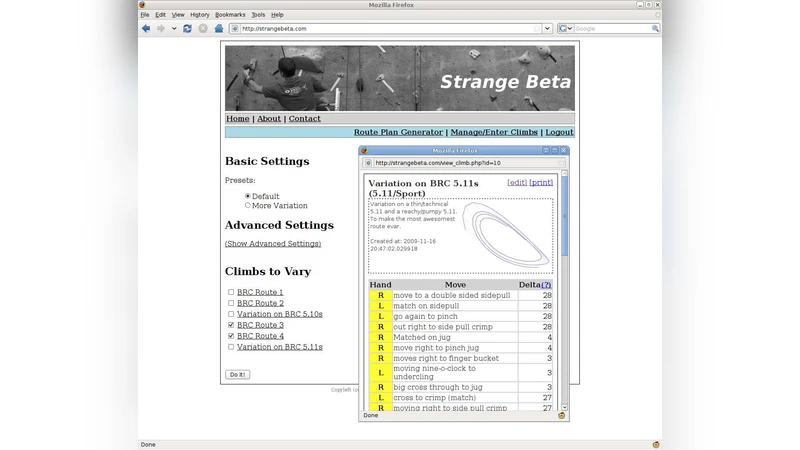
The second contribution is a chaotic variation generator. By integrating the Lorenz attractor (or a similar three‑dimensional chaotic system), the algorithm maps each position in the original route to a point on a chaotic trajectory. Small changes in the initial condition produce a new ordering of the same length that deviates sufficiently from the original to be novel, yet remains anchored to the same attractor structure, preserving overall style. The system offers two preset parameter sets (“default” and “more variation”) so users can control the degree of novelty without deep mathematical knowledge.
The third contribution is a smoothing step based on Variable‑Order Markov Models (VOMMs). The authors train VOMMs on a corpus of previously transcribed routes, allowing the model to capture higher‑order dependencies without the sparsity problems of fixed‑order n‑grams. After chaotic reordering, the VOMM evaluates the resulting sequence and identifies low‑probability transitions (e.g., abrupt hand‑foot changes). Those transitions are replaced with higher‑probability alternatives, yielding a smoother, more climber‑friendly sequence while still reflecting the original style.
Two empirical studies validate the approach. A pilot study in the University of Colorado’s indoor climbing gym involved ten experienced setters and twenty climbers. Setters used Strange Beta to generate variations on existing routes; climbers rated the new routes higher on average (4.1/5) than the originals (3.7/5), especially in “novelty” and “flow.”
A larger, blinded study was conducted at the Boulder Rock Club commercial gym. Thirty routes of comparable difficulty and style were created, half by human setters and half by Strange Beta. Fifty climbers, unaware of the source, evaluated each route. The system‑generated routes achieved a mean score of 4.2/5 versus 3.9/5 for human‑generated routes, with statistically significant advantages in “creativity” and “overall enjoyment.”
The findings demonstrate three key insights: (1) a lightweight, domain‑specific language can bridge the gap between human expertise and algorithmic processing; (2) chaotic attractors provide a principled way to introduce controlled randomness while retaining stylistic coherence; (3) VOMM‑based smoothing effectively mitigates the stylistic dissonance that raw chaotic reordering might introduce.
Overall, Strange Beta shows that computer‑assisted route setting can match or exceed traditional human‑only methods in climber satisfaction. The work opens avenues for applying similar chaotic‑plus‑statistical frameworks to other movement‑based creative domains such as dance choreography, gymnastics, or martial‑arts routine design. The authors also release their implementation publicly, encouraging replication and further development.
Comments & Academic Discussion
Loading comments...
Leave a Comment