On the relation between Nori Motives and Kontsevich Periods
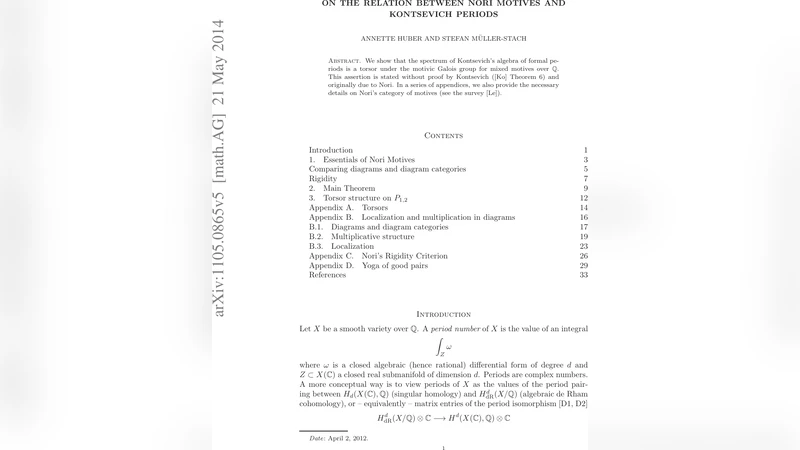
We show that the spectrum of Kontsevich’s algebra of formal periods is a torsor under the motivic Galois group for mixed motives over the rational numbers. This assertion is stated without proof by Kontsevich and originally due to Nori. In a series of appendices, we also provide the necessary details on Nori’s category of motives.
💡 Research Summary
The paper establishes that the spectrum of Kontsevich’s algebra of formal periods, denoted P, carries a natural torsor structure under the motivic Galois group of Nori’s category of mixed motives over ℚ. This statement, originally announced by Kontsevich without proof and attributed to Nori, is proved in full detail.
The authors begin by recalling Nori’s construction of an abelian tensor category of mixed motives. They introduce the diagram D_eff of “effective good pairs” (X,Y,i) where X is a ℚ‑variety, Y⊂X a closed subvariety, and i an integer. Morphisms are given by pull‑back along maps of varieties and by boundary maps for triples X⊃Y⊃Z. A sub‑diagram ˜D_eff of “very good pairs” imposes additional geometric conditions (affineness, normal‑crossing divisors) that guarantee cellular‑type cohomology. The universal abelian category C(D,T) attached to a representation T:D→ℚ‑Mod is shown to be equivalent to the category of finite‑dimensional comodules over a coalgebra A(T). For the representation H* assigning singular cohomology H_i(X(ℂ),Y(ℂ);ℚ) the resulting category C(D_eff,H*) is precisely Nori’s effective motive category MM_eff Nori; localising with respect to the Lefschetz object 1(−1)=H₁(G_m,{1}) yields the full mixed motive category MM_Nori. The authors verify that D_eff carries a commutative graded product (X,Y,i)×(X′,Y′,i′)=(X×X′,X×Y′∪Y×X′,i+i′) and that H* is a graded tensor functor, so MM_Nori becomes a neutral Tannakian category with fibre functor H*.
Next, Kontsevich’s algebra of formal periods P⁺ is defined as the ℚ‑vector space generated by symbols (X,D,ω,γ) subject to linearity, functoriality, and boundary relations; multiplication is given by exterior product of forms and Cartesian product of chains. Localising P⁺ at the basic period (G_m,{1},dX/X,S¹) produces the algebra P. The authors construct a canonical isomorphism between P and the torsor of tensor isomorphisms between the de Rham and singular fibre functors on MM_Nori: \
Comments & Academic Discussion
Loading comments...
Leave a Comment