Weak bimonads and weak Hopf monads
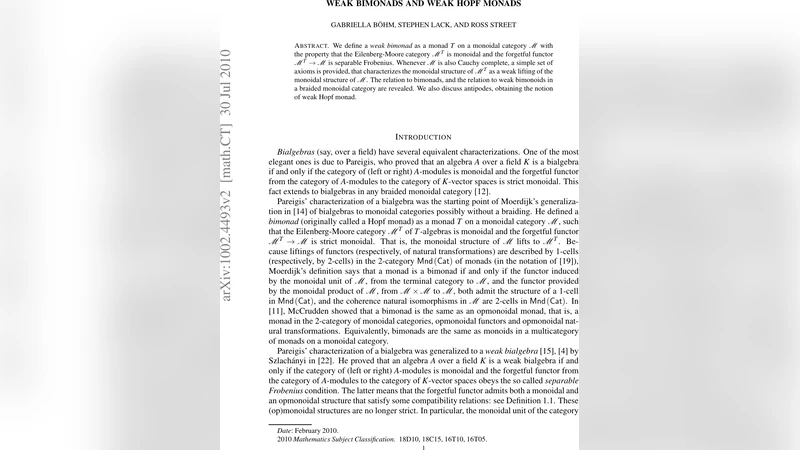
We define a weak bimonad as a monad T on a monoidal category M with the property that the Eilenberg-Moore category M^T is monoidal and the forgetful functor from M^T to M is separable Frobenius. Whenever M is also Cauchy complete, a simple set of axioms is provided, that characterizes the monoidal structure of M^T as a weak lifting of the monoidal structure of M . The relation to bimonads, and the relation to weak bimonoids in a braided monoidal category are revealed. We also discuss antipodes, obtaining the notion of weak Hopf monad.
💡 Research Summary
The paper introduces the notion of a weak bimonad on a monoidal category M and develops a comprehensive theory that parallels, yet substantially generalises, the classical theory of bimonads and Hopf monads.
A bimonad is a monad T on M that is simultaneously a comonad, with the monad and comonad structures satisfying strict compatibility conditions. Under these hypotheses the Eilenberg–Moore category M^T automatically inherits a monoidal structure and the forgetful functor U: M^T → M is a strong (i.e. strict) monoidal functor. In many concrete situations—most notably in the theory of weak quantum groups, weak Hopf algebras, and various non‑symmetric tensor categories—these strong compatibility requirements are too restrictive. The comultiplication often fails to be a genuine comonoid morphism, and the forgetful functor does not preserve the tensor product strictly.
To overcome this limitation the authors propose weak bimonads. A weak bimonad T is a monad equipped with a weak comonad structure (counit (\hat\eta) and comultiplication (\hat\Delta)) such that the following three conditions hold:
-
Weak lifting of the monoidal structure – The category M^T of T‑algebras carries a tensor product (\widehat\otimes) and a unit (\widehat I) defined by a weak lifting of the tensor of M. Concretely, for T‑algebras ((A,a)) and ((B,b)) the product is ((A\otimes B,; a\otimes b\circ \hat\Delta_{A,B})).
-
Separably Frobenius forgetful functor – The forgetful functor (U: M^T\to M) is not strong monoidal, but it is a separable Frobenius functor: there exist natural transformations (U\to U\otimes U) and (U\otimes U\to U) that make (U) both a left and a right adjoint to itself, and the associated unit–counit pair splits. This condition replaces the usual requirement that (U) be strict monoidal.
-
Compatibility axioms – The monad multiplication (\mu) and unit (\eta) interact with the weak comonad structure via a small set of axioms (five when M is Cauchy complete). These axioms guarantee that the lifted tensor product on M^T is associative and unital up to the canonical isomorphisms induced by the Frobenius splitting.
When M is Cauchy complete, the authors show that the whole structure can be captured by five elementary equations (unit‑multiplication compatibility, counit‑comultiplication compatibility, Frobenius separability, a mixed distributive law, and the weak lifting condition). This makes the definition practically verifiable in concrete categories.
The paper then analyses the relationship between weak bimonads and weak bimonoids in a braided monoidal category C. If B is a weak bimonoid (i.e. an object equipped with compatible weak monoid and weak comonoid structures satisfying a separable Frobenius condition), the functor (T_B = B\otimes -) becomes a weak bimonad on C. Conversely, given a weak bimonad that is “representable” (for instance, when the underlying functor is of the form (X\mapsto A\otimes X) for some object A), one can reconstruct a weak bimonoid A. Thus the classical correspondence between bimonads and bimonoids extends to the weak setting.
Having established the weak bimonad framework, the authors turn to weak Hopf monads. They introduce an antipode—a natural transformation (S: T\Rightarrow T)—subject to two weakened antipode equations that involve the weak comultiplication and the separable Frobenius structure. These equations are analogues of the usual Hopf algebra antipode identities but are relaxed so that S need not be a strict inverse; instead it behaves as a weak inverse up to the Frobenius splitting. When such an antipode exists, the Eilenberg–Moore category M^T becomes a strong monoidal category, and the weak bimonad upgrades to a weak Hopf monad. In this situation the category of T‑algebras inherits both monoidal and comonoidal structures that satisfy the usual Hopf compatibility, thereby recovering the classical Hopf monad theory as a special case.
The authors illustrate the theory with several examples:
-
Weak quantum groups – Classical weak Hopf algebras give rise to weak bimonoids in the category of vector spaces; the associated tensor‑by‑B functor is a weak bimonad, and the known antipode of the weak Hopf algebra supplies the antipode for the weak Hopf monad.
-
Cauchy‑complete tensor categories – In any Cauchy‑complete monoidal category where idempotents split, the separable Frobenius condition can be realised by splitting an idempotent that encodes the failure of strict compatibility.
-
Applications to physics – The authors hint at potential uses in topological quantum field theory and categorical quantum mechanics, where non‑strict tensorial behaviour is natural.
In summary, the paper provides a systematic categorical framework for handling monads whose comonoidal part is only weakly compatible with the monoidal structure. By replacing the strong monoidal requirement on the forgetful functor with a separable Frobenius condition, the authors obtain a flexible yet mathematically robust notion of weak bimonad. The subsequent development of weak Hopf monads, together with the explicit connection to weak bimonoids, extends the reach of Hopf‑type structures to a broad class of examples that were previously inaccessible to the classical theory. This work is likely to become a reference point for future research in quantum algebra, higher category theory, and categorical approaches to quantum physics.
Comments & Academic Discussion
Loading comments...
Leave a Comment