On paths-based criteria for polynomial time complexity in proof-nets
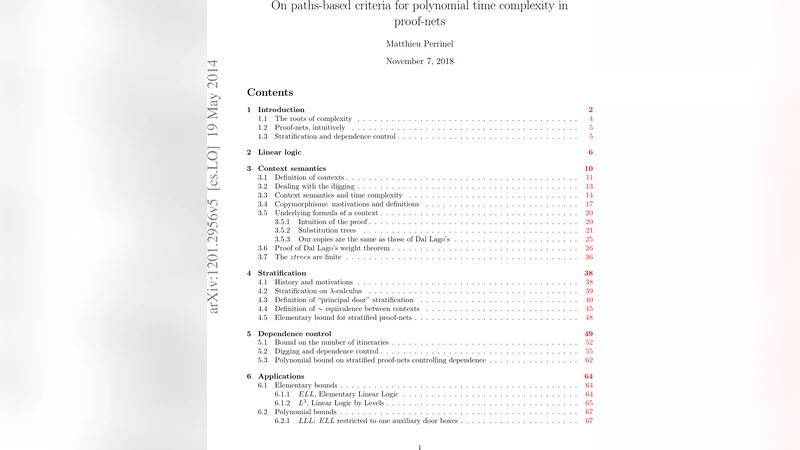
Girard’s Light linear logic (LLL) characterized polynomial time in the proof-as-program paradigm with a bound on cut elimination. This logic relied on a stratification principle and a “one-door” principle which were generalized later respectively in the systems L^4 and L^3a. Each system was brought with its own complex proof of Ptime soundness. In this paper we propose a broad sufficient criterion for Ptime soundness for linear logic subsystems, based on the study of paths inside the proof-nets, which factorizes proofs of soundness of existing systems and may be used for future systems. As an additional gain, our bound stands for any reduction strategy whereas most bounds in the literature only stand for a particular strategy.
💡 Research Summary
The paper addresses the long‑standing problem of providing a uniform, strategy‑independent polynomial‑time (P‑time) soundness criterion for subsystems of linear logic that are used as programming languages under the proofs‑as‑programs paradigm. Girard’s Light Linear Logic (LLL) was the first system to capture exactly P‑time by imposing two constraints on proof‑nets: a stratification principle that limits the nesting of exponential boxes and a “one‑door” principle that restricts the way duplication can be introduced. Later systems, L⁴ and L³ᵃ, relaxed each of these constraints separately, but each required a bespoke, technically heavy soundness proof that only worked for a particular cut‑elimination strategy.
The authors propose a single, broad sufficient condition that subsumes the earlier criteria. Their approach is based on a detailed study of paths inside proof‑nets. A proof‑net is a graph whose nodes are logical links (tensor, par, etc.), exponential boxes, and wires that connect them. A path is a sequence of edges that follows the flow of a cut‑elimination step from one link to another. The authors classify paths into two families:
- Regular paths – those that never cause a level increase when crossing a box. These correspond exactly to the stratification condition of LLL.
- Irregular paths – those that involve level changes, typically arising from duplication (contraction) and erasure (weakening) inside boxes.
The key insight is that the overall complexity of cut‑elimination can be bounded solely by controlling the length and number of these paths, regardless of the reduction order. The authors introduce a Path‑Length Bound: every regular path must have length bounded by a polynomial in the size of the initial proof‑net, and the total number of irregular paths must be bounded by a constant (independent of the input size) while each irregular path also respects a polynomial length bound.
To prove that this bound guarantees P‑time cut‑elimination for any reduction strategy, they develop a path compression technique. Compression works by identifying repeated patterns of duplication/erasure at the same level and collapsing them into a single meta‑operation. This operation reduces the effective length of irregular paths without altering the logical meaning of the net. Because compression can be applied locally and does not depend on the global reduction schedule, the resulting bound holds for arbitrary strategies (e.g., eager, lazy, parallel).
The paper then shows how the existing systems fit into this framework. L⁴ satisfies the regular‑path condition because its “one‑door” restriction still guarantees that level‑increasing crossings are limited. L³ᵃ, which relaxes stratification, still meets the bound because its design ensures that the number of irregular paths is a fixed constant; the authors demonstrate that the path‑compression argument can be used to enforce the required polynomial length. Consequently, the previously separate soundness proofs for LLL, L⁴, and L³ᵃ become special cases of the general path‑based criterion.
Beyond unifying past results, the authors argue that the criterion is constructive: when designing a new linear‑logic fragment, one only needs to verify the two simple quantitative properties on the proof‑net’s paths. No intricate combinatorial arguments about box nesting or reduction order are necessary. This opens the way for future systems that may combine features of L⁴ and L³ᵃ, or introduce novel exponential controls, while still enjoying an immediate P‑time guarantee.
In summary, the paper makes three major contributions:
- It identifies a clean, quantitative invariant (path‑length bound) that is sufficient for P‑time soundness of a wide class of linear‑logic subsystems.
- It provides a strategy‑independent proof that this invariant yields a polynomial bound on cut‑elimination, using the novel path‑compression technique.
- It demonstrates that the invariant subsumes the earlier, more ad‑hoc soundness arguments for LLL, L⁴, and L³ᵃ, thereby offering a unified theoretical foundation for future research on implicit computational complexity within linear logic.
Comments & Academic Discussion
Loading comments...
Leave a Comment