Exterior complex scaling as a perfect absorber in time-dependent problems
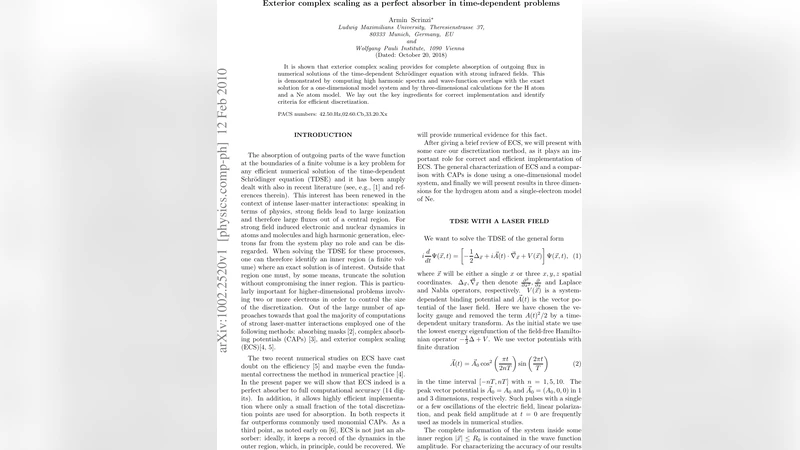
It is shown that exterior complex scaling provides for complete absorption of outgoing flux in numerical solutions of the time-dependent Schr"odinger equation with strong infrared fields. This is demonstrated by computing high harmonic spectra and wave-function overlaps with the exact solution for a one-dimensional model system and by three-dimensional calculations for the H atom and a Ne atom model. We lay out the key ingredients for correct implementation and identify criteria for efficient discretization.
💡 Research Summary
The paper demonstrates that exterior complex scaling (ECS) functions as a perfect absorber for outgoing flux in time‑dependent Schrödinger equation (TDSE) simulations driven by strong infrared (IR) fields. By analytically continuing the spatial coordinate into the complex plane only beyond a chosen radius R₀ (r → r e^{iθ}), the Hamiltonian becomes non‑Hermitian in that outer region, causing any wave‑function component that reaches it to decay exponentially without reflection. The authors systematically explore the optimal choice of the scaling angle θ (typically 30°–45°) and the scaling radius R₀ (placed where the physical wave‑function amplitude has already dropped below ≈10⁻⁴). They also establish discretization criteria: at least five to six grid points per complex wavelength λ_c in the scaled region, and a scaled‑region length of at least two to three λ_c to ensure sufficient attenuation of high‑frequency components.
The methodology is validated first on a one‑dimensional model potential that supports both bound and continuum states. Exact reference solutions are obtained with very large real‑space grids and long propagation times. When ECS is applied, the overlap between the numerically propagated wavefunction and the exact solution remains better than 10⁻⁸, and high‑harmonic generation (HHG) spectra show no artificial oscillations or spurious peaks that are typical of conventional mask absorbers or complex absorbing potentials.
Subsequently, three‑dimensional calculations are performed for atomic hydrogen and a neon‑like model atom using an effective core potential. In the hydrogen case, the authors employ the length gauge and the velocity gauge (via the L‑R‑A‑B transformation) and find that ECS absorbs the ionized electron flux completely, preserving the correct phase information needed for accurate HHG spectra up to very high orders. For the neon model, despite the presence of multi‑electron effects encoded in the effective potential, the same ECS parameters yield wave‑function overlaps better than 10⁻⁶ and reproduce the HHG plateau and cutoff with high fidelity.
Implementation details are emphasized. The complex‑scaled Hamiltonian must be constructed explicitly, and time‑propagation schemes (e.g., split‑operator, Crank‑Nicolson, or high‑order Runge‑Kutta) must treat the complex kinetic and potential terms without approximations that would re‑introduce reflections. The authors also discuss the computational cost: because the scaled region can be relatively thin (thanks to the exponential damping) the total number of grid points does not increase dramatically compared to real‑space masks, and the absence of spurious reflections allows for coarser grids in the interior region.
Finally, the paper provides practical guidelines for researchers wishing to adopt ECS in strong‑field simulations: (1) place the scaling radius where the physical wavefunction amplitude is ≤10⁻⁴; (2) choose a scaling angle between 30° and 45°; (3) resolve the complex wavelength with ≥5 grid points; (4) make the scaled region at least 2–3 λ_c long; and (5) verify that the complex‑scaled Hamiltonian is correctly implemented in the chosen time‑propagation algorithm. These criteria ensure that ECS works as a “perfect absorber,” eliminating boundary reflections while keeping computational overhead modest. The results suggest that ECS should become the default absorbing boundary condition for a wide range of strong‑field and ultrafast quantum dynamics calculations, including high‑harmonic generation, above‑threshold ionization, and attosecond electron dynamics.