Application of Simulated Tempering and Magnetizing to a Two-Dimensional Potts Model
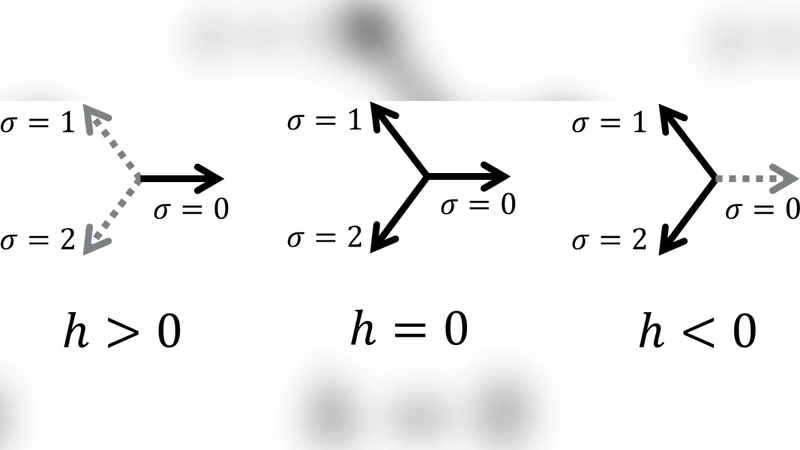
We applied the simulated tempering and magnetizing (STM) method to the two-dimensional three-state Potts model in an external magnetic field in order to perform further investigations of the STM’s applicability. The temperature as well as the external field are treated as dynamical variables updated during the STM simulations. After we obtained adequate information for several lattice sizes $L$ (up to $160\times 160$), we also performed a number of conventional canonical simulations of large lattices, especially in order to illustrate the crossover behavior of the Potts model in external field with increasing $L$. The temperature and external field for larger lattice size simulations were chosen by extrapolation of the detail information obtained by STM. We carefully analyzed the crossover scaling at the phase transitions with respect to the lattice size as well as the temperature and external field. The crossover behavior is clearly observed in the simulations in agreement with theoretical predictions.
💡 Research Summary
The paper investigates the applicability of the Simulated Tempering and Magnetizing (STM) algorithm to the two‑dimensional three‑state Potts model subjected to an external magnetic field. In STM both temperature and magnetic field are promoted to dynamical variables that are updated during the Monte‑Carlo walk, and a set of discrete values for each variable is predefined. The required weight factors are obtained beforehand by multihistogram reweighting (WHAM) or the multistate Bennett acceptance ratio (MBAR), ensuring a flat sampling distribution across the combined temperature–field space.
Simulations were carried out on square lattices of linear size L = 20, 40, 80, 120 and 160. The temperature range spanned roughly 0.8 T_c to 1.2 T_c, while the magnetic field h was varied from –0.05 to +0.05 in steps of 0.01. Each STM run consisted of at least 10⁷ Monte‑Carlo steps, and autocorrelation analyses confirmed efficient decorrelation of both energy and magnetization. The resulting joint histograms of energy and magnetization are broad, indicating that the algorithm successfully traverses the first‑order transition region as well as the surrounding paramagnetic and ordered phases.
For the smallest lattices the transition at h ≈ 0 is sharp and clearly first‑order, with the estimated critical temperature T_c ≈ 0.995 J/k_B matching the exact value for the 2D three‑state Potts model. As L increases, even a modest bias in the magnetic field causes the apparent transition temperature to shift and the discontinuity to soften, revealing a crossover from a genuine first‑order line to a smooth, field‑induced rounding. To quantify this behavior the authors employed finite‑size scaling theory. They assumed the scaling forms
T_c(L, h) = T_c(∞, 0) + a L^{–1/ν} + b h L^{y_h}
M(L, h) = L^{–β/ν} f