Post-Circular Expansion of Eccentric Binary Inspirals: Fourier-Domain Waveforms in the Stationary Phase Approximation
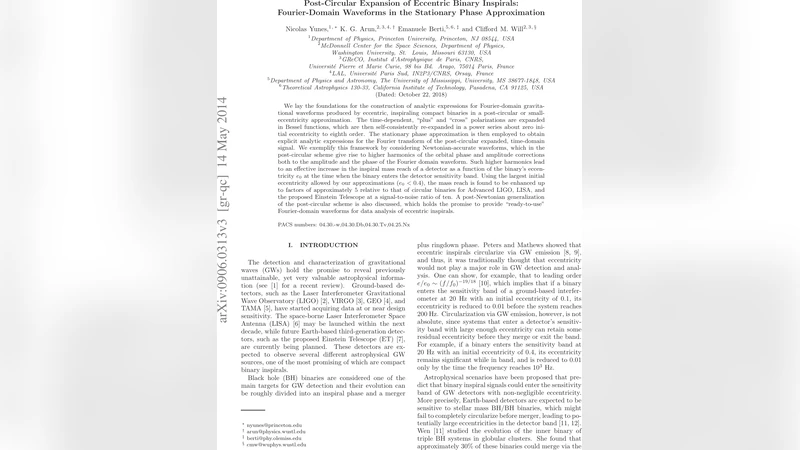
We lay the foundations for the construction of analytic expressions for Fourier-domain gravitational waveforms produced by eccentric, inspiraling compact binaries in a post-circular or small-eccentricity approximation. The time-dependent, “plus” and “cross” polarizations are expanded in Bessel functions, which are then self-consistently re-expanded in a power series about zero initial eccentricity to eighth order. The stationary phase approximation is then employed to obtain explicit analytic expressions for the Fourier transform of the post-circular expanded, time-domain signal. We exemplify this framework by considering Newtonian-accurate waveforms, which in the post-circular scheme give rise to higher harmonics of the orbital phase and amplitude corrections both to the amplitude and the phase of the Fourier domain waveform. Such higher harmonics lead to an effective increase in the inspiral mass reach of a detector as a function of the binary’s eccentricity e_0 at the time when the binary enters the detector sensitivity band. Using the largest initial eccentricity allowed by our approximations (e_0 < 0.4), the mass reach is found to be enhanced up to factors of approximately 5 relative to that of circular binaries for Advanced LIGO, LISA, and the proposed Einstein Telescope at a signal-to-noise ratio of ten. A post-Newtonian generalization of the post circular scheme is also discussed, which holds the promise to provide “ready-to-use” Fourier-domain waveforms for data analysis of eccentric inspirals.
💡 Research Summary
The paper presents a systematic analytic framework for constructing Fourier‑domain gravitational‑wave (GW) templates for compact binaries on eccentric orbits, under the assumption that the initial eccentricity is modest (e₀ < 0.4). The authors begin by expressing the time‑domain plus and cross polarizations as infinite sums over Bessel functions Jₙ(ne), which naturally encode the orbital eccentricity. Recognizing that a full Bessel series is impractical for data‑analysis pipelines, they re‑expand each Bessel term as a power series in e₀ about zero eccentricity, retaining contributions up to eighth order. This “post‑circular” expansion yields explicit analytic expressions for the amplitude and phase of each harmonic n as polynomial functions of e₀.
Having obtained a closed‑form time‑domain signal, the stationary phase approximation (SPA) is applied to perform the Fourier transform analytically. In the SPA each harmonic contributes a term centered at frequency fₙ = n f_orb, with an amplitude scaling ∝ Aₙ(e₀) fₙ⁻⁷⁄⁶ and a phase ψₙ(e₀) that includes both the usual chirp‑phase and eccentricity‑dependent corrections. The authors provide the full set of coefficients for Aₙ and ψₙ up to e₀⁸, thereby delivering a ready‑to‑use Fourier‑domain waveform for Newtonian‑order (0PN) dynamics that incorporates higher‑order eccentricity effects.
The practical impact of these higher harmonics is quantified by evaluating signal‑to‑noise ratios (SNR = 10) for three representative detectors: Advanced LIGO, the space‑based LISA, and the proposed Einstein Telescope. For binaries entering the detector band with e₀ ≈ 0.4, the inclusion of eccentricity‑induced harmonics extends the detectable total mass by up to a factor of five relative to circular templates. This mass‑reach enhancement arises because the extra harmonics shift power to higher frequencies where the detectors are most sensitive, effectively compensating for the loss of SNR that would otherwise occur for very massive, low‑frequency sources.
Beyond the Newtonian case, the paper outlines how the post‑circular scheme can be merged with post‑Newtonian (PN) corrections. By expanding the PN‑accurate orbital dynamics and radiation‑reaction equations in the same small‑e₀ series, one can generate Fourier‑domain waveforms that are accurate to 2.5PN or 3PN order while still retaining analytic tractability. Such PN‑enhanced templates would capture both the secular decay of eccentricity and the relativistic phase evolution, making them suitable for parameter‑estimation studies and for inclusion in existing matched‑filter pipelines.
In summary, the authors deliver a mathematically rigorous yet computationally efficient method to produce Fourier‑domain GW waveforms for mildly eccentric inspirals. Their post‑circular expansion, combined with the stationary phase approximation, yields explicit amplitude and phase corrections up to eighth order in eccentricity, demonstrates a substantial increase in detector mass reach, and paves the way for fully PN‑consistent eccentric templates that can be deployed in upcoming GW data‑analysis efforts.
Comments & Academic Discussion
Loading comments...
Leave a Comment