Synchronization of two coupled multimode oscillators with time-delayed feedback
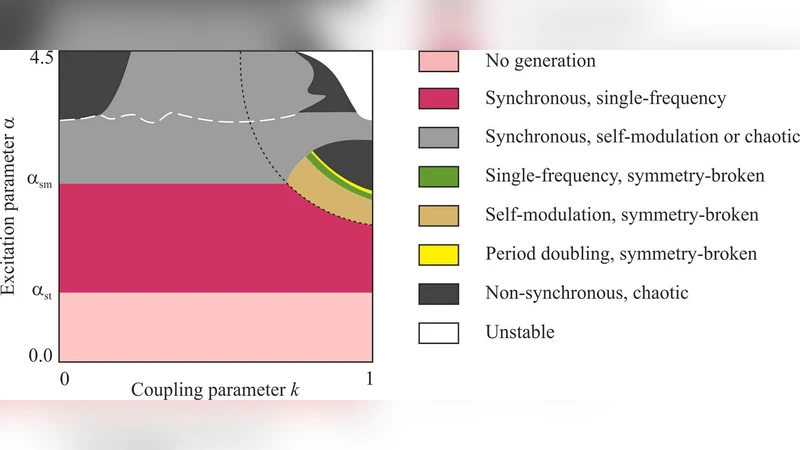
Effects of synchronization in a system of two coupled oscillators with time-delayed feedback are investigated. Phase space of a system with time delay is infinite-dimensional. Thus, the picture of synchronization in such systems acquires many new features not inherent to finite-dimensional ones. A picture of oscillation modes in cases of identical and non-identical coupled oscillators is studied in detail. Periodical structure of amplitude death and “broadband synchronization” zones is investigated. Such a behavior occurs due to the resonances between different modes of the infinite-dimensional system with time delay.
💡 Research Summary
The paper investigates the synchronization dynamics of two coupled oscillators that each incorporate time‑delayed feedback, focusing on the distinctive features that arise from the infinite‑dimensional phase space inherent to delay systems. By modeling each oscillator as a nonlinear differential equation with a feedback term delayed by τ, the authors construct a coupled system characterized by two control parameters: the coupling strength κ and the delay time τ. Because each oscillator supports multiple intrinsic modes (a multimode structure), the combined system possesses an infinite spectrum of eigenfrequencies, and the interaction of these modes under delay leads to phenomena absent in finite‑dimensional oscillator networks.
For identical oscillators (identical intrinsic parameters), the study reveals four principal regimes in the (κ, τ) parameter plane: (1) synchronized regime where both oscillators lock in phase, frequency, and amplitude; (2) desynchronized regime with persistent phase drift; (3) amplitude‑death (AD) regime where the oscillators’ amplitudes collapse to zero; and (4) a narrow region of broadband synchronization that emerges only under specific delay conditions. The AD zones appear periodically as τ varies, roughly when τ satisfies resonance conditions of the form ω₀τ ≈ nπ (n integer), causing the phase difference between the modes to become π and leading to destructive interference. The synchronized region expands with increasing κ, while the AD zones widen when the coupling is strong enough to enforce phase opposition across the dominant modes.
When the oscillators are non‑identical (different natural frequencies Δω ≠ 0), the multimode interaction becomes richer. The authors demonstrate that for certain combinations of Δω and τ, especially when Δω·τ ≈ (2n+1)π/2, a broadband synchronization (BBS) regime emerges. In BBS, a wide band of frequencies becomes phase‑locked, and the system remains synchronized even under substantial variations of κ or τ. This effect is attributed to simultaneous resonance of several mode pairs, which forces a collective phase constraint across the infinite‑dimensional spectrum. The paper shows that BBS can coexist with, or be interleaved by, periodic AD zones, creating a complex “checkerboard” pattern of dynamical behavior in the parameter plane.
To elucidate the underlying bifurcation structure, the authors perform a linear stability analysis of the delay differential equations. The characteristic equation contains exponential terms e^{-λτ}, leading to an infinite set of characteristic roots λ. By tracking the crossing of these roots through the imaginary axis, they identify Hopf bifurcation curves that separate stable (steady‑state or AD) from oscillatory (synchronized or BBS) regimes. Numerical continuation and direct time‑domain simulations confirm the analytical predictions, revealing that the primary Hopf branches correspond to the dominant mode pair, while secondary branches involve higher‑order modes and give rise to the periodic AD islands.
A key contribution of the work is the construction of a detailed (κ, τ) stability map, color‑coded to distinguish synchronized, desynchronized, AD, and BBS regions. This map serves as a practical design tool: by selecting appropriate delay and coupling values, engineers can deliberately induce or avoid amplitude death, achieve robust synchronization across a broad frequency range, or exploit the multistable coexistence of regimes for applications such as secure communication, laser array control, or neural network modeling where delayed feedback is intrinsic.
Overall, the study extends the theory of coupled oscillators into the realm of infinite‑dimensional delay systems, highlighting how mode‑mode resonances mediated by time delay generate novel synchronization patterns, periodic amplitude‑death zones, and broadband locking phenomena. The findings deepen our understanding of delayed feedback dynamics and open avenues for exploiting these effects in complex technological and biological systems.