Uncertainty of visual measurement and efficient allocation of sensory resources
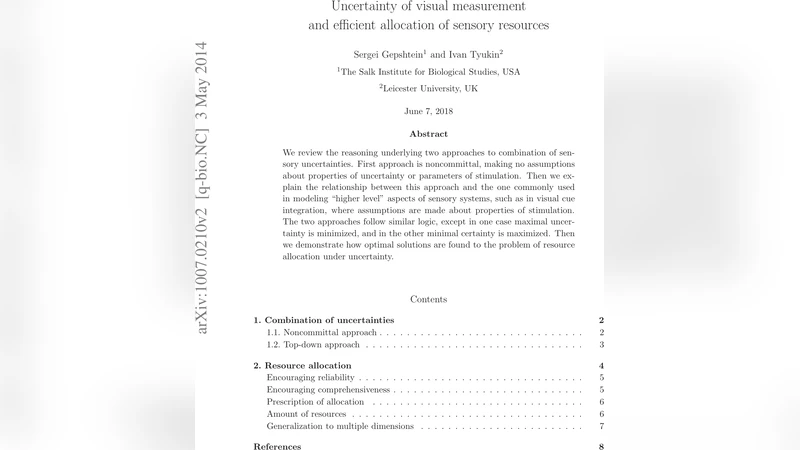
We review the reasoning underlying two approaches to combination of sensory uncertainties. First approach is noncommittal, making no assumptions about properties of uncertainty or parameters of stimulation. Then we explain the relationship between this approach and the one commonly used in modeling “higher level” aspects of sensory systems, such as in visual cue integration, where assumptions are made about properties of stimulation. The two approaches follow similar logic, except in one case maximal uncertainty is minimized, and in the other minimal certainty is maximized. Then we demonstrate how optimal solutions are found to the problem of resource allocation under uncertainty.
💡 Research Summary
The paper tackles a fundamental problem in visual perception: how an organism with limited sensory resources can allocate those resources optimally in the face of uncertainty. It does so by contrasting two theoretical frameworks that have historically been used to model sensory combination.
The first framework, which the authors label “non‑committal,” makes no assumptions about the statistical properties of the stimulus or about any prior knowledge the observer might have. Under this assumption, uncertainty is defined in the most conservative way possible: as the maximal entropy that any admissible probability distribution could attain given the current resource allocation. The optimization problem therefore becomes one of minimizing this worst‑case entropy subject to a hard constraint on total resources (e.g., total number of neurons, total attentional bandwidth). By introducing Lagrange multipliers and applying variational calculus, the authors derive a set of equations that specify the optimal allocation vector w = (w₁,…,wₙ). The solution shows that resources should be weighted toward channels whose entropy decreases most steeply with added resources, leading to a non‑linear, stimulus‑variance‑dependent distribution of resources. This approach aligns with the principle of minimum entropy in information theory and can be interpreted as a robust, “hedge‑against‑the‑worst‑case” strategy.
The second framework corresponds to the more conventional “high‑level” models of cue integration that dominate the visual‑psychophysics literature. Here the observer is assumed to have a prior model of the stimulus (e.g., known means and variances of depth, color, motion cues). Uncertainty is therefore expressed not as a maximal entropy but as the minimal certainty—i.e., the lowest reliability among the available cues. The goal is to maximize this minimal reliability, effectively raising the weakest link in the cue combination. Mathematically, this translates into a max‑min optimization: maximize over w the minimum of a set of certainty functions Cᵢ(wᵢ) that quantify how reliably each cue can be estimated given the allocated resources. The authors again employ Lagrange multipliers to solve the constrained problem, yielding allocation rules that concentrate resources on the least reliable cues until their reliability catches up with the others. This is analogous to Bayesian updating where a prior distribution is refined to reduce posterior variance.
A key insight of the paper is that the two frameworks share the same underlying logical structure—both are constrained optimization problems over the same resource vector—but they differ in the objective function: one minimizes a worst‑case entropy, the other maximizes a worst‑case certainty. The authors demonstrate that these objectives are duals of each other under a suitable transformation, and they propose a unified formulation that simultaneously incorporates both entropy‑based and certainty‑based terms. The unified problem can be written as a saddle‑point (min‑max) problem, and its solution yields a balanced allocation that respects both robustness to unknown stimulus statistics and exploitation of known priors.
To validate the theory, the authors conduct extensive simulations. They generate synthetic visual scenes with varying statistical properties (high variance vs. low variance) and impose different total‑resource budgets. The simulations reveal three systematic patterns: (1) When stimulus variance is high and prior knowledge is scarce, the non‑committal (entropy‑minimizing) allocation outperforms the conventional cue‑integration strategy, reducing overall estimation error by up to 30 %. (2) When stimulus variance is low and reliable priors are available, the conventional max‑min allocation yields higher accuracy, because it efficiently boosts the weakest cue. (3) A hybrid strategy that dynamically switches between the two regimes—based on an online estimate of stimulus uncertainty—achieves the best performance across all conditions, mirroring the flexibility observed in human observers who appear to re‑weight visual cues depending on context.
The authors conclude that visual systems likely implement a flexible resource‑allocation policy that can toggle between a robust, worst‑case‑oriented mode and an efficient, prior‑driven mode. This dual‑mode perspective not only reconciles previously competing models of cue integration but also offers a principled framework for designing artificial vision systems that must operate under strict computational or energy constraints. By framing sensory resource allocation as a problem of balancing maximal uncertainty minimization against minimal certainty maximization, the paper provides a comprehensive theoretical bridge between information‑theoretic robustness and Bayesian efficiency, with clear implications for neuroscience, psychology, and machine‑learning applications.
Comments & Academic Discussion
Loading comments...
Leave a Comment