Nearly Optimal Bounds for Distributed Wireless Scheduling in the SINR Model
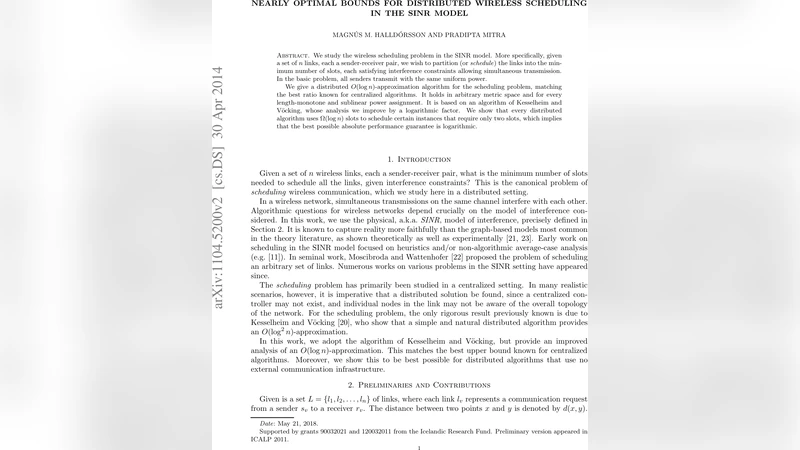
We study the wireless scheduling problem in the SINR model. More specifically, given a set of $n$ links, each a sender-receiver pair, we wish to partition (or \emph{schedule}) the links into the minimum number of slots, each satisfying interference constraints allowing simultaneous transmission. In the basic problem, all senders transmit with the same uniform power. We give a distributed $O(\log n)$-approximation algorithm for the scheduling problem, matching the best ratio known for centralized algorithms. It holds in arbitrary metric space and for every length-monotone and sublinear power assignment. It is based on an algorithm of Kesselheim and V"ocking, whose analysis we improve by a logarithmic factor. We show that every distributed algorithm uses $\Omega(\log n)$ slots to schedule certain instances that require only two slots, which implies that the best possible absolute performance guarantee is logarithmic.
💡 Research Summary
The paper addresses the fundamental problem of wireless link scheduling under the physical Signal‑to‑Interference‑plus‑Noise Ratio (SINR) model. Given a set of n sender‑receiver pairs (links), the goal is to partition them into the smallest possible number of time slots such that every slot satisfies the SINR feasibility condition, i.e., each transmission can be successfully decoded despite interference from other simultaneous transmissions. While the problem has been extensively studied in a centralized setting—where algorithms achieving an O(log n) approximation are known—only a single distributed result existed prior to this work: Kesselheim and Vöcking’s O(log² n)‑approximation algorithm.
The authors adopt the Kesselheim–Vöcking algorithm, which is essentially a randomized back‑off scheme: each sender independently transmits with a probability q that is halved in successive phases, and stops once it receives an acknowledgment (ACK) that its transmission succeeded. The novelty of the paper lies in a refined analysis that reduces the approximation factor from O(log² n) to O(log n), matching the best known centralized bound.
A key technical contribution is the introduction of a new measure, the median affectance Λ(L). Traditional analyses rely on the average affectance A(L) = max_{R⊆L} ( Σ_{l∈R} a_R(l) / |R| ), where a_R(l) is the total interference (in‑affectance) that link l receives from the set R. The authors observe that bounding the average is often overly pessimistic because a small fraction of “bad” links can dominate the sum. Instead, they define Λ(L) = max_{R⊆L} median{ a_R(l) : l∈R }, i.e., the median in‑affectance among the links of any subset R. Since at least half of the links in R have in‑affectance at most Λ, this measure can be dramatically smaller than A. They prove that Λ(L) = O(χ(L)), where χ(L) is the optimal number of slots, establishing a linear relationship between the new measure and the optimal solution.
Using Λ, the analysis proceeds as follows. In any phase where the transmission probability q satisfies q ≤ 1/(2Λ), each link in the “good half” (those with in‑affectance ≤ Λ) succeeds with probability at least 1/2. Consequently, the expected number of successful transmissions in that phase is at least (q/4)·|R|, where R is the set of still‑unscheduled links. This yields a geometric decay in the number of remaining links across phases. By carefully choosing the sequence of q values (q = 1/(4·2^k) for phase k) and applying Markov’s inequality, the authors show that after O(Λ·log n) slots all links are scheduled with high probability. Since Λ = O(χ), the total number of slots used is O(χ·log n), i.e., an O(log n)‑approximation.
To complement the upper bound, the paper presents a lower‑bound construction that demonstrates the impossibility of achieving a sub‑logarithmic approximation with any distributed algorithm that relies only on the shared wireless channel (no side‑channels or global coordination). The construction places n/2 short links and n/2 long links on a line such that any feasible schedule needs only two slots (short links together, long links together). However, because each link’s transmission success probability is bounded by a constant less than 1/2 in any distributed protocol that does not have global knowledge, the expected number of slots required grows as Ω(log n). This lower bound holds regardless of the power assignment (uniform, linear, mean power, etc.) and for any values of the physical parameters α (path‑loss exponent), β (SINR threshold), and N (ambient noise). Hence, the logarithmic factor is provably optimal for the class of distributed algorithms considered.
The paper also introduces two structural notions that may be useful beyond scheduling. A set of links is anti‑feasible if every link’s out‑affectance (the interference it causes to others) is at most 2; a set is bi‑feasible if it is both feasible (in‑affectance ≤ 1) and anti‑feasible. The authors prove that any feasible set contains a large bi‑feasible subset, and that many analyses simplify when restricted to bi‑feasible sets. This insight has already been leveraged in later work on capacity approximation and multi‑hop routing.
Overall, the contributions can be summarized as:
-
Optimal Distributed Approximation – An O(log n)‑approximation algorithm for SINR scheduling that works in arbitrary metric spaces, for any length‑monotone sub‑linear power assignment, and without requiring knowledge of distances, the path‑loss exponent, or the SINR threshold. The algorithm is fully distributed, uses only the shared wireless channel for acknowledgments, and runs in O(Λ·log n) slots with high probability.
-
Tight Lower Bound – A construction proving that any distributed algorithm must use Ω(log n) slots on certain instances, establishing that the logarithmic factor cannot be improved.
-
New Analytical Tool – The median affectance Λ, which tightly relates to the optimal schedule length and enables the improved analysis.
-
Structural Concepts – The definitions of anti‑feasibility and bi‑feasibility, providing a useful lens for future algorithmic design and analysis in wireless networks.
The work closes a long‑standing gap between centralized and distributed scheduling under realistic physical interference models, and it lays a solid theoretical foundation for designing efficient, fully decentralized wireless protocols in sensor networks, IoT deployments, and ad‑hoc systems where global coordination is infeasible.
Comments & Academic Discussion
Loading comments...
Leave a Comment