Torsion Limits and Riemann-Roch Systems for Function Fields and Applications
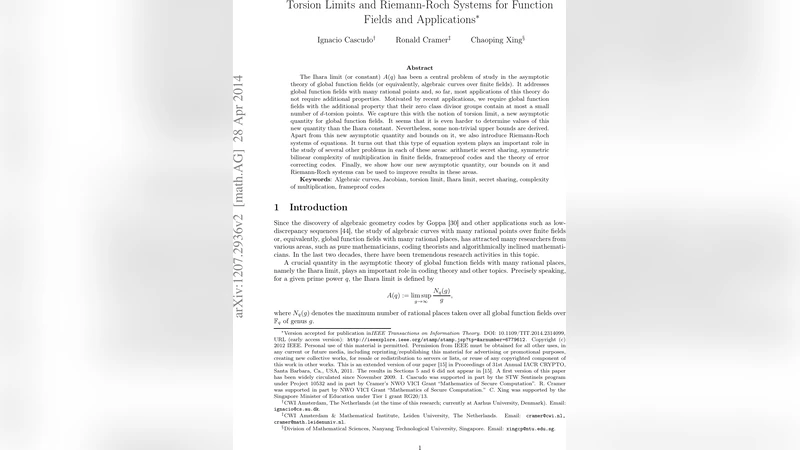
The Ihara limit (or -constant) $A(q)$ has been a central problem of study in the asymptotic theory of global function fields (or equivalently, algebraic curves over finite fields). It addresses global function fields with many rational points and, so far, most applications of this theory do not require additional properties. Motivated by recent applications, we require global function fields with the additional property that their zero class divisor groups contain at most a small number of $d$-torsion points. We capture this by the torsion limit, a new asymptotic quantity for global function fields. It seems that it is even harder to determine values of this new quantity than the Ihara constant. Nevertheless, some non-trivial lower- and upper bounds are derived. Apart from this new asymptotic quantity and bounds on it, we also introduce Riemann-Roch systems of equations. It turns out that this type of equation system plays an important role in the study of several other problems in areas such as coding theory, arithmetic secret sharing and multiplication complexity of finite fields etc. Finally, we show how our new asymptotic quantity, our bounds on it and Riemann-Roch systems can be used to improve results in these areas.
💡 Research Summary
The paper introduces a novel asymptotic invariant for global function fields—called the torsion limit—and shows how this invariant, together with a newly defined class of Diophantine‑type equations called Riemann‑Roch systems, can be exploited to improve several well‑studied applications in coding theory, secret sharing, and finite‑field arithmetic.
1. Motivation and definition.
In the classical asymptotic theory of function fields over a finite field $\mathbb{F}q$, the Ihara constant $A(q)=\limsup{g\to\infty} N_q(g)/g$ measures how many rational points a sequence of curves can have relative to its genus. Most applications (e.g., algebraic‑geometry codes) only need curves with many rational points. Recent work, however, demands additional structural constraints: the zero‑class divisor group $\mathrm{Pic}^0(F)$ (the Jacobian) should contain only a few $d$‑torsion points. To capture this requirement the authors define, for a fixed integer $d\ge2$,
\
Comments & Academic Discussion
Loading comments...
Leave a Comment