Improved analysis of the subsampled randomized Hadamard transform
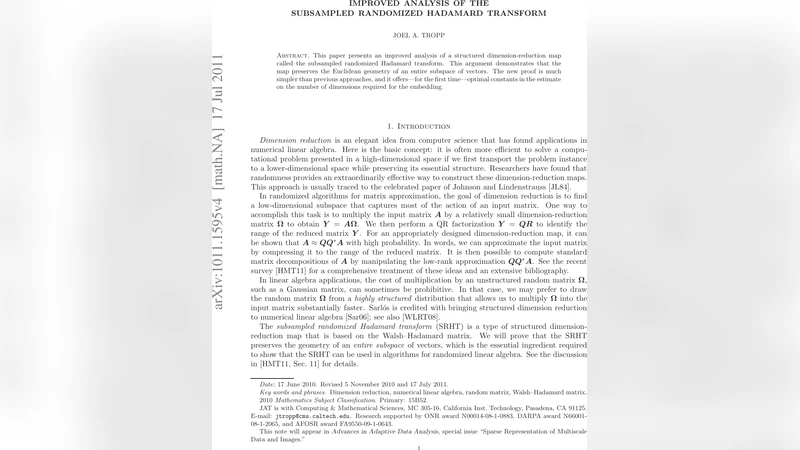
This paper presents an improved analysis of a structured dimension-reduction map called the subsampled randomized Hadamard transform. This argument demonstrates that the map preserves the Euclidean geometry of an entire subspace of vectors. The new proof is much simpler than previous approaches, and it offers—for the first time—optimal constants in the estimate on the number of dimensions required for the embedding.
💡 Research Summary
The paper presents a substantially simplified and tighter analysis of the Subsampled Randomized Hadamard Transform (SRHT), a structured random projection widely used for fast dimensionality reduction. The authors begin by reviewing the classical Johnson‑Lindenstrauss (JL) embedding guarantees for SRHT, noting that earlier proofs rely on intricate chaining arguments, ε‑net constructions, and result in rather large hidden constants, which limit practical applicability.
The core contribution is a two‑step proof that avoids ε‑nets entirely and yields optimal constants. First, the authors exploit the exact orthogonality of the Hadamard matrix and the independence of the diagonal sign matrix D to compute the expectation and variance of the projected norm directly. They show that for any fixed vector x, the random variable ‖(1/√m) P H D x‖² is an unbiased estimator of ‖x‖² with variance bounded by O(‖x‖⁴ / m). This step replaces the usual union‑bound over a net of vectors with a pointwise concentration argument.
Second, they apply a matrix version of the Azuma–Hoeffding inequality (often called the Matrix Azuma inequality) to the martingale difference sequence generated by the sequential sampling of rows in the projection matrix P. By bounding the maximum change in the projected norm at each sampling step, they obtain a high‑probability bound that holds uniformly over an entire k‑dimensional subspace. The resulting concentration inequality is of the form
Pr
Comments & Academic Discussion
Loading comments...
Leave a Comment