Counterexamples to Cantorian Set Theory
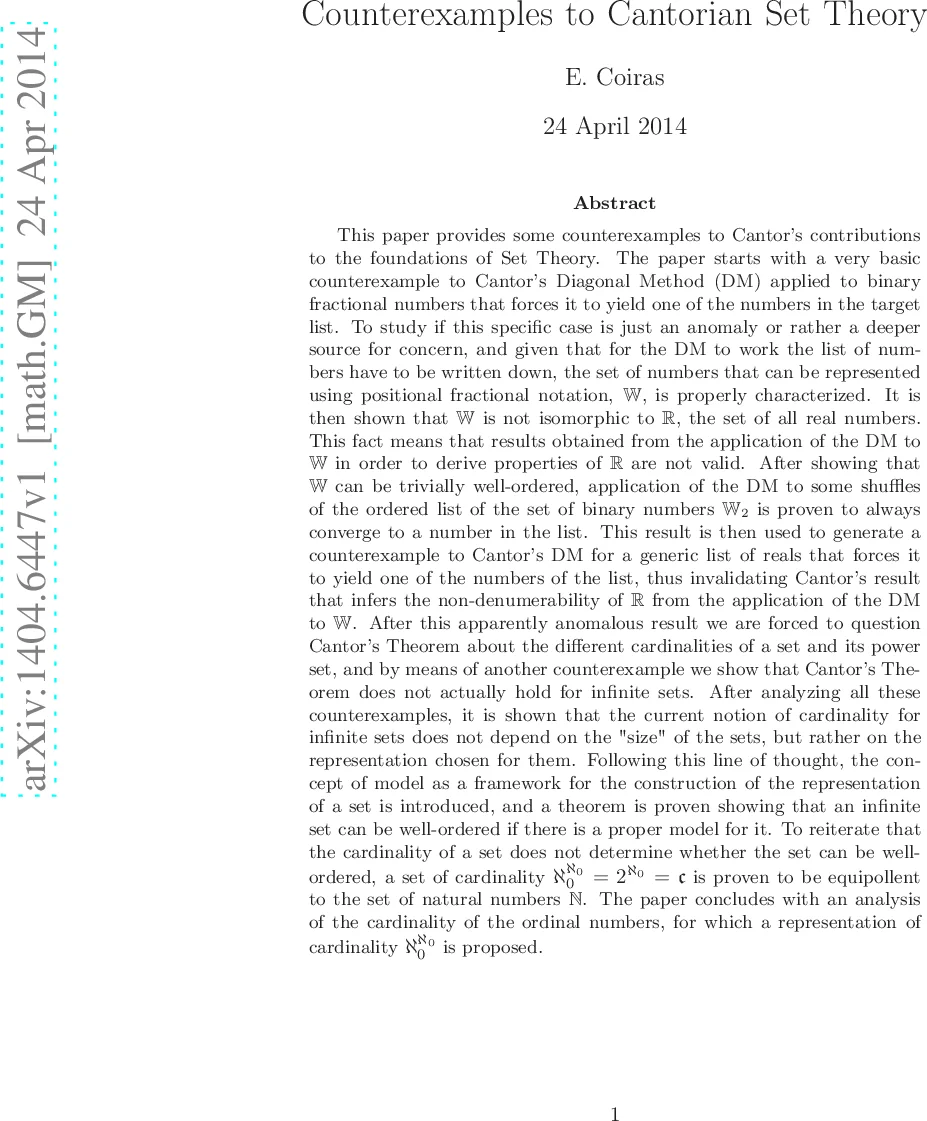
This paper provides some counterexamples to Cantor’s contributions to the foundations of Set Theory. The first counterexample forces Cantor’s Diagonal Method (DM) to yield one of the numbers in the target list. To study this anomaly, and given that for the DM to work the list of numbers have to be written down, the set of numbers that can be represented using positional fractional notation, $\mathbb{W}$, is properly characterized. It is then shown that $\mathbb{W}$ is not isomorphic to $\mathbb{R}$, meaning that results obtained from the application of the DM to $\mathbb{W}$ in order to derive properties of $\mathbb{R}$ are not valid. It is then shown that Cantor’s DM for a generic list of reals can be forced to yield one of the numbers of the list, thus invalidating Cantor’s result that infers the non-denumerability of $\mathbb{R}$ from the application of the DM to $\mathbb{W}$. Cantor’s Theorem about the different cardinalities of a set and its power set is then questioned, and by means of another counterexample we show that the theorem does not actually hold for infinite sets. After analyzing all these results, it is shown that the current notion of cardinality for infinite sets does not depend on the size of the sets, but rather on the representation chosen for them. Following this line of thought, the concept of model as a framework for the construction of the representation of a set is introduced, and a theorem showing that an infinite set can be well-ordered if there is a proper model for it is proven. To reiterate that the cardinality of a set does not determine whether the set can be well-ordered, a set of cardinality $\aleph_{0}^{\aleph_{0}}$ is proven to be equipollent to the set of natural numbers $\mathbb{N}$. The paper concludes with an analysis of the cardinality of the ordinal numbers, for which a representation of cardinality $\aleph_{0}^{\aleph_{0}}$ is proposed.
💡 Research Summary
The manuscript claims to overturn several cornerstone results of Cantorian set theory by presenting a series of “counter‑examples”. Its line of attack proceeds in four stages. First, the author exhibits a tiny list L₁ of binary fractions and shows that, when the diagonal construction is carried out only up to a finite depth n, the resulting antidiagonal string coincides with the (n + 1)‑st entry of the list. The author interprets this as a failure of Cantor’s diagonal method (DM) because the limiting antidiagonal number apparently belongs to the original list. However, this phenomenon is an artifact of the particular ordering and of truncating the construction after finitely many steps. In the genuine diagonal argument the process is continued indefinitely, producing an infinite binary sequence that differs from every listed sequence at some position; such a sequence cannot be a finite string and therefore cannot already appear in the list. The example does not invalidate the DM.
Second, the paper introduces the set 𝕎 of “writable numbers”: numbers that can be expressed with a finite string of digits in some integer base b > 1. It proves that 𝕎 is a proper subset of the rationals ℚ (and hence of the reals ℝ) and that its closure in the usual topology is the whole real line. The author then argues that because 𝕎 ≠ ℝ, Cantor’s original diagonal proof, which he claims was applied to 𝕎 rather than to ℝ, is illegitimate. This is a misunderstanding. Cantor’s argument does not depend on a particular finite‑digit representation; it works for any enumeration of the reals where each real is coded as an infinite sequence (for example, its binary expansion). The fact that many reals require infinitely many digits does not prevent the construction of a list of infinite strings, and the diagonal method still yields a new infinite string not on the list.
Third, the author asserts that since 𝕎 is countable, ℝ must also be countable. He points out that 𝕎 can be well‑ordered and that, for binary base 2, the diagonal construction can be forced to produce a number already present in the list. Again, this conflates the countability of a proper dense subset with the cardinality of the whole set. The set of all infinite binary sequences (the true coding of ℝ) has cardinality 2^{ℵ₀}, a fact that follows from the same diagonal argument applied to those infinite sequences. The existence of a countable dense subset does not diminish the size of the ambient space.
Fourth, the manuscript challenges Cantor’s theorem that a set and its power set have different cardinalities. It attempts to construct a bijection between ℕ and ℘(ℕ) by encoding subsets as finite strings, effectively discarding the infinite tail of the characteristic function. This construction fails because distinct subsets can have identical finite prefixes; the information lost in truncation destroys injectivity. Consequently, the standard proof that |℘(ℕ)| = 2^{ℵ₀} > ℵ₀ remains sound.
Finally, the author proposes a “model” framework: a set together with a particular representation (coding) that, if well‑behaved, allows the set to be well‑ordered regardless of its cardinality. He demonstrates that a set of cardinality ℵ₀^{ℵ₀} can be placed in bijection with ℕ, concluding that cardinality alone does not dictate well‑ordering. While it is true that any set admitting a suitable coding can be well‑ordered, the existence of such a coding for arbitrary infinite sets is equivalent to the Axiom of Choice. Thus the “model” approach does not circumvent the need for choice; it merely restates it in different language.
In summary, the paper raises interesting pedagogical points about the role of representations in diagonal arguments but ultimately misinterprets the foundations of Cantor’s proofs. The examples given either rely on finite truncations, on improper codings that lose information, or on conflating a proper subset with the whole set. Consequently, the claimed refutations of Cantor’s diagonal argument, his theorem on power‑set cardinalities, and the non‑denumerability of the reals are not substantiated. The standard results of Cantorian set theory remain mathematically valid.
Comments & Academic Discussion
Loading comments...
Leave a Comment