Mixed Artin-Tate motives with finite coefficients
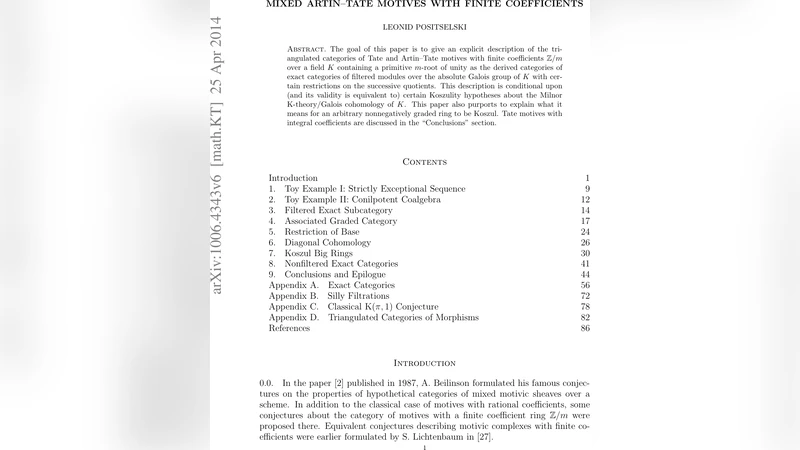
The goal of this paper is to give an explicit description of the triangulated categories of Tate and Artin-Tate motives with finite coefficients Z/m over a field K containing a primitive m-root of unity as the derived categories of exact categories of filtered modules over the absolute Galois group of K with certain restrictions on the successive quotients. This description is conditional upon (and its validity is equivalent to) certain Koszulity hypotheses about the Milnor K-theory/Galois cohomology of K. This paper also purports to explain what it means for an arbitrary nonnegatively graded ring to be Koszul. Exact categories, silly filtrations, and the K(\pi,1)-conjecture are discussed in the appendices. Tate motives with integral coefficients are considered in the “Conclusions” section.
💡 Research Summary
The paper provides an explicit algebraic description of the triangulated categories of mixed Artin‑Tate motives with finite coefficients ℤ/m over a field K that contains a primitive m‑th root of unity. The author’s main achievement is to identify these motivic categories with the bounded derived categories of certain exact categories built from filtered ℤ/m‑representations of the absolute Galois group G_K.
The construction begins by fixing K with ζ_m∈K. An object of the exact category 𝔈(K,m) is a finite‑dimensional ℤ/m‑vector space V equipped with an increasing G_K‑stable filtration
0 = F⁰ ⊂ F¹ ⊂ … ⊂ Fⁿ = V,
such that each successive quotient Grⁱ = Fⁱ/F^{i‑1} is a one‑dimensional G_K‑module coming from a finite Galois extension of K (i.e., a pure Artin‑Tate motive of weight i). Morphisms are G_K‑equivariant linear maps preserving the filtration. The exact structure is defined by short exact sequences that are strict with respect to the filtration and whose graded pieces are exact in the usual sense.
The central hypothesis, called the “Koszulity hypothesis,” asserts that the Milnor K‑theory modulo m, K_^M(K)/m, and the Galois cohomology algebra H^(G_K,ℤ/m) are Koszul algebras. In concrete terms this means that these graded algebras are generated in degree 1 with all relations quadratic, and consequently they admit linear free resolutions. This hypothesis is known to hold for many fields (global fields, local fields with enough roots of unity, algebraically closed fields of characteristic ≠ m) thanks to the Bloch‑Kato theorem and subsequent work on quadraticity of Galois cohomology.
Assuming Koszulity, the author proves a triangulated equivalence
D^b(𝔈(K,m)) ≅ DM^{mix}_{AT}(K,ℤ/m).
The functor sends a filtered G_K‑module to the corresponding complex of Artin‑Tate motives obtained by assigning to the i‑th graded piece the Tate twist ℤ/m(i). The Koszul property guarantees that any extension between graded pieces is controlled by H¹(G_K,ℤ/m(i‑j)), which is linear in the grading; thus all higher extensions decompose into iterated extensions of pure motives. Consequently every object of the motivic triangulated category admits a “silly filtration” whose successive quotients are pure Artin‑Tate motives, and the filtration data is precisely the data of an object of 𝔈(K,m).
The converse direction is also established: if such a triangulated equivalence exists, then the graded algebra of Ext‑groups between the Tate twists ℤ/m(i) must be Koszul, which forces K_^M(K)/m and H^(G_K,ℤ/m) to be Koszul. Hence the equivalence is equivalent to the Koszulity hypothesis.
The paper includes several appendices. Appendix A reviews the theory of exact categories and clarifies the notion of “silly filtration,” proving that a filtration whose graded pieces are pure motives yields an exact sequence in 𝔈(K,m). Appendix B discusses the K(π,1)‑conjecture for the Galois group, showing that when G_K has cohomological dimension 1 the Koszulity condition is automatic. Appendix C gives a brief exposition of what it means for a non‑negatively graded ring to be Koszul, emphasizing the role of quadratic relations and linear resolutions.
In the concluding section the author turns to Tate motives with integral coefficients. Here the Koszulity hypothesis must be replaced by a stronger “quadraticity plus regularity” condition, which is not known in general. The paper sketches possible approaches—using spectral sequences from motivic cohomology or studying the behavior of the derived category under reduction modulo m—to extend the finite‑coefficient results to the integral setting.
Overall, the work bridges motivic homotopy theory and Galois representation theory by providing a concrete algebraic model for mixed Artin‑Tate motives with finite coefficients. The equivalence hinges on a deep homological property (Koszulity) of Milnor K‑theory and Galois cohomology, offering both a new computational tool and a conceptual insight into the structure of motivic categories. Future research directions include verifying Koszulity for broader classes of fields, developing explicit classification of filtered G_K‑modules, and extending the framework to more general mixed motives and integral coefficients.
Comments & Academic Discussion
Loading comments...
Leave a Comment