Split digraphs
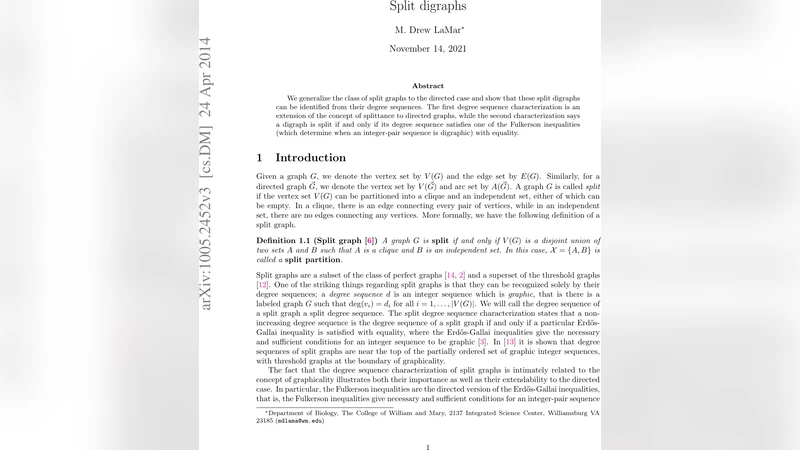
We generalize the class of split graphs to the directed case and show that these split digraphs can be identified from their degree sequences. The first degree sequence characterization is an extension of the concept of splittance to directed graphs, while the second characterization says a digraph is split if and only if its degree sequence satisfies one of the Fulkerson inequalities (which determine when an integer-pair sequence is digraphic) with equality.
💡 Research Summary
The paper introduces “split digraphs,” a directed‑graph analogue of split graphs, and shows that these structures can be recognized solely from their degree sequences. A split graph is classically defined as a graph whose vertex set can be partitioned into a clique and an independent set. Extending this to digraphs, the authors partition the vertex set into three parts: a “dense” part D that induces a complete sub‑digraph (every possible ordered pair of vertices in D is an arc), a “sparse” part S that induces an empty sub‑digraph (no arcs between vertices of S), and a remainder T whose internal arcs are unrestricted but whose connections to D and S are governed by the split structure. The key contribution is two equivalent characterizations of split digraphs that rely only on the in‑degree/out‑degree pair sequence.
The first characterization generalizes the notion of splittance, originally defined for undirected graphs as the minimum number of edge edits needed to turn a graph into a split graph. For digraphs the authors define a “directed splittance” that simultaneously accounts for in‑degrees and out‑degrees. They formulate an optimization problem: given a degree pair sequence ((d_i^+, d_i^-)), find a partition into D, S, and T that requires zero arc additions or deletions. By sorting the degree pairs and applying a greedy construction, they devise an (O(n\log n)) algorithm that computes the directed splittance. Their main theorem states that a digraph is a split digraph if and only if its directed splittance equals zero.
The second characterization is based on the classic Fulkerson inequalities, which give necessary and sufficient conditions for a pair sequence to be digraphic. The inequalities read
\
Comments & Academic Discussion
Loading comments...
Leave a Comment