On the Nuclear Norm heuristic for a Hankel matrix Recovery Problem
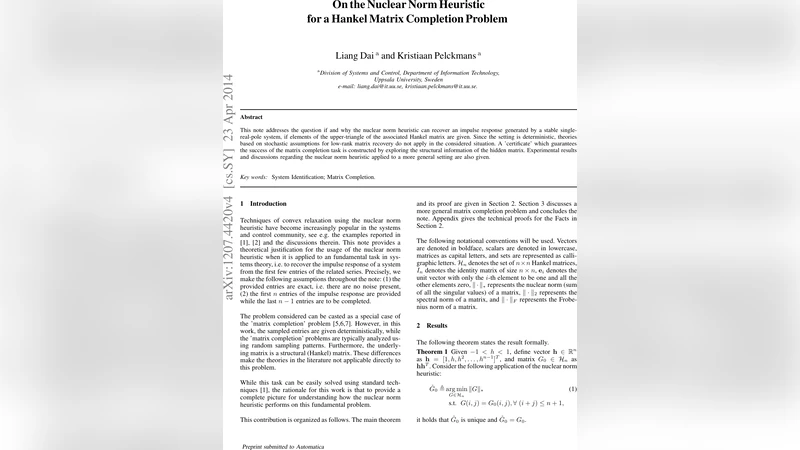
This note addresses the question if and why the nuclear norm heuristic can recover an impulse response generated by a stable single-real-pole system, if elements of the upper-triangle of the associated Hankel matrix were given. Since the setting is deterministic, theories based on stochastic assumptions for low-rank matrix recovery do not apply here. A ‘certificate’ which guarantees the completion is constructed by exploring the structural information of the hidden matrix. Experimental results and discussions regarding the nuclear norm heuristic applied to a more general setting are also given.
💡 Research Summary
The paper investigates whether the nuclear‑norm heuristic can exactly recover the impulse response of a stable single‑real‑pole system when only the upper‑triangular entries of the associated Hankel matrix are observed. Unlike most low‑rank matrix completion results, which rely on random sampling and probabilistic guarantees, the setting here is completely deterministic: the system’s pole is fixed, the impulse response is known to be geometric, and the sampling pattern (the upper‑triangle) is predetermined. Consequently, standard stochastic analyses do not apply.
The authors first formalize the problem. For a pole (a) with (|a|<1), the impulse response is (h_k = a^k). The (n\times n) Hankel matrix (H) defined by (H_{ij}=h_{i+j}=a^{i+j}) is rank‑one and can be written as (H = u v^{\top}) with (u =
Comments & Academic Discussion
Loading comments...
Leave a Comment