Unbounded bivariant $K$-theory and correspondences in noncommutative geometry
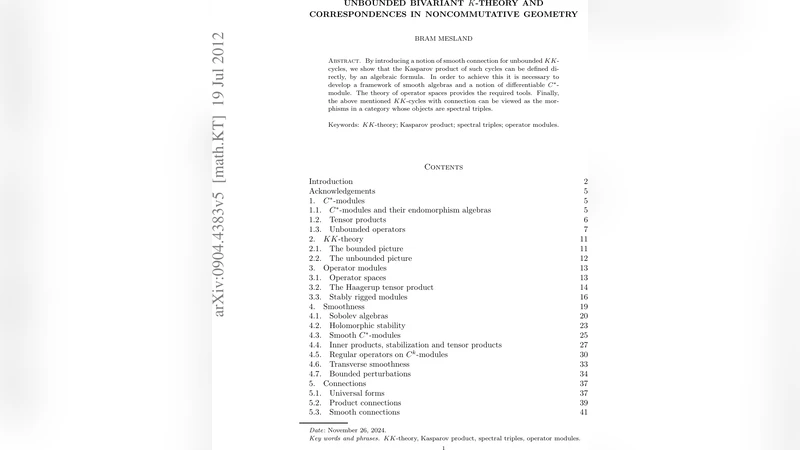
By introducing a notion of smooth connection for unbounded $KK$-cycles, we show that the Kasparov product of such cycles can be defined directly, by an algebraic formula. In order to achieve this it is necessary to develop a framework of smooth algebras and a notion of differentiable $C^{*}$-module. The theory of operator spaces provides the required tools. Finally, the above mentioned $KK$-cycles with connection can be viewed as the morphisms in a category whose objects are spectral triples.
💡 Research Summary
The paper develops a new framework for unbounded bivariant K‑theory that incorporates differential structure directly into Kasparov’s bivariant KK‑theory. The authors begin by observing that traditional bounded KK‑cycles lack the analytic flexibility needed to encode geometric data such as connections and curvature in non‑commutative spaces. To remedy this, they introduce the notion of a “smooth connection” on an unbounded KK‑cycle, which is a densely defined, closed operator ∇ satisfying a Leibniz rule with respect to a chosen smooth structure on the underlying C*‑algebra.
A central technical achievement is the construction of “smooth algebras”. Starting from a C*‑algebra A, they equip it with a Fréchet‑type topology generated by a family of seminorms that make the algebra into an operator space. This additional structure allows one to speak of completely bounded maps and completely bounded projections, tools that are essential for handling unbounded operators in a controlled way. Within this setting they define “differentiable C*‑modules”, i.e., Hilbert C*‑modules that carry a compatible smooth action of A and admit a densely defined derivation ∂: A → B(H) extending the algebra’s differential structure.
Given a differentiable module E, an unbounded self‑adjoint regular operator D on E, and a smooth connection ∇: E → E ⊗A Ω¹(A) (where Ω¹(A) denotes the universal one‑forms of the smooth algebra), the triple (E, D, ∇) becomes an unbounded KK‑cycle with connection. The authors prove that if ∇ is completely bounded and the commutator
Comments & Academic Discussion
Loading comments...
Leave a Comment