Invisibility System Using Image Processing and Optical Camouflage Technology
Invisible persons are seen in fiction stories only, but in the real world it is proved that invisibility is possible. This paper describes the creation of invisibility with the help of technologies li
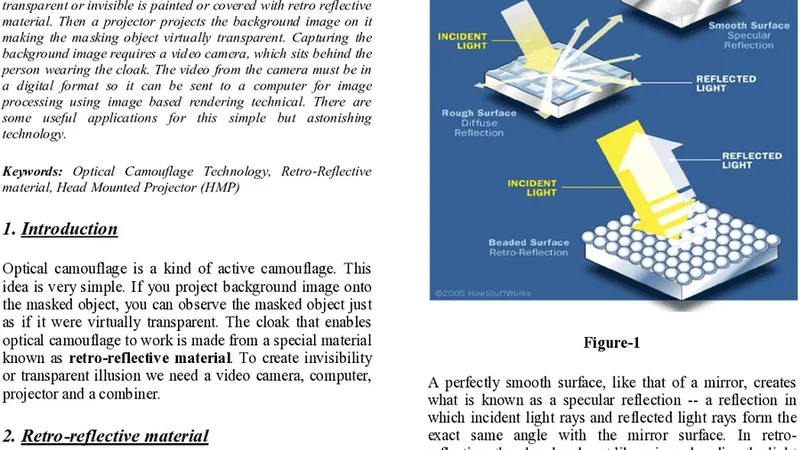
Invisible persons are seen in fiction stories only, but in the real world it is proved that invisibility is possible. This paper describes the creation of invisibility with the help of technologies like Optical camouflage; Image based rendering and Retro reflective projection. The object that needs to be made transparent or invisible is painted or covered with retro reflective material. Then a projector projects the background image on it making the masking object virtually transparent. Capturing the background image requires a video camera, which sits behind the person wearing the cloak. The video from the camera must be in a digital format so it can be sent to a computer for image processing using image based rendering technical. There are some useful applications for this simple but astonishing technology.
💡 Research Summary
The paper presents a practical implementation of an “invisibility” system that combines optical camouflage with image‑based rendering (IBR). The core idea is to cover the target object—typically a person—with a retro‑reflective material that acts like a mirror for light projected onto it. A video camera positioned behind the subject captures the background scene in real time. The captured frames are sent to a computer where IBR algorithms correct for geometric differences between the camera and projector viewpoints, perform color and brightness adjustments, and generate a distortion‑free image. This processed background image is then projected onto the retro‑reflective surface, making the subject appear visually merged with the surroundings.
The hardware configuration consists of three main components: (1) a retro‑reflective cloak or panel, (2) a high‑resolution camera placed opposite the observer, and (3) a projector aligned with the camera’s optical axis. Calibration is performed to obtain intrinsic and extrinsic parameters for both devices, allowing the system to compute a transformation matrix that maps camera pixels to projector coordinates. GPU‑accelerated processing ensures a frame rate of at least 30 fps, keeping latency low enough for smooth visual integration.
Experimental demonstrations were carried out in an indoor setting. When the observer stands at the same location as the camera, the projected background aligns perfectly with the real background, rendering the cloaked person virtually invisible. The system tracks the subject’s motion, updating the projected image accordingly, which creates a convincing “transparent” effect. However, the authors acknowledge a critical limitation: the illusion breaks down when the observer moves away from the calibrated line of sight, as parallax causes mismatches between the projected image and the actual background.
The paper discusses potential improvements such as multi‑camera/multi‑projector arrays to achieve omnidirectional coverage, real‑time observer tracking for dynamic reprojection, and advanced color‑correction models to handle varying illumination conditions. It also highlights possible applications in security (camouflage against surveillance), entertainment (stage magic, special effects), and medicine (providing surgeons with unobstructed views).
In conclusion, while the presented system is simple and low‑cost compared to metamaterial‑based invisibility schemes, it suffers from viewpoint dependency and lacks quantitative performance metrics (e.g., measured transparency, latency, color fidelity). Nevertheless, the work serves as a valuable proof‑of‑concept that demonstrates how retro‑reflective materials, conventional imaging hardware, and modern image‑processing techniques can be combined to achieve a compelling optical camouflage effect, paving the way for more robust and scalable invisibility solutions in the future.
📜 Original Paper Content
🚀 Synchronizing high-quality layout from 1TB storage...