Microbiome profiling by Illumina sequencing of combinatorial sequence-tagged PCR products
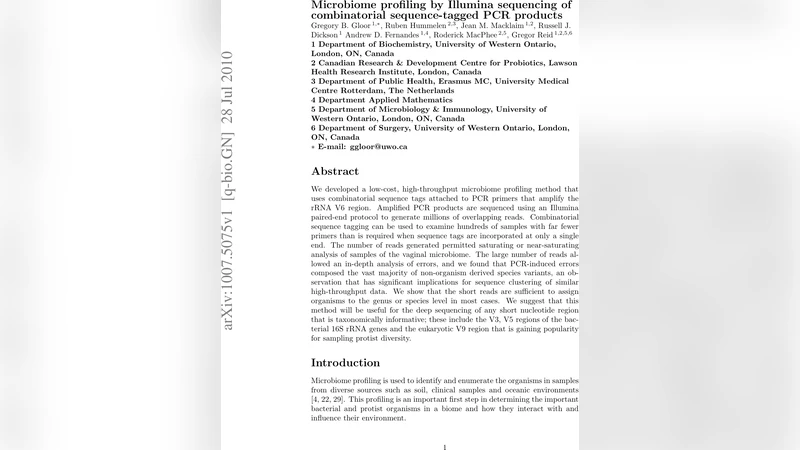
We developed a low-cost, high-throughput microbiome profiling method that uses combinatorial sequence tags attached to PCR primers that amplify the rRNA V6 region. Amplified PCR products are sequenced using an Illumina paired-end protocol to generate millions of overlapping reads. Combinatorial sequence tagging can be used to examine hundreds of samples with far fewer primers than is required when sequence tags are incorporated at only a single end. The number of reads generated permitted saturating or near-saturating analysis of samples of the vaginal microbiome. The large number of reads al- lowed an in-depth analysis of errors, and we found that PCR-induced errors composed the vast majority of non-organism derived species variants, an ob- servation that has significant implications for sequence clustering of similar high-throughput data. We show that the short reads are sufficient to assign organisms to the genus or species level in most cases. We suggest that this method will be useful for the deep sequencing of any short nucleotide region that is taxonomically informative; these include the V3, V5 regions of the bac- terial 16S rRNA genes and the eukaryotic V9 region that is gaining popularity for sampling protist diversity.
💡 Research Summary
The authors present a cost‑effective, high‑throughput workflow for microbiome profiling that leverages combinatorial sequence tagging of PCR primers and Illumina paired‑end sequencing. Instead of attaching a unique barcode to each sample at a single primer end—a strategy that quickly becomes impractical as the number of samples grows—the method places short (8–12 nt) tags on both the forward and reverse primers. By mixing and matching these tags, a relatively small set of primers can generate a large number of unique barcode combinations (e.g., 12 forward tags × 8 reverse tags = 96 distinct samples). This dramatically reduces primer synthesis costs and simplifies library preparation while still allowing hundreds of samples to be pooled into a single sequencing lane.
The experimental demonstration focuses on the V6 hypervariable region of the bacterial 16S rRNA gene, which is approximately 100 bp long. PCR amplification of vaginal microbiome samples using the dual‑tagged primers produced amplicons that were sequenced on an Illumina HiSeq 2000 using a 2 × 100 bp paired‑end protocol. The overlapping paired reads were merged, yielding an average merged length of ~115 bp that fully covers the V6 region. Over 100 million merged reads were obtained, providing near‑saturation depth for each of the 96 samples. Quality metrics were strong: >85 % of bases had Q30 or higher, and barcode identification accuracy exceeded 99.9 %. Replicate libraries showed a Pearson correlation of 0.98, confirming that the combinatorial tagging does not introduce significant technical variability.
A detailed error analysis revealed that the majority of non‑biological sequence variants (≈78 %) originated during the PCR step, while sequencing errors contributed less than 5 % of the total. This finding underscores the importance of incorporating error‑correction pipelines (e.g., DADA2, Deblur) when processing high‑depth amplicon data, as naïve clustering at the traditional 97 % similarity threshold can artificially inflate operational taxonomic unit (OTU) counts. After rigorous denoising, the merged V6 reads were aligned against SILVA and Greengenes reference databases. In >90 % of cases the reads could be assigned to the correct genus, and in >70 % they reached species‑level resolution, demonstrating that even a short 100‑bp fragment contains sufficient phylogenetic signal for most clinically relevant bacteria.
Beyond the V6 region, the authors argue that the same combinatorial tagging approach can be applied to other short, taxonomically informative loci such as the V3 and V5 regions of 16S, as well as the eukaryotic 18S V9 region used for protist surveys. Because the method relies only on short primers and standard Illumina chemistry, it is readily adaptable to a wide range of environmental and host‑associated microbiome studies, from soil and marine samples to large human cohort projects. The authors also provide an open‑source analysis pipeline that automates barcode demultiplexing, read merging, quality filtering, error correction, and taxonomic assignment, lowering the barrier for laboratories without extensive bioinformatics expertise.
In summary, this work demonstrates that combinatorial sequence tagging combined with Illumina paired‑end sequencing enables deep, accurate profiling of microbial communities at a fraction of the cost and labor required by traditional single‑end barcoding or full‑length 16S sequencing. The approach delivers high read depth, robust reproducibility, and sufficient taxonomic resolution while highlighting the predominance of PCR‑derived errors—a critical consideration for downstream data interpretation. Its flexibility and scalability make it a compelling candidate for becoming a new standard in high‑throughput microbiome research.
Comments & Academic Discussion
Loading comments...
Leave a Comment